For more than twenty years, the website was the center of the digital universe. If you wanted attention, you built pages. If you wanted growth, you optimized for search. If you wanted leverage, you published content and waited for traffic.
I built my own digital home, hub, and business on this model sixteen years ago. It worked extraordinarily well. At its peak, my website (the one you’re reading right now) attracted 5 million visitors.
This model didn’t just work for me. It created and shaped millions of businesses worldwide. But it no longer reflects reality.
Most websites remain online, indexed and regularly updated. Yet economically, strategically and structurally, they’ve become obsolete. Not because the web is dying but because AI has fundamentally shifted where value gets captured.
Why this matters
The shift isn’t coming. It’s already here.
More than half of all searches now end without a click. AI answers questions directly. Search engines have become destinations, not referrers.
The result:
- Fewer visitors
- Fewer conversions
- Less revenue
- Less leverage
Even for sites that appear successful.
If your business depends on traffic you don’t control, content that can be summarized instantly, or platforms whose incentives no longer align with yours, you’re vulnerable.
This isn’t about improving your SEO or publishing more content. It’s about whether your digital business model still functions in an AI-first world.
Ignore this shift and you’ll optimize yourself into irrelevance. Understand it and you’ll unlock a once-in-a-decade opportunity to redesign your competitive advantage.
The challenge is simple: Adapt now or become the next cautionary tale.
AI changed consumption, not just creation
Most conversations about AI focus on content creation: Faster writing, better images, automated video, infinite output.
That’s not the real disruption. The real disruption is on the consumption side.
Large language models don’t browse websites the way humans do. They don’t care about your navigation, your layout, or your conversion funnel. They ingest information. They abstract patterns. They synthesize answers. From an AI’s point of view, your website isn’t a destination.
You are its raw material. You are the open cut mine where the large language models come to play and scrape and extract your ore for free with no compensation to you.
Once information is absorbed into an AI system, the user no longer needs to visit the source to get value from it. The answer appears upstream in search summaries, chat interfaces, copilots and assistants.
That single shift breaks the economic logic behind millions of websites.
Search is no longer a traffic engine
Search used to work like a referral system. You asked a question. Google sent you to the best answer. The website captured the visit.
That model is collapsing.
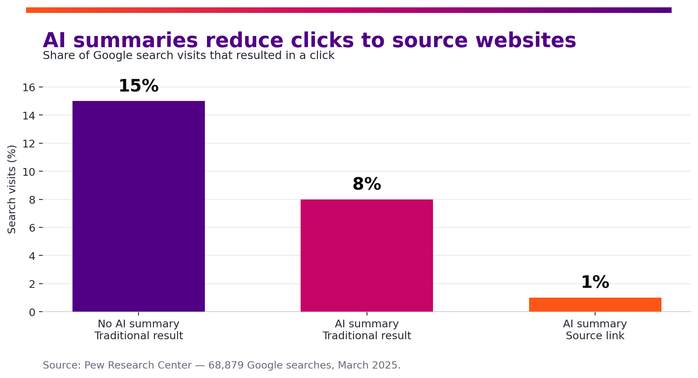
By 2025, multiple industry studies showed that over half of all searches now end without a click. These are known as zero-click searches — queries resolved directly on the results page through featured snippets, AI summaries, or knowledge panels.
When AI summaries appear, click-through rates drop dramatically. In some studies, organic CTR fell by 40–60% for informational queries once AI answers were introduced. This isn’t a marginal SEO tweak. It’s a structural shift. The user still gets the answer. The website no longer gets the visit.
And this leads to an uncomfortable truth about search and the lie many in the SEO industry are spreading.
The SEO industry is selling a fiction
Let’s stop pretending. SEO agencies aren’t adapting to AI. They’re renaming the collapse.
- GEO (Generative Engine Optimization) – The attempt to influence AI-generated answers without owning attribution, traffic, or outcomes.
- AEO (Answer Engine Optimization) – Optimizing content to be summarized by machines that rarely send users back.
- LLMO (Large Language Model Optimization) – Shaping training signals for models that extract value without returning it.
- AI Optimization (Artificial Intelligence Optimization) – A catch-all label used when no one can clearly explain where the growth actually comes from.
Different labels. Same lie.
There is no AI traffic to optimize for. There are answers, not clicks. Influence, not attribution.
Visibility, not ownership. SEO was built on a bargain: rankings produced traffic. And AI broke that bargain. So agencies now sell dashboards that measure relevance while revenue disappears.
That’s not a strategy. That’s denial with a retainer. SEO as a tactic will survive. SEO as a growth engine is already dead. And anyone promising otherwise is either behind the curve — or hoping you are.
The silent collapse of website economics
Most digital business models were built on a simple chain:
Attention → Traffic → Monetization
AI breaks that chain.
When the answer is delivered directly:
- No page view is generated
- No ad impression is served
- No email is captured
- No pixel fires
- No brand relationship forms
The website still exists. The economic event does not. This is why so many founders feel uneasy but can’t quite explain why. Their sites haven’t “failed.” Rankings might still look decent. Content may still be published weekly.
But the underlying economics have changed. You can now “win” search and still lose the business outcome.
Content has more value and less power
Here’s the paradox of the AI era: Your content has never been more valuable. Your website has never been less powerful.
High-quality blogs, explainers, frameworks, and tutorials are essential training data for AI systems. The better your content is, the more likely it influences AI-generated answers. But influence is no longer the same as ownership.
AI systems rarely attribute traffic proportionally. Users consume insights without ever seeing the source. Platforms capture the relationship, not you.
Cloud infrastructure data shows that AI crawlers now retrieve content at massive scale, often far exceeding the referral traffic they send back. For many publishers, this means higher hosting costs and lower returns at the same time.
This is extraction without reciprocity. Most websites were never designed for that.
Why “just create better content” is no longer enough
For years, the default advice was simple: Publish more, publish better, publish consistently. That worked when content was scarce and distribution rewarded origin.
In an AI-mediated world, better content often just means:
- Better summaries
- Better synthesized answers
- Fewer reasons for a user to click
This is why many teams feel stuck on a treadmill. They’re working harder, publishing more, and optimizing constantly yet seeing declining traffic and engagement.
The problem isn’t effort. It’s that information itself has been commoditized. AI makes answers cheap. Websites built only to deliver answers become optional.
What AI cannot commoditize (Yet)
This is not an argument for despair. AI exposes what was never defensible — and clarifies what still is. There are things AI struggles to replace:
- Judgment: Not answers, but discernment.
- Context: And that especially would include personal, emotional, or situational.
- Trust:, And this is built through consistency and credibility over time.
- Identity: For creating the feeling of “this is for people like me.”
- Action: Assisting people to move from insight to decision, action and changed behavior.
Most websites were optimized for information delivery. The future belongs to systems optimized for human movement.
The future belongs to systems optimized for human movement because information no longer changes behavior on its own. In an AI-saturated world, answers are instant, abundant, and cheap, which means knowing more rarely leads to doing differently.
What creates value now are systems that move people from confusion to clarity, from insight to decision, and from decision to action — repeatedly and reliably. These systems don’t just inform; they guide, nudge, and reinforce progress through feedback loops, context, identity, and accountability.
While AI excels at delivering information, only well-designed human-centered systems can create momentum, commitment, and change. That is where durable advantage now lives.
Ideas and information are where you start but identifying some decisions and action to take even if it is a micro-action, is where the rubber hits the road.
The website’s new role in an AI world
So what is a website for now? Not to host everything you know. Not to rank for every keyword. Not to act as a digital library.
A modern website is a threshold, not a destination. Its job is to:
- Signal who this is for
- Establish trust quickly
- Communicate worldview and values
- Invite a relationship
- Transition people into deeper systems
Increasingly, the real value lives elsewhere:
- In communities
- In tools
- In services
- In companions
- In decision systems
- In ongoing feedback loops
In fact, what a website should be in this new era of AI is not the front door to more information but an invitation to start or continue transformation. The website is no longer the product. It’s the interface to the product or service.
Why this insight matters now
This shift isn’t theoretical or distant.
Publishers are already reporting 30–50% declines in search traffic year over year. Businesses built entirely on SEO are quietly failing. Creators are discovering that visibility no longer equals leverage. The risk isn’t just traffic loss. It’s strategic blindness.
If you still believe:
- Traffic equals growth
- Content equals moat
- Ranking equals relevance
You’re optimizing for a world that no longer exists.
The winners of the next decade will:
- Own direct relationships
- Build systems that learn
- Move people from clarity to action
- Design around identity, not just information
- Use AI as infrastructure, not competition
The real brutal truth
AI didn’t kill websites. It revealed which ones were hollow. Most websites are still standing. But standing isn’t the same as functioning.
In a world where answers are instant and information is free, a website that only informs is already obsolete.
The future belongs to those who design for what AI cannot commoditize, and build digital businesses around that.
The post Most Websites Are Already Dead – AI Just Made It Obvious appeared first on jeffbullas.com.
* This article was originally published here



No comments:
Post a Comment