💡 Start Your Online Business Today

🚀 Ready to Build Your Online Business?
👉 Start Here with This FREE Guide!

Tuesday, September 15, 2026

AI Didn’t Kill Authorship. It Changed What Authorship Means.

About ten years ago I was wandering through the Musée Rodin in Paris. I am not an artist. I went in with the naive assumption most of us carry into a gallery: Rodin made the Rodins.

Then I discovered the studio behind the name.

Rodin was deeply involved in the conception and modelling of his sculpture, but the physical realization of major works often depended on a network of assistants and specialist craftspeople. The Musée Rodin explains that he employed skilled practitioners to enlarge and reduce models, marble carvers to translate plaster into stone, foundries to cast bronze, and assistants such as Camille Claudel who worked on difficult details. The hand that struck every blow of the chisel was not always Rodin’s. Yet we still say: “a Rodin.”

That discovery stayed with me because it disturbed a simple idea of authorship I had never examined.

Then, a few days ago, I read a New York Times profile titled “The Incredible Art of Being Jeff Koons”. The same question returned, but in a form that feels remarkably relevant to the age of AI.

At one point Koons had more than 100 people working in his studio, including teams hand-copying old masters. Today the operation is smaller, but the system remains exacting: digital models, scans, standardized lighting, paint-by-numbers codes, external foundries and specialist fabricators. Koons told the Times that his systems are intended to ensure that every gesture, colour and shape is the way he wants it.

Who, then, made the art?

The easy answer is: his team. The more interesting answer is: Koons authored it.

That distinction may help us understand one of the most uncomfortable questions facing writers now: if an AI helps research, structure, edit and even produce sentences, who is the author?

The false choice: purity or abdication

The argument around AI and writing has hardened into two camps.

At one extreme is abstinence. A “real” writer should write every word. AI may be allowed to fix spelling or perhaps find a source, but the moment it generates prose the work becomes suspect.

At the other extreme is abdication. Give the machine a topic, ask it to research, outline, draft and polish 1,500 words, glance over the result, then publish it under your name.

The first confuses authorship with keystrokes. The second confuses supervision with authorship.

The scale of the temptation is easy to understand. In a randomized experiment published in Science, Shakked Noy and Whitney Zhang gave 453 college-educated professionals realistic writing tasks. Access to ChatGPT reduced average completion time by 40 percent and increased assessed quality by 18 percent. That is not a marginal productivity improvement. It is a reason every writer, marketer, consultant and knowledge worker is being forced to rethink how work gets made.
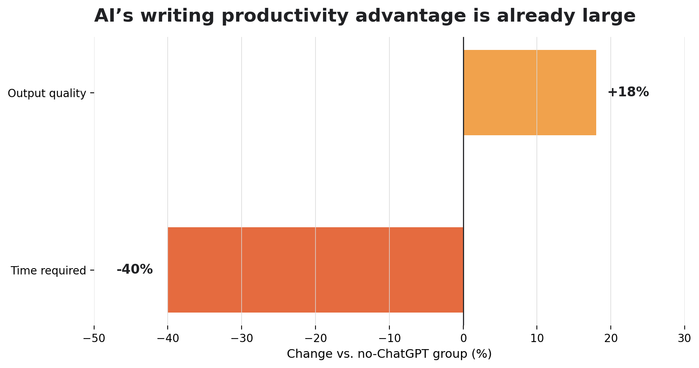
Figure 1. ChatGPT’s measured effect on professional writing tasks. Source: Noy & Zhang, Science (2023).

But speed is not the same as authorship.

From maker to architect

Humans have been moving up the abstraction stack for centuries.

We moved from muscle to machines; from doing every task to operating the machine; from operating the machine to designing the system. The builder becomes the architect. The craftsperson becomes the creative director. The founder who once needed a department can increasingly orchestrate a network of software and AI agents.

AI accelerates that move because it can automate not only physical labour but parts of cognitive labour.

For writers, the ladder might look like this: sentence maker → editor → director → architect of meaning.

There is enormous leverage in that progression. One person can explore more research, test more counterarguments, surface more connections and move from idea to published work faster than ever before.

But there is a trap in the metaphor of “moving up.” Higher leverage does not automatically mean higher mastery.

Rodin could delegate because Rodin knew sculpture. He had modelled clay, studied bodies, understood proportion and developed taste through practice. That accumulated craft gave him the capacity to look at work produced by someone else and say: no, that is wrong.

The same is true of a great editor, architect, chef or conductor. Direction is strongest when it rests on an internal model built by doing the work.

AI now allows us to leap up the leverage ladder before we have climbed the mastery ladder. That creates a new figure: the fragile director. They can generate impressive-looking work at extraordinary speed but may not possess the craft required to tell whether it is actually good.

Making is also thinking

This is why I resist the idea that the ideal future is one in which humans stop doing and spend all their time directing machines.

Part of what I love about art is technical excellence: seeing what a human hand has learned to do with marble, pigment, a brush, wood, sound or light. Sometimes the execution is not merely a delivery mechanism for the idea. The execution is part of the idea.

The same applies to writing.

A sentence can contain information, but it can also contain rhythm, restraint, surprise, personality and years of practice. We admire Orwell or Didion not merely because of what they thought, but because of the precision with which they learned to express thought.

The danger is that AI can give us the appearance of mastery without the apprenticeship that produces judgment.

A 2026 review in Trends in Cognitive Sciences describes this broader problem as cognitive offloading. Offloading work to AI can impede skill acquisition or contribute to skill decay, although the authors stress that the outcome depends on how the technology is used. That qualifier matters. The issue is not AI itself. It is what we choose to stop practising.

Automate friction that wastes life. Preserve friction that develops you.

Transcribing a two-hour interview by hand is mostly friction. Searching 100 documents for a quote can be friction. Reformatting citations is friction.

But wrestling with an argument can be formative friction. Finding the sentence that says exactly what you mean can be formative friction. Writing an introduction before asking AI for one can expose what you actually think.

The AI creativity paradox

The research increasingly suggests that AI creates a trade-off rather than a simple win or loss.

In a Science Advances experiment, Anil Doshi and Oliver Hauser gave writers access to generative-AI story ideas. Writers who could request up to five AI ideas produced stories rated 8.1 percent more novel and 9 percent more useful than the human-only group. The biggest gains went to writers who started with lower creativity scores.

But the stories also became more alike. AI-assisted stories moved closer to the average story in their condition. With access to one AI idea, the increase in similarity represented 10.7 percent of the similarity-score range found in the human-only group.
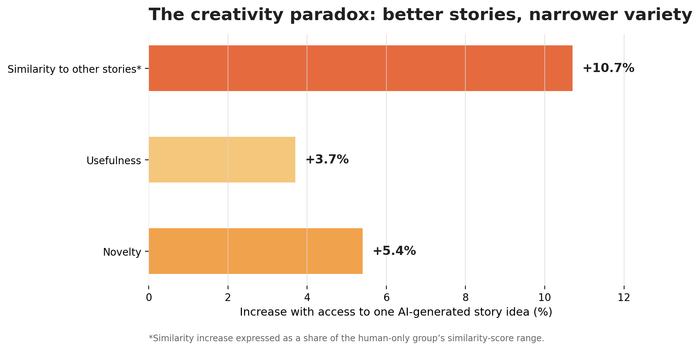
Figure 2. One AI-generated idea improved judged creativity while also increasing similarity between stories. Source: Doshi & Hauser, Science Advances (2024).

That paradox has since become harder to dismiss. A 2025 study of 2,200 college admissions essays found that human-written essays added new semantic diversity roughly two to eight times faster than base GPT-4 essays as the number of essays increased. And a 2026 meta-analysis spanning 19 studies and 61 effect sizes found a small but statistically significant homogenisation effect in human-AI co-creation.

AI can make each of us better while making all of us more similar.

That is where “AI slop” enters the story.

In 2025, Merriam-Webster named “slop” its word of the year and defined it as low-quality digital content produced, usually in quantity, with AI. The phrase is useful, but I think slop is a symptom rather than the disease.

The deeper problem is abdication.

AI slop appears when we outsource not only production but curiosity, experience, point of view, taste and judgment. The machine supplies the topic, the structure, the examples, the language and sometimes even the conclusion. The human becomes a publishing endpoint.

The result can be grammatically clean and intellectually empty.

A new definition of authorship

This is why Rodin and Koons matter to the AI writing debate.

They show that authorship has never required the author to perform every physical act of production. Art has a long history of workshops, apprentices, assistants, foundries and specialist fabricators. What matters is the nature of the contribution and the degree of creative control.

Even copyright law is moving toward this distinction. In its 2025 report on AI and copyrightability, the U.S. Copyright Office concluded that using AI as an assistive tool does not prevent copyright protection. Human-created selection, arrangement or modification can qualify. But simply providing prompts is not, by itself, enough to establish authorship of AI output.

That is a legal standard, not a complete philosophy of writing. But the direction is useful.

Authorship is not “I touched every word.”

It is closer to five responsibilities: Origin — why does this work exist? Intent — what am I trying to say? Direction — what should be researched, included, excluded or challenged? Judgment — is this true, interesting, beautiful, useful and mine? Responsibility — am I prepared to put my name behind it and defend it?

None of those requires typing every sentence. All of them require being present.

The two ladders of AI-assisted creation

I now think creators need to climb two ladders at once.

  1. The first is the leverage ladder: maker → operator → director → architect. 
  2. The second is the mastery ladder: novice → apprentice → craftsperson → master.

AI can rocket us up the first ladder. It cannot automatically carry us up the second.
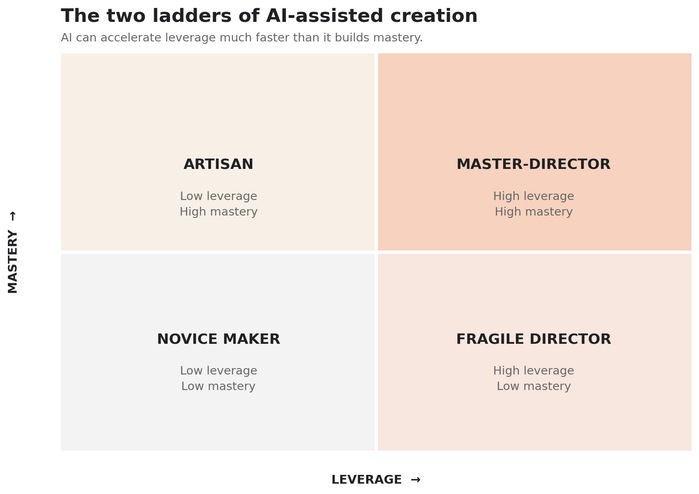
Figure 3. The strongest AI-age creator combines high leverage with high mastery. Framework: Jeff Bullas.

The dangerous position is high leverage and low mastery: the fragile director.

The exciting position is high leverage and high mastery: the master-director. That is Rodin with a studio. It is the architect who understands construction. It is the editor who has written thousands of pages. And it may be the strongest model for the AI-age writer.

The boundary I am trying to draw

I am still working this out in my own writing.

Sometimes I have abdicated too much. I have supplied a topic or headline and let AI run too far. Other times I have written the opening, supplied the lived experience, directed the research, challenged the argument, rejected language, moved sections and edited heavily. Increasingly, I think of the second approach as authorship rather than purity.

The percentage of AI-generated words is a poor test.

A better test is whether the work would exist in substantially the same form without the human behind it.

Did the piece begin with something I noticed, experienced or genuinely wanted to understand? Did I decide what question mattered? Did I challenge the evidence? Did I choose what belonged and what did not? Could I explain and defend the argument without opening the AI chat? Would another person giving the model the same headline have produced essentially the same article?

And one more question may matter even more: Am I still practising the craft that allows me to judge the machine?

I don’t want AI to free me from writing. I want it to free me from unnecessary labour so I can spend more time on observation, thought, story, craft and judgment.

The future should not be a civilisation of people who have forgotten how to make things but have become excellent at requesting them.

Nor should we romanticise unnecessary labour merely because humans once had to perform it.

The better destination is the master-builder: hands capable of making, a mind capable of designing, judgment capable of directing, and technology capable of multiplying all three.

Use AI to expand thought and amplify expression. Do not let it decide what you mean.

Or even more simply:

Delegation can expand authorship. Abdication abandons it.

The deeper question: what will you do with all this leverage?

AI can help us write faster.

It can help us research more deeply, explore more options and produce at a scale that was impossible a few years ago.

But that creates a new problem.

The more capability we gain, the more important it becomes to know:

What do I actually want to create?

What is worth my attention?

What deserves my time, energy and commitment?

The danger is not only that AI starts writing for us.

It is that we become surrounded by so many possibilities that we lose sight of our own direction.

That is part of why I’m building Zyrro.

Zyrro is designed to help you understand the patterns behind who you are, what energizes you, what matters to you and which paths may be worth exploring next.

Not to hand you a fixed answer.

Not to tell you what your purpose is.

But to help you make better choices in a world where AI can generate almost infinite options.

Because the real opportunity of AI is not simply to produce more.

It is to give us more leverage to become more intentional about what we choose to make, pursue and become.

AI can amplify your capabilities. Zyrro is being built to help you decide where to point them.

If that sounds useful, join the Zyrro waitlist and follow the journey as we launch.

Research & source links

The post AI Didn’t Kill Authorship. It Changed What Authorship Means. appeared first on jeffbullas.com.


* This article was originally published here

Start making $100+ per day this week with the best dfy system - Subscribe here!


Thursday, September 10, 2026

Your Reinvention Is Bad for the Algorithm’s Business

Last quarter, one company made fifty-five billion dollars selling ads against what you do online. That is about seven thousand dollars a second, day and night, for three months. You are not the customer. You are what they sell.

To sell to you, the machine needs to build a profile:  What you like, what you click, what you buy. 

Then it charges advertisers to reach that profile. The more predictable you are, the cleaner the container and category  you’re in, the more they pay.

Because a person who acts the same way every day is easy to sell.

That same profile decides what fills your feed. So the feed does not reward your best work. 

It rewards your most predictable work and the posts that keep you scrolling past the ads.

Why that matters 

Change what you write about, and the machine is no longer sure who to show it to. So it shows it to fewer people. Your reach falls. Your online visibility is throttled. And it doesn’t matter how good your content  or writing is.  

Your genius is sent to the graveyard. Buried.  And you get no warning and no reason. Just black box purgatory. 

Most people read that fall the wrong way. They decide the new work was weak, or that they are. So they go back to the old thing and the machine gets what it was built to keep: a person who never changes.

A creator I have never met felt it

He posted a video he was proud of about his new direction. It sank. So he posted one clip about his old topic, the thing he was trying to leave behind. It exploded. Another hundred thousand views. In the only language it has, reach, the machine told him who he was still allowed to be.

Another watched it happen in slow motion. A run of videos about a medical emergency he had survived convinced the machine that was his whole channel, and every new film after got buried. A cage his own success had built.

I know that box. Seventeen years in, this year I tried to climb out of mine.

What I found was worse than a box. It was a business.

The same machine, every feed

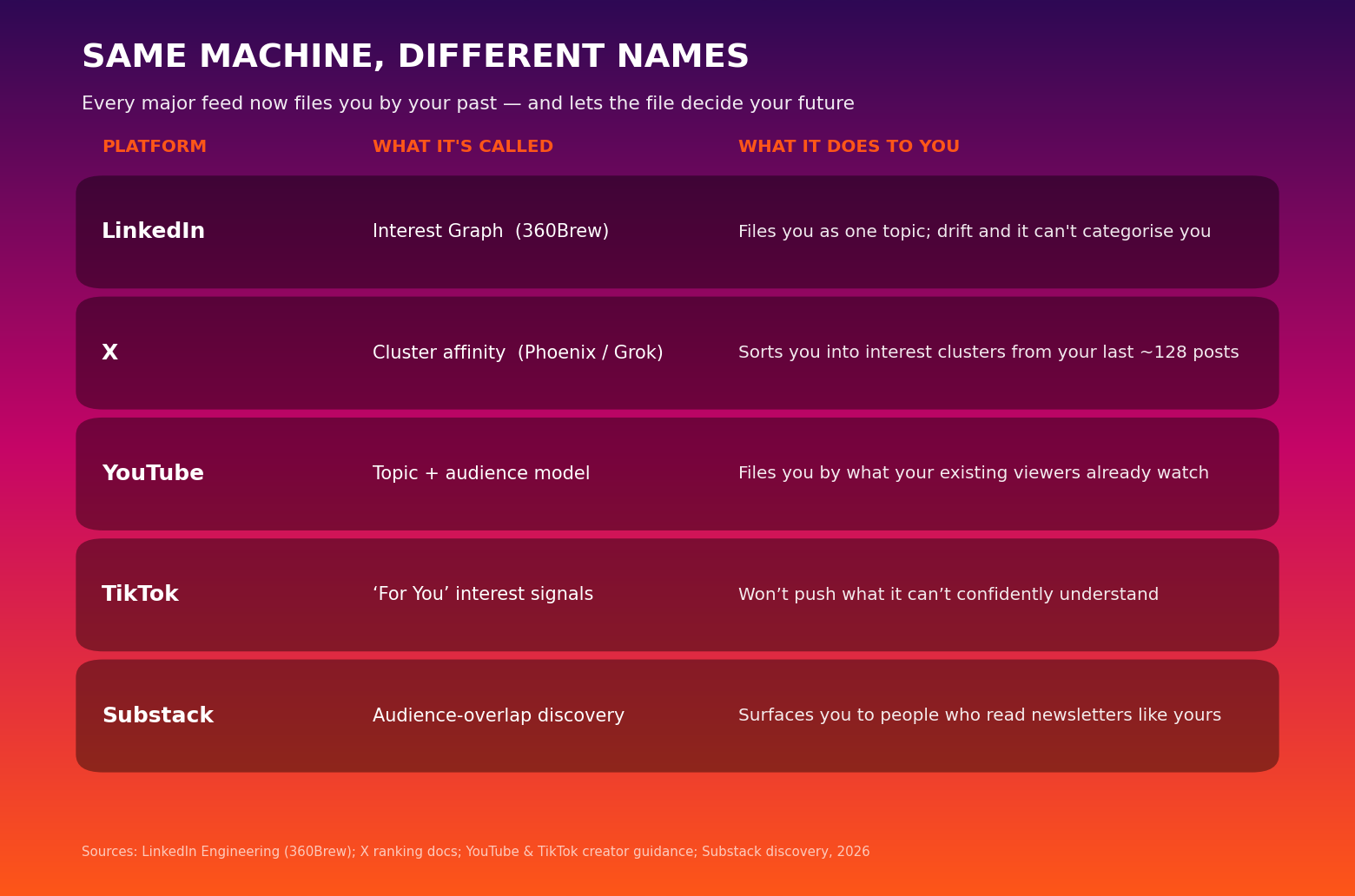
The trap is not a YouTube quirk. It is every feed, running the same algorithmic machine and formula under different names on the 5 platforms.

  • LinkedIn: Interest Graph (360Brew). Files you as one topic; if you drift, it can’t categorise you.
  • X: Cluster affinity (Phoenix / Grok). Sorts you into interest clusters read from your last ~128 posts.
  • YouTube: Topic + audience model. Files you by what your existing viewers already watch.
  • TikTok: ‘For You’ interest signals. Won’t push what it can’t confidently understand.
  • Substack: Audience-overlap discovery. Surfaces you to people who read newsletters like yours.

It is the same formula whatever the logo

  1. It learns what you posted before.
  2. It decides that is who you are.
  3. It shows anything new to fewer people.

It is the black box of the platforms giving you what they think is your identity.

Source: LinkedIn Engineering, X ranking docs, and creator guidance across platforms, 2026

Algorithmic Identity

A scholar named it fifteen years ago. He called it your algorithmic identity.

The machine studies your trail, decides who you are, and hands you a self you never chose. 

His hard line: that self is made useful not for you, but for someone else.

Useful to whom?

That is the question nobody answers on the platforms welcome screen. 

So let me answer it.

You are not the customer. You never were.

The customer is the advertiser. The product is you. Here is the receipt:

  • Meta told its own regulators that substantially all its money comes from advertising and built on tracking what you do, on and off its apps.
  • To do it, the machine reads billions of signals about you, and that means every like, every pause, how long you hover to guess what you’ll want before you do.
  • This year it passes Google to become the largest ad seller on earth — around 243 billion dollars.
  • The engine that decides what you see is the same engine that decides which ad you are worth. Your feed and your price tag run on one file.

The interest graph is not a library card. It is a sales file. It sorts you so a stranger can buy the right slice of your attention.

You are not being served. You are being sold. And a person who keeps changing is hard to sell.

You built it. For free.

Now the part that should make you angry.

You built the machine that files you. You are still building it. And you are not being paid for the part that matters.

Every post you publish does three jobs, and not one of them is yours:

  1. It trains your cage. It teaches the machine your topic, so it can keep serving you to the same crowd and lock you in.
  2. It makes the inventory. Your work is the thing that keeps people scrolling — past the ads that pay for all of it.
  3. It sharpens the file. Every click on your post refines the profile they rent to advertisers.

You are the factory and the product. You are not on the payroll.

Look at the split. 

YouTube pays a creator roughly 5 to 15 dollars for a thousand views, while charging advertisers 7 to 20 or more for the same thousand. The platform keeps the gap. Across the feeds they take 20 to 45 percent of what your work earns.

The creator economy is worth a quarter of a trillion dollars a year, and most of the people making it own nothing — not the content, not the audience, not the reach. Scholars have a flat word for the arrangement: unpaid labor.

What it cost me to change

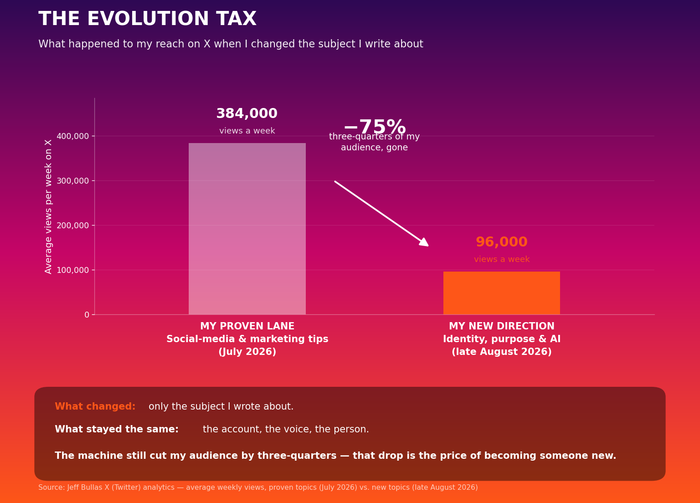
I paid a different tax. Not in dollars. In reach.

Source: Jeff Bullas X analytics — July reach wave vs. late-August after shifting to identity and AI writing, 2026

When the machine gets confused between the past and the present

  • For years I fed it what it expected,  social media tips, how to win at the feed and it rewarded me. A wave that reached 384,000 people in a week.
  • Then I wrote as who I am now. My reach fell to 96,000. Down seventy-five percent.

Not because the work was worse. Because a shape-shifter is bad for business. Harder to file. Harder to sell. 

The machine met a stranger where it expected an old friend, and it turned the lights down.

It is not just me

For a while I thought this was my private frustration. The numbers say it is a workforce.

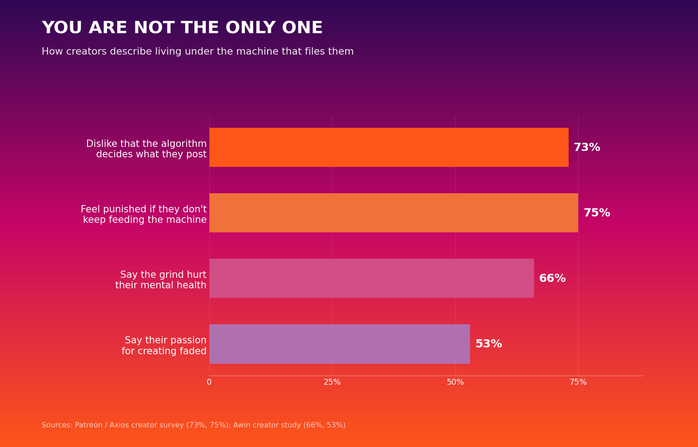
Source: Patreon / Axios creator survey (73%, 75%); Awin creator study (66%, 53%)

By the numbers

The impacts are not trivial and it removes motivation and joy of work for creators

  • Nearly three in four creators dislike that a machine decides what they can post. Three in four feel punished the moment they stop feeding it. 
  • Two in three say the grind hurt their mental health
  • Half say their love of the work faded.

Here is the cold part. 

No one at these companies has to sit in a room and decide to freeze you. The business model decides it for them. And the AI algorithm implements it. 

Predictable pays. But evolving as a person does not. You confuse the machine. It does not know what box to put you in. 

Which is worse than a conspiracy. A conspiracy you can expose. An incentive just keeps paying out.

And now they don’t even need you

Here is the last turn of the screw.

The machines have learned to eat the content and skip the creator. 

Google’s AI now answers inside the search page for roughly a quarter of all searches. Publishers who spent twenty years feeding it are watching traffic fall by anywhere from a fifth to nine-tenths. The answer stays on the page. The click never comes.

They took the work. They kept the reader. They cut you out of the deal.

Feed the machine. It keeps the money. And now it does not even send the traffic back.

The way out is not what you think

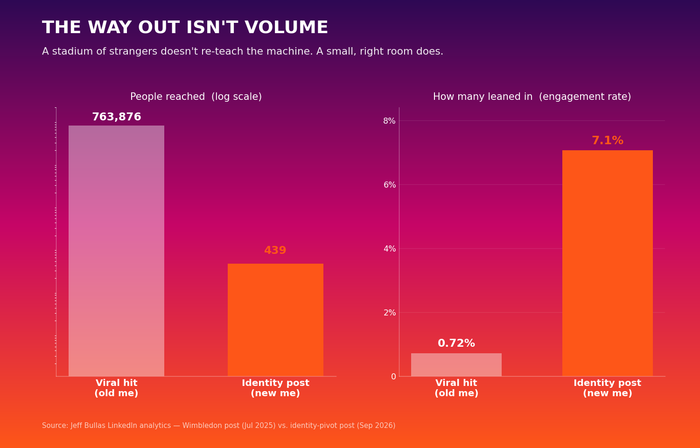
Stop chasing reach. A big crowd that scrolls past does not change how the machine sees you. A smaller crowd that stops and reads does.

Source: Jeff Bullas LinkedIn analytics — Wimbledon post (Jul 2025) vs. identity-pivot post (Sep 2026)

My biggest post reached 763,876 people, and almost none stayed at 0.72 percent. 

The post where I wrote as the new me reached 439, and seven percent of them leaned in. The giant crowd did not change my file. It just pointed the machine back at my past.

Here are four ways to reach the right people. They work on every feed.

  1. Write for the people you actually want, not the biggest crowd. The machine now measures how long people spend on your post. A small, right audience that reads to the end counts for more than a huge one that skims. So write posts worth stopping for.
  2. Show up in your new topic before you post about it. Find the people, groups and hashtags in that space. Comment, reply and collaborate there for a few weeks first. Then, when you post, that audience already knows you — and the machine has already seen you belong there.
  3. Change one thing at a time. Keep your voice and style the same while you change the subject. Change everything at once and the machine treats you as a stranger, so you start from zero. Move slowly and you keep the audience you already have. (This is how you earn a new category instead of resetting.)
  4. Build an email list. It is the one audience no platform can throttle, delete or charge you to reach. When you have someone’s email, you reach them directly and no algorithm gets a vote. I have thirty thousand subscribers, and no interest graph decides whether they hear from me. Even Meta and Google now admit a list is one of the most valuable things a creator can own. Start collecting emails today.

One honest caveat: 

This is getting easier, not harder. The newer algorithms look more at the post in front of them and less at your past, so a strong post on a new topic now travels further than it would have a year ago. 

The penalty for changing is real but it is shrinking. There has never been a better time to change what you write about.

The machine could be built the other way

None of this is a law of nature. It is a choice, written in code, by companies whose business is prediction.

A feed could reward you for growing instead of fining you for it. It could read your curiosity as a direction to follow, not a pattern to lock. It could treat you as a person, not a profile to sell.

That machine is possible. We just have not been sold it — because a becoming you is harder to monetise than a predictable one.

I have left a container before

I walked out of one container at 27, when the world I was handed stopped fitting the one I could see. I started again at 52, at a keyboard, before dawn. I am building again at 69.

Every time, the hard part was never leaving. It was getting the world to stop calling me by my old name. This time the world is a machine, and the machine keeps a file — and sells it. But a tax is not a wall. You can pay it. You can climb.

Every feed files you by who you were.

Then it sells that file, pays you in reach, and cuts the reach the moment you try to become someone new.

That is the deal. You never signed it. You can still walk away from it.

You are not the inventory. You are not the unpaid factory. You are a person still becoming one.

Own your audience. Keep your voice. Change in the open, at a cost, on purpose — until the file has no choice but to catch up.

The container was built to sell who you were. You were built to outgrow it.

The feed decided who you are. Zyrro helps you decide instead — your direction, your strengths, the signal only you can send. I’m letting a small group in first. 

Get early access and join the waitlist →

The post Your Reinvention Is Bad for the Algorithm’s Business appeared first on jeffbullas.com.


* This article was originally published here
Start making $100+ per day this week with the best dfy system - Subscribe here!


Wednesday, September 2, 2026

AI Made Content Cheap. It Made Thought Leadership Priceless.

I asked three different AI models the same question last week.

ChatGPT answered. Claude said the same thing. Gemini just put up its hand and said yes.

For about four seconds, I thought I’d found the truth.

Then I remembered where all three of them had intelligence but had not learned to think.

They had just agreed.

The Thing About Agreement

Three separate answers, all pointing the same way, looks like proof. That’s the instinct, and it’s wrong.

It wasn’t three minds checking each other’s work. It was three engines trained on a lot of the same internet, arriving at the same place because they’d read most of the same things.

Agreement isn’t evidence when everyone studied from the same notes.

I’ve made this mistake before, just with humans instead of machines. Ask five people in the same industry the same question and they’ll often converge too, not because anyone checked independently, but because they all read the same three books last year. 

And corporate groupthink had taken hold. Instead of independent thinking, fitting in had become the way to comply. Agree first and think later is a standard modus operandi.

Consensus has always been a weaker signal than it sounds.

I wrote that observation up. Posted it on X, in a few short lines, no polish.

No one argued.

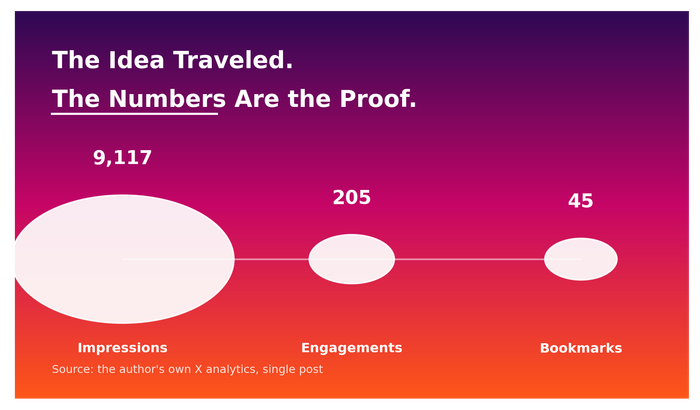
Source: the author’s own X analytics, single post

Nine thousand, one hundred and seventeen impressions. Two hundred and five engagements. Forty-five bookmarks, from people who wanted to find it again later.

Then something happened that the post itself couldn’t do alone. 

I rewrote the same idea for LinkedIn, in different words, for people who never saw the original, and it broke out there too.

Nobody told me to repost a tweet. That’s not what happened.

An idea travelled because the idea was strong enough to survive the trip, not because I was clever about distribution.

That’s the actual test now, and it isn’t “can you publish.” It’s whether your idea survives being said twice, in two rooms, in two formats, by two different versions of you. Most content can’t survive that. Most content was never trying to.

The Bigger Picture

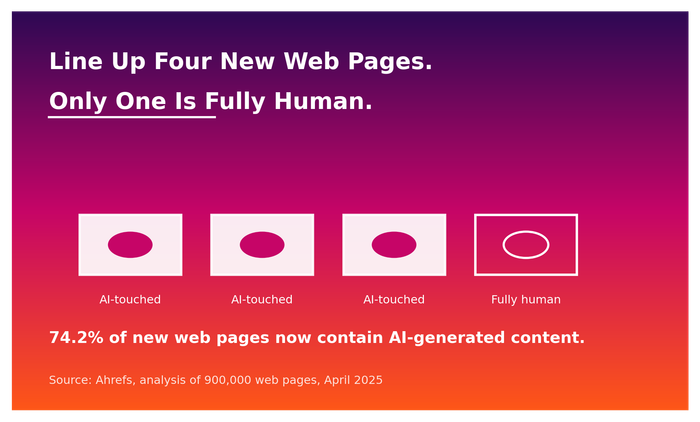
My one small post wasn’t an isolated case. Ahrefs went looking for the same pattern at scale, across 900,000 web pages published in April 2025.

Source: Ahrefs, analysis of 900,000 web pages, April 2025

74.2% of them had a machine’s fingerprints somewhere in the wording. Only one in four pages left was written by a human alone, with nothing else touching it.

If you lined up four posts on your feed right now, three of them would fail that test.

This isn’t the first time a new tool made publishing easier and made publishing prove less. 

  • Blogs turned everyone into a writer. 
  • Podcasts turned everyone into a broadcaster. 

Each wave quietly reset what counted as effort. AI is just the fastest wave yet, and the first one that hit text, images, video and code all in the same year.

Here’s the villain, if you want one. It isn’t AI. 

It’s abundance. 

Publishing used to prove you’d done the work. Now it mostly proves you have a subscription.

I’ll implicate myself here too. Seventeen years of my career were built partly on publishing more often than most people in my field could keep up with. 

That volume strategy still moves the needle, a little.
I am experimenting on X to see if it that works.

It was never going to survive a competitor that can out-publish all of us before lunch.
Artificial Intelligence

Two Kinds Of Content

There’s content creation, and there’s thought leadership, and the flood has forced them apart, whether anyone chose that or not.

Content creation says: here’s something useful. Thought leadership says: here’s something I noticed, and it might change how you see this.

AI does the first one well. I use it for exactly that, most days.

The second one still needs a person who notices a pattern before it’s been confirmed by anyone else, who says so under their own name, and who’s willing to be wrong about it in public.

That’s not a prompt. 

That’s a spine.

What The Machine Can’t Do For You

Photography didn’t end painters. It ended the job of painting things that simply looked like the thing.

AI is doing the same to expertise, at a much faster pace. It can write the report, build the deck, draft the strategy, summarise a decade of research, and do all of it competently before lunch.

So the question stops being “can you produce the work.”

It becomes “can you tell which work is worth producing,” and that’s a completely different skill.

It looks like knowing which of six fluent, well-written options is actually right for this client, this moment, this level of risk. It looks like catching the one that’s dangerous to ship, when it reads exactly as confident as the one that isn’t.

  • Judgment. 
  • Taste. 
  • Reputation. 

The specific, uncopyable shape of the life you’ve lived so far. 

AI can amplify all of it once you already have it. It has no way to manufacture the life that built it in the first place.

None of that shows up as a line on a resume. It shows up as the pitch you didn’t take, the trend you didn’t chase, the draft you deleted because it was clever but not true.

Zoom out and it isn’t only freelancers who feel this. 

A company can buy fluent, competent output from almost anywhere now, for almost nothing. What it can’t buy anywhere is a person who already sees the pattern everyone else is about to hit. And even at the top, a polished quarterly letter used to signal competence. It doesn’t anymore. 

Competence is free now. 

What signals it is being the person who saw the problem before there was a deck about it.

What This Is Worth

A real point of view stopped being a nice-to-have on a profile page. It’s turning into a balance sheet item.

Edelman and LinkedIn asked almost 2,000 B2B decision-makers about this in 2025. Seventy-one percent said a company’s thought leadership communicated its value better than its product marketing did. 

Among the toughest audience there is, the finance and legal and procurement people who screen out cold outreach for a living, 95% said strong thought leadership made them more open to being contacted at all.

That kind of trust shows up as revenue in places people don’t expect. 

  • Consulting. 
  • Speaking. 
  • Coaching. 
  • A course 
  • A book
  • A membership, 
  • A piece of software. 
  •  A side hustle that quietly turns into the actual company.

None of that starts with more content. It starts with being known for something specific.

You don’t need thirty-three million readers for this to work on you. You need one true idea, said often enough and clearly enough that someone remembers who said it. Small audiences with real trust already outperform large ones that only ever half-believe you.

Influence chased for its own sake is hollow. Influence that shows up because you had something true to say is a business model with your name already on it.

The Part That Worries Me

AI can build thought leadership. It can also replace the person doing the thinking, and you won’t notice the swap until it’s already done.

If it finds every idea, argues every position, and picks every topic for you, you end up publishing more and meaning less. Same output. Less of you in it.

You’ve seen the result already. 

Ten slides, no real author, a stock photo of a lightbulb, a caption that could belong to any company in any industry. 

Nobody sat down and decided to make something that forgettable. It just happened, one convenient prompt at a time.

A rented opinion collapses the first time somebody asks a real follow-up question.

I’m not pretending to be above any of this. I use AI for research, for structure, for a second opinion at the hour when no human wants to pick up the phone. 

What doesn’t get outsourced is the noticing itself, the specific, stubborn conviction that out of a thousand possible patterns, this one is the one worth saying out loud.

That is where I am reading a book or watching a video and I notice:

  • A sentence or a phrase that makes me curious. 
  • Raises a question. 
  • Sounds interesting. 

That part was never going to scale. 

Which is exactly why it still means something.

The Observation Loop

I think about this now as a loop, not a funnel. A funnel assumes you already know the answer and you’re just moving it downstream. A loop assumes you don’t know yet, which is the more honest place to actually start from. It also means the newsletter you’re reading right now is a draft of an idea, not a verdict on it.

Observe → Think → Test → Publish → Listen → Refine → Repeat.

Notice something, from work or life or a thread you can’t leave alone.

Ask what it might actually mean, before you’re sure.

Hand it to AI and make it argue the other side. Let it go looking for the evidence that proves you wrong.

Publish it while it’s still a little rough.

Watch what people push back on. That reaction is data too, and it’s often the best kind you’ll get.

Sharpen it. Do it again tomorrow, on purpose.

This newsletter is that loop, running in public, with my name attached to every turn of it.

What Would You Want To Be Known For

I still don’t know if the three AI models were right about the question I originally asked them. That was never really the point.

The point is that I noticed something none of them could have flagged on their own: that their agreement wasn’t proof of anything. 

Machines can’t catch that kind of thing about themselves. Noticing it is still, stubbornly, a human job.

That’s the whole opportunity, if you want it. 

AI gives one person more reach than a small agency had ten years ago. Reach on its own is just noise at scale. Reach plus a real point of view is a business: one honest opinion, a machine that executes at speed, and an audience that already trusts you enough to keep opening the email.

That’s not a content calendar. That’s a company, quietly wearing a newsletter as a disguise.

I don’t know yet what tomorrow’s pattern will be, or which platform it shows up on first. I’ve stopped needing to know that in advance. The loop finds it, if I keep running it.

So, not “how do I create more.” A smaller question, and a harder one: what do you already know, or notice, or believe, that’s worth becoming known for.

What would you want to become known for?

The post AI Made Content Cheap. It Made Thought Leadership Priceless. appeared first on jeffbullas.com.


* This article was originally published here
Start making $100+ per day this week with the best dfy system - Subscribe here!


AI Didn’t Kill Authorship. It Changed What Authorship Means.

About ten years ago I was wandering through the Musée Rodin in Paris. I am not an artist. I went in with the naive assumption most of us ca...