💡 Start Your Online Business Today

🚀 Ready to Build Your Online Business?
👉 Start Here with This FREE Guide!

Tuesday, August 18, 2026

This is what 700 Rejections Taught Me

At 51, I applied for 700 jobs.

Not 70. Seven hundred.

If you allow half an hour for each one — the tailoring, the cover letter, the form that makes you retype the CV you already attached — that is 350 hours. Nearly nine working weeks of a life, spent asking.

One word and one phrase came back.

Overqualified. Culture fit.

Here is what was on the résumé those two words were applied to.

  • I had sold PC’s to the government in the early days of the industry and taken an $800,000 annual budget to $30 million in a single year.
  • Then one of the largest telcos in the country hired me to build their wholesale internet traffic division. We went from $4 million a year to $50 million a year in twelve months.

Roughly $75 million of new annual revenue, built from scratch, in two different industries, across two technology shifts.

The system’s word for that was overqualified.

The two words, translated

Overqualified means we cannot afford you, or we think you will leave, or we suspect you will make your manager uncomfortable.

Culture fit means we cannot picture you in the room.

Neither is a reason. Both are a verdict. And neither can be appealed, because nobody ever has to say what they actually mean.

The rest of the vocabulary works the same way. Digital native. High energy. Recent graduate. Fast-paced environment. None of those words mean young. All of them mean young.

I am not the only one on the receiving end of it.

A poll of more than 1,600 workers aged 50-plus, published by AARP in January 2026, found 64% had seen or experienced age discrimination at work. Of those, 91% believed it was common.

A ProPublica and Urban Institute investigation found more than half of American workers over 50 are pushed out of their career jobs before they choose to go. Few ever earn what they earned before. The over-50s then stay unemployed close to twice as long as everyone else. Mentions of ageism in Glassdoor reviews rose 133% in a single year.

There is no villain with a face in any of this.

No hiring manager wakes up wanting to throw away three decades of judgment. The damage is done by a sorting system built for speed, and a system cannot see a career. It can only see a date.

A résumé hands the story of your life to a stranger and asks them to be fair with it.

That is the deal most people over 50 are still accepting. Seven hundred times, in my case, before I stopped.

The number nobody sent you

Here is what has happened to that word while everyone was busy being frightened of robots.

Stanford’s Digital Economy Lab, working with payroll records from ADP covering millions of American workers, tracked what happened to jobs after ChatGPT arrived. The paper is called Canaries in the Coal Mine? and it has been revised twice as more data has come in.

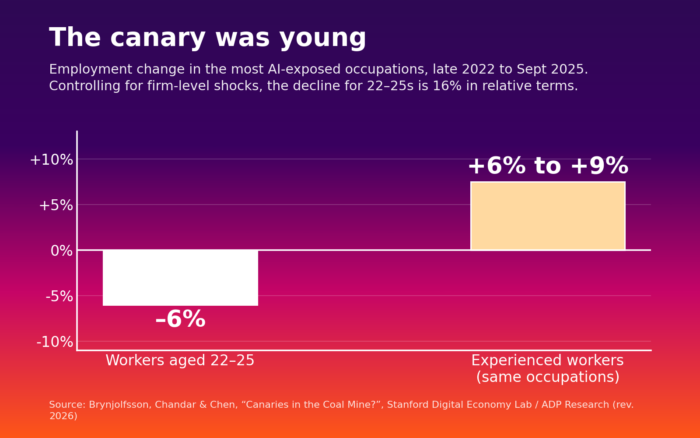
Workers aged 22 to 25 in the most AI-exposed occupations saw employment fall around 6%. Control for shocks inside individual companies and the relative decline is 16%.

Workers with real experience, in the same occupations, went the other way. Employment rose between 6% and 9%.

The canaries were young.

Chart 1: Employment change in the most AI-exposed occupations. Source: Stanford Digital Economy Lab / ADP Research.

Read that again, slowly, if you are over 50.

In the jobs most exposed to the machines, experience got more valuable. Not less. The market has quietly repriced you upward and nobody thought to mention it.

The market changed its mind. The story didn’t.

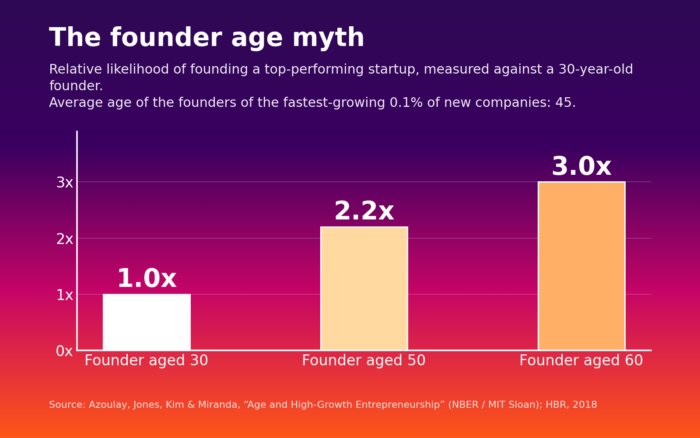
Pierre Azoulay at MIT, with colleagues at Kellogg, Wharton and the US Census Bureau, studied 2.7 million company founders. Among the fastest-growing 0.1% of new companies, the average founder age was 45. Among firms that went on to be acquired or listed, 46.7.

A 50-year-old founder is around 2.2 times more likely to build a top-performing company than a 30-year-old. A 60-year-old is three times more likely.

Chart 2: Relative likelihood of founding a top-performing startup, by founder age. Source: Azoulay, Jones, Kim & Miranda (NBER / MIT Sloan).

The same shift shows up in how companies now buy senior expertise. The fractional executive market has passed $5.7 billion and grows at 14% a year. The number of fractional leaders doubled from 60,000 in 2022 to 120,000 in 2024. Close to three-quarters bring 15 years or more. More than 40% of American small and mid-sized businesses are expected to be using fractional leadership by the end of this year.

In the consulting market beside it, 37% of business owners are aged 50 to 59, and another 29% are over 60.

Two-thirds of that market is already run by people my age.

The same experience that made me overqualified for a salary makes me expensive as an advisor. Identical track record. Opposite verdict. The only thing that changed was which door I walked through.

The flood that made you visible

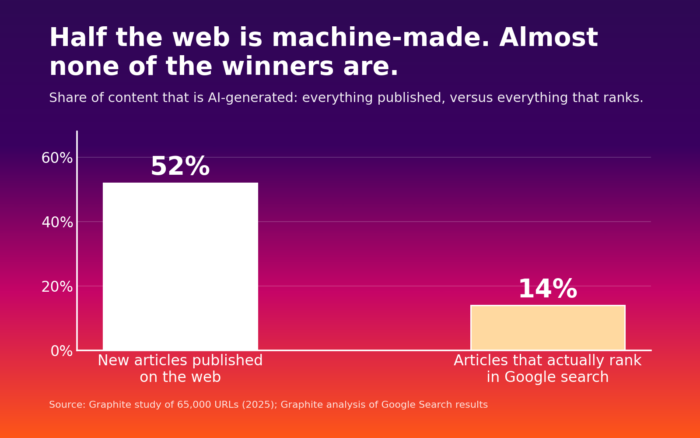
One more number, and it is the strangest of them. The SEO firm Graphite sampled 65,000 articles published on the web and found around 52% of new articles are now written by a machine.

Half the internet is synthetic.

But when they looked at what actually ranks in Google, only 14% of it was AI-generated. Eighty-six percent was human.

Chart 3: AI-generated share of content published, versus AI-generated share of content that ranks. Source: Graphite.

The flood did not bury the human. It made the human obvious.

Scarcity moved while everyone was watching the wrong thing.

Content is not scarce. Information is not scarce. Frameworks, tips, summaries, explainers — a machine will produce a thousand of those before your coffee cools.

What is scarce is knowing, in your body, what happens when a $4 million business has to become a $50 million business and you have twelve months and nobody around you has done it before.

You have something like that. It is sitting in your head, doing nothing, generating no return.

The buyers are reading. You are not writing.

The Edelman and LinkedIn B2B Thought Leadership Impact Report has surveyed senior decision-makers for eight years and the findings barely move. Seventy-three percent say thought leadership is a more trustworthy basis for judging what a company can actually do than that company’s own marketing. Ninety percent are more receptive to a business that consistently publishes something worth reading.

In the 2025 edition, 54% said a piece of thought leadership pushed them to research a product they had not been considering at all.

Meanwhile, on the platform where those people spend their working attention, roughly 1% of members post anything in a given week. That 1% generates around nine billion impressions.

So the decision-makers are reading.

And almost nobody carrying thirty years of scar tissue is writing.

Your experience is invisible until it is published.

Not a strategy. Not a funnel. A physical fact about how the world now works.

“I don’t want to be an influencer”

Good. Nobody is asking you to be.

It is the objection I hear most from people with grey in their hair and a serious career behind them, and it is fair. The words “personal brand” have been ruined by people selling frameworks for a life they have not lived.

So set the words aside and look at what is actually being asked.

A B2B personal brand is not a following. It is a public record of how you think. It is what a buyer finds at 9pm before a meeting when they type your name into a search bar — either a decade of considered thinking, or a profile photo and a job title.

No dancing. No morning routine. No thread of twelve tips.

One question, asked in public, over and over. Here is a problem in my industry. Here is what it cost me to learn it. Here is what I now believe.

A résumé tells people where you have been. A body of work shows them how you think. Only one of those is worth paying for.

Before you publish a word, know what you’re actually saying.

I built Zyrro to surface the identity underneath your track record. The specific thing that makes your point of view yours, not a machine’s. Takes 10-15 minutes to answer a few questions and it’s FREE. Join the waitlist to be first in.

Join the Zyrro waitlist!

Cicero got there first

In 44 BC, Cicero was 62 and out of power. Rome had moved on from him. He sat down and wrote a short book about growing old.

In it he argues that the great things are not done by strength, or speed, or quickness of body. They are done by judgment, standing and considered opinion. He points out that the ship’s captain does not climb the mast. He sits at the tiller, and the ship goes where he decides.

Two thousand years later a payroll database ran the numbers and agreed with him.

Five moves, and none of them is a résumé

When I started writing online I just thought I was writing a blog. But I discovered later I was creating authority. One post at a time.

But I also learned as I wrote and distilled what I learned. The art and science of writing and creating has magical powers that aren’t obvious on starting but are revealed as others affirm what you reveal from your life stories and observations.

Experience and expertise published even in a simple and honest way is far more powerful than any clever thoughts that are never revealed.

You don’t need to be a world famous author but just an honest practitioner.   You don’t need to be a poet, just reveal what you learned and use plain language. 

George Orwell revealed the power of simple writing in his short 14 page book titled “Politics and the English Language”

Here are the five moves.

1. Stop applying. Start publishing.

A résumé is a request. A body of work is a claim. One gets filtered by software. The other gets read by a human who then comes looking for you. Change which one you spend your Sundays on.

2. Pick one scar, not your whole CV.

Not the roles. Not the titles. One thing that went badly wrong and what it rewired in you. A machine can produce polish at zero cost. It cannot produce the Tuesday your largest client walked out, or what you did on the Wednesday.

3. Write to one person, two levels below where you were.

Not “the market.” One operator, staring right now at the problem you solved in 2011, who does not yet know it is solvable. Everything you write should be aimed at that one face.

4. Use AI for the scaffolding. Never for the signal.

Research, structure, charts, twenty headline options — hand all of it to the machine. Story, opinion, verdict, the line that makes somebody sit up — that is yours and it stays yours. The moment the machine writes your point of view, you become the thing the market is already drowning in.

5. Publish on a slow clock.

A hundred posts, not ten. The first fifty feel like shouting into a car park.

What happened when I stopped asking

After the 700, I stopped.

I had lost a business before that, a retail bed store, of all things and spent a stretch rebuilding and licking my wounds at my brother’s place near Lake Macquarie, which is a beautiful part of the world and a hard place to be at 51 with a phone that does not ring.

In March 2009, at 52, I started writing a blog. No audience. No network worth the name. No plan beyond curiosity.

I got up at 4:30 in the morning and wrote.

Nine months later there were 100,000 readers a month. Over the years that followed, 33 million people across 190 countries read something I published.

Same man. Same experience. The same $75 million on the résumé that nobody wanted.

Seven hundred applications produced nothing. Publishing produced everything that came after.

I did not get better. I stopped asking permission to be visible.

Last year I posted that I was 69 and founding an AI startup, and asked whether I was mad. The response was almost nothing. A polite trickle.

That silence taught me more than applause would have. The market does not react to your age. It reacts to whether you have given it anything to hold on to.

The container

Every life I have watched closely is a sequence of containers. A job. A company. A belief. An identity that fitted at 30 and cuts under the arms at 55.

The container is never the problem. Staying in it after you have outgrown it is.

Somewhere right now a person is sitting in a meeting room, half-listening, thinking: there has to be more to this than this.

If that is you, the numbers are finally on your side. AI came for the entry level, not for you. Buyers trust a published opinion more than a brochure. The fastest-growing companies are being founded by people your age. Two-thirds of the consulting market already is you.

The only thing missing is a record.

They called me overqualified 700 times.

It turned out they were right. Just not in the way they meant.

Stop applying. Start publishing.

You know the record. Now name the signature behind it.

Zyrro is the AI-powered platform built for exactly this moment,  helping 50-plus professionals turn thirty years of judgment into a public identity nobody can replicate. The free identity report is the first step. The waitlist is open.

Join the Zyrro waitlist!

Further reading

The post This is what 700 Rejections Taught Me appeared first on jeffbullas.com.


* This article was originally published here

Start making $100+ per day this week with the best dfy system - Subscribe here!


Wednesday, August 12, 2026

What Your Curiosity Reveals About Your Future

Brian Grazer threw up on Jonas Salk.

He had worked for a long time to get an hour with the man who beat polio. They met in the lobby of the Beverly Hills Hotel. Grazer walked across the room and his nerves won.

Salk steadied him. Ordered orange juice for his blood sugar. Helped him clean up.

Then invited him home for an eight-hour conversation.

Grazer went on to produce Apollo 13 and A Beautiful Mind. But the habit underneath the films is stranger than any of the films. And it started with a boy who could not read.

The man who hired someone to keep him curious

Grazer was a dyslexic kid who spent school inventing ways to avoid his teacher’s eyes. Looking down. Firing paper clips. Staging a cough. He knew he could not answer what was coming.

Then he got a job as a law clerk at Warner Brothers. His work was delivering documents to powerful people. Drudge work.

So he invented a line. He told the assistants that the papers were only valid if he handed them over in person.

It got him through the door. And once he was in the room, he asked questions.

That small piece of theatre became a lifelong method. For thirty-five years he has sat down with a stranger from outside his world. He calls them curiosity conversations. About one a week.

Carl Sagan. Isaac Asimov. Two CIA directors. Edward Teller, who built the hydrogen bomb. Carlos Slim, then the richest man on earth.

Some took a year of letters and phone calls to land. A year of work for sixty minutes of talk.

He was not after facts. He wanted to sit inside a mind that had done something he could not do. What does it feel like to remove a disease from the world? What does a man tell himself after he builds the worst weapon ever made?

Never with a movie in mind. That was the rule.

When he got busy, he hired a person whose only job was to arrange these conversations. The New Yorker wrote about the role. It even got a title. Cultural attaché.

Read that again. A man employed someone full time to keep him curious.

What curiosity used to cost

Curiosity used to be expensive.

It cost you letters that went unanswered. Assistants who hung up. Twelve months of waiting for one hour. And on one afternoon in Beverly Hills, it cost a grown man his dignity in front of his hero.

The real tax was not time. It was rejection, in writing, from people who owed you nothing.

Now curiosity costs nothing. Which is why almost nobody tracks it.

My own curiosity machine

I have a place where I keep the things that catch me.

For about a year I have run a project inside a chatbot called Book Summaries. Whenever something snags my attention, I drop it in. A book. A research paper. A newspaper clipping. A stray article at 5am.

There was no plan. I followed what interested me and nothing else.

With each one I do the same four things. Summarise it. Argue with it. Connect it to something else I have read. Then sometimes turn it into a post, a framework, a product.

It is a curiosity conversation with a machine instead of a stranger. It happens before the sun is up, in silence, in a chair by a window. No letters. No year of waiting. No orange juice required.

Then I asked it a question I had never thought to ask.

The question that read me back

I asked: what have I been trying to understand?

Not what did I save. What have I circled, over and over, without noticing.

Five questions came back. Every one of them had already turned into a project.

What makes us human when machines become intelligent? That became the Human Signal.

What is still valuable when a machine can produce almost anything? That became my obsession with judgement.

How do we find work that feels chosen instead of forced? That became Zyrro.

How can one experienced person build extraordinary leverage? That became the one-person company I keep sketching.

How should knowledge change when the world moves faster than books can be printed? That became living books.

I had not decided on any of these. They had been deciding me for a year while I thought I was only reading.

The pattern is the person

Look at what happened there.

I did not choose five questions. I chose a clipping. Then another clipping. Then a book, then a paper, across a year, with no plan at all.

The pattern was built out of a hundred small yeses.

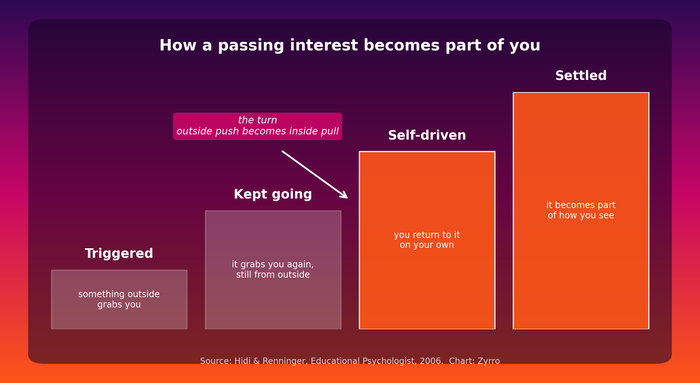
Researchers have mapped how this works. Suzanne Hidi and K. Ann Renninger describe interest as moving through four phases. Something catches you. It catches you again. It starts coming back on its own. And then it settles in and becomes part of how you see.

The turn happens in the third phase. That is where the thing stops needing to be triggered from outside and starts running on its own fuel.

You do not decide it. You notice it, late, the way I did.

We named ourselves Homo sapiens. Wise man. It is a generous title for a species whose real signature is the question.

And the oldest question we ask is this one. Who am I?

Most of us answer it with a borrowed word. A job title. A company. A degree. Something we did in 2011.

None of those are you. They are what you were paid to be.

Your curiosity trail is different. Nobody paid you for it. Nobody was watching. You did it for free, in stolen minutes, and it kept happening anyway.

That is closer to evidence than anything printed on a business card.

Where the energy lives

Here is the part that stopped me.

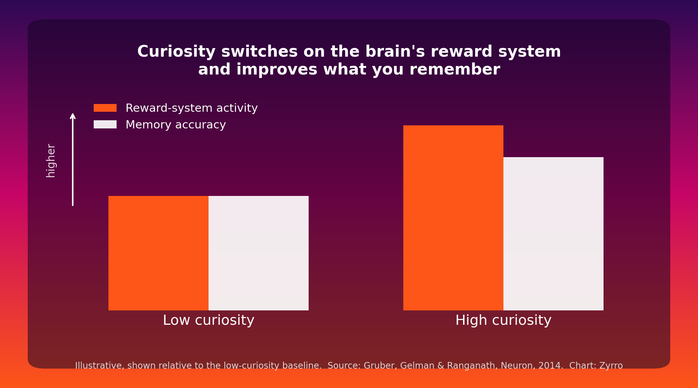
At UC Davis, Matthias Gruber, Bernard Gelman and Charan Ranganath put people in a scanner and showed them trivia questions. Some the person burned to know the answer to. Some they did not care about. When curiosity was high, the midbrain and the nucleus accumbens lit up. The brain’s reward circuit. The same machinery that answers to food and money.

Memory improved for what they were curious about. It also improved for unrelated material that happened to be in front of them at the same time.

Curiosity does not just make you want to learn. It changes the state of the brain that does the learning.

Read that as a life instruction, not a lab result. Your energy is not spread evenly across your days. It pools.

Most advice has this backwards. Find your motivation, it says, then apply it to your work.

The research points the other way. Lean into the thing that already pulls you, and motivation arrives afterwards, as a result.

I know this from the inside. In 2009 I did not start with discipline. I published, a stranger on another continent replied, something in me lifted, and I published again. The 4:30am alarm was never willpower. It was a loop that had begun to pay me back.

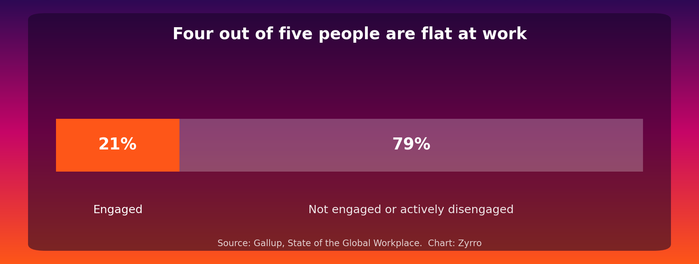
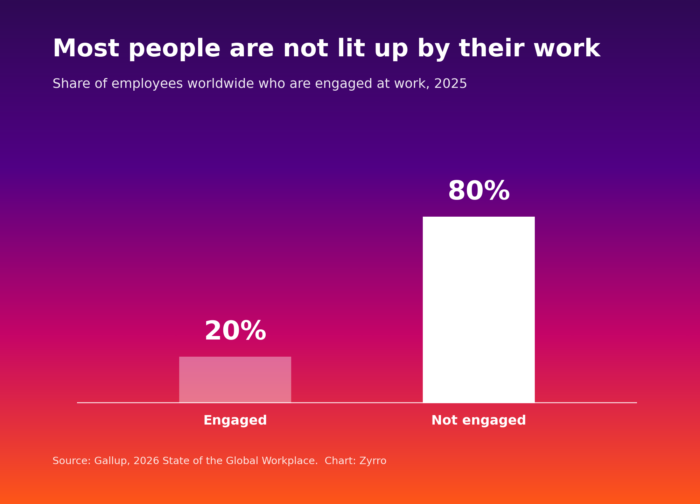
Source: Gallup, 2026 State of the Global Workplace. Chart: Zyrro.

Meanwhile, four out of five people on this planet are not engaged at work.

That is not a character flaw spread across eight billion people. That is a fit problem at scale. Most of us are spending our best hours in a place where the energy never pools.

This is the problem I am building Zyrro for. It reads your patterns back to you,  what you keep returning to, where your energy gathers, and what work would run on its own fuel instead of your willpower. The waitlist is open here.

The narrowing

Grazer’s method has one feature mine does not.

Salk gave him something he would never have known to ask for.

The machine answers what I bring it. A stranger interrupts what I bring.

And the interruption is getting rare, because most of what we touch all day is built to do the opposite.

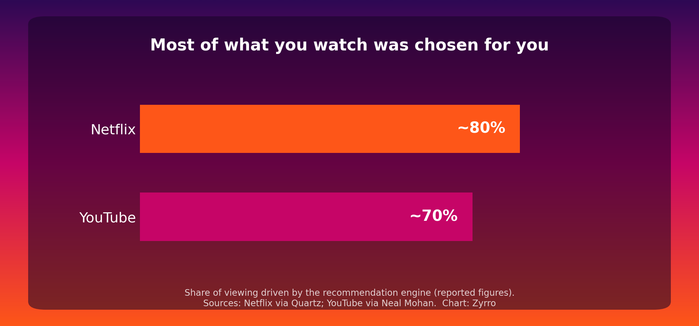
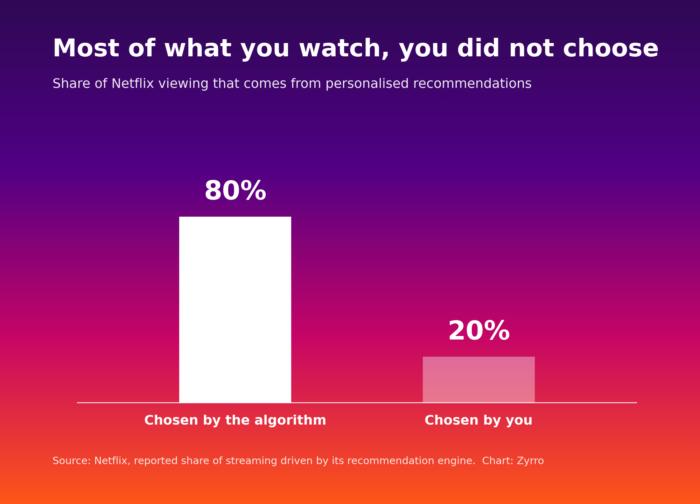
Source: Netflix’s reported share of viewing driven by its recommendation engine, via Quartz. Chart: Zyrro.

Around eight in ten hours watched on Netflix come from what the system chose to put in front of you. On YouTube the figure has been put at roughly seven in ten.

Hold the two charts side by side. Eight in ten hours chosen for you. Eight in ten people flat at work. Different cages, same arithmetic.

Nobody set out to narrow you. It happens because the thing is being helpful. It learned what you like, so it brings you more of what you like, forever.

Helpful is not the same as wide.

A feed is a mirror that flatters. A stranger is a window that argues.

There is a second problem and it is quieter. The machine has manners. It meets me where I stand and almost never tells me the question itself is wrong.

A stranger has no such training. Take your marketing theory to a virologist and they will look at you the way you would look at someone who brought a bicycle to a boat race.

That look is worth more than a good answer. It costs nothing and it cannot be prompted.

Why the odd idea is the multiplier

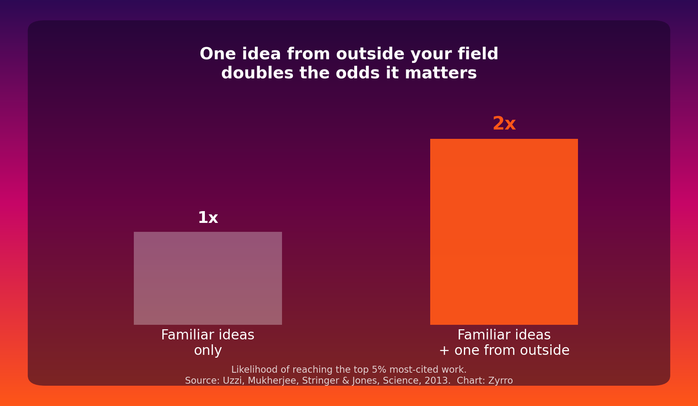
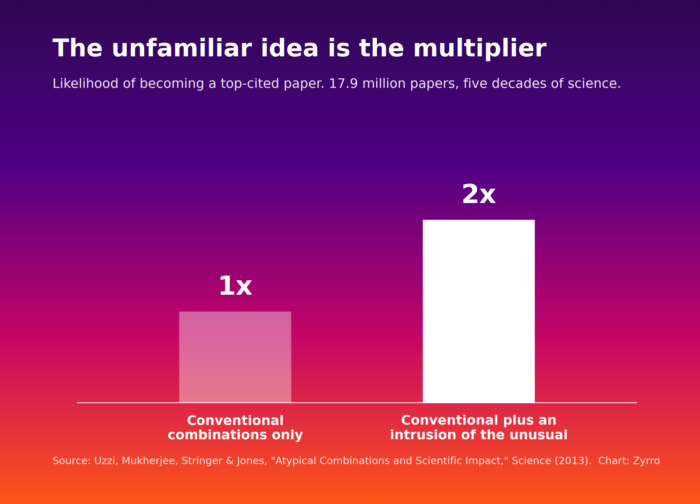
At Northwestern, Brian Uzzi and three colleagues went through 17.9 million research papers across five decades of science. They wanted to know what makes a paper matter.

It was not raw novelty. The work that landed hardest was mostly conventional, built on the familiar ideas of its own field, with one intrusion of something unusual. A reference from a world that had no business being there.

Those papers were twice as likely to end up among the most cited work in science.

Source: Uzzi, Mukherjee, Stringer and Jones, “Atypical Combinations and Scientific Impact,” Science (2013). Chart: Zyrro.

Read that as a map of a life and not just a map of a lab. Depth in your own field is the base. The strange import is the multiplier.

Grazer built a career on that finding without ever seeing the data. He was a film producer having dinner with a virologist. He heard a rapper on the radio and went to meet him, and years later that door opened onto films he could not have made from inside Hollywood.

He was making the atypical combination on purpose. One hour at a time.

My own strange import

I know how this works because it built my life.

In 2008 I was in a hole. A retail business I had opened had failed and closed. I was selling real estate to pay the bills. My marriage had ended and I had retreated out of the city to my brother’s place beside a lake, where I sat for the best part of a year and licked my wounds.

My own industry had run out of answers. So I read outside it.

Tim Ferriss showed me that work did not have to sit inside a building. David Meerman Scott showed me that attention could be earned with content instead of bought with money. Then a blog post from a software company said something plain: if you have an inkling of a business you want to start, start a blog.

A fitness experimenter, a PR contrarian and a marketing company had nothing to do with each other. Or with me.

I put them together anyway, and in March 2009 I started writing. Then I got up at 4:30am and did it again for five years.

Only now can I see it clearly. Those three books and posts were not a strategy. They were the visible part of a pattern I had been running for years without a name for it.

Try one this week

Choose someone outside your industry. Not a peer. Not a prospect.

Ask what problem they cannot stop thinking about.

Ask what outsiders get wrong about their work.

Ask what they believe that most people in their field do not.

Then carry one idea home and put it somewhere it does not belong.

One rule holds the whole thing up. Go in with nothing to sell. The moment you have a deal in mind it stops being curiosity and becomes a meeting.

Keep the machine too. It goes deep and it never sleeps. But depth with no width makes you an expert nobody can surprise, and width with no depth makes you a dinner party.

One gives you the answer. The other gives you the question.

The trail

A CV records where you have been. Your curiosity trail may reveal where you are going.

The things you cannot stop reading about are data. They are telling you what you care about, what wakes you up, what tension you want to resolve, and where you might have something to say that nobody else can.

Grazer’s trail is thirty-five years of strangers. Mine is a year of clippings and a machine that read them back to me. Both are the same act. Both are a person refusing to stay inside their own field.

Yours is already written. You have just never read it back.

The container you were handed is your job title, your feed, and your own good taste. It is smaller than you think.

Something bigger is standing just outside it, waiting for a letter.

What question have you been unable to stop asking?

There is a fuller version of you already there, sitting in your patterns and your energy and the work that lights you up. It is hard to see on your own. That is what Zyrro was built to do. Join the waitlist.

Further reading: Brian Grazer and Charles Fishman, A Curious Mind: The Secret to a Bigger Life. The Salk story is also told in Time.

The post What Your Curiosity Reveals About Your Future appeared first on jeffbullas.com.


* This article was originally published here
Start making $100+ per day this week with the best dfy system - Subscribe here!


Monday, August 3, 2026

AI Made Everyone Better. Originality Became Scarce.

A while ago I read a draft I had written and did not recognise the person who wrote it.

It was not bad. That was the problem.

The sentences were clean. The structure held. The research sat in the right places. Every paragraph did its job and moved on.

And it sounded like nobody.

I had used AI for the heavy lifting, the way I always do now. Research. Structure. Sorting the mess into an order. What came back was smooth, competent and completely unhaunted.

There was no scar in it. No moment where a real person had been wrong about something and had to work out why.

I deleted most of it and started again at 4:30 the next morning.

What I did not understand at the time was that this was not my failure as a writer. It was a measurable effect, and researchers have now put a number on it.

The tool lifts the floor and lowers the ceiling

In 2024, Anil Doshi of University College London and Oliver Hauser of the University of Exeter ran a controlled experiment and published it in Science Advances. They asked people to write short stories. Some wrote alone. Some were offered story ideas from GPT-4. Then evaluators rated the results, not knowing which was which. You can read the study here.

The stories written with AI help were rated as more creative, better written and more enjoyable.

The gain was biggest for the least creative writers. The tool lifted the people who needed lifting. That is a good thing and I want to say it plainly before I say the rest.

Here is the rest.

The AI-assisted stories were more similar to one another than the human-only stories.

Everyone got better. Everyone got closer together.

The researchers called it a social dilemma. Each writer is better off. The group produces a narrower range of what exists.

Individually better. Collectively smaller. That is not a trade-off anyone agreed to make.

Then they counted the ideas

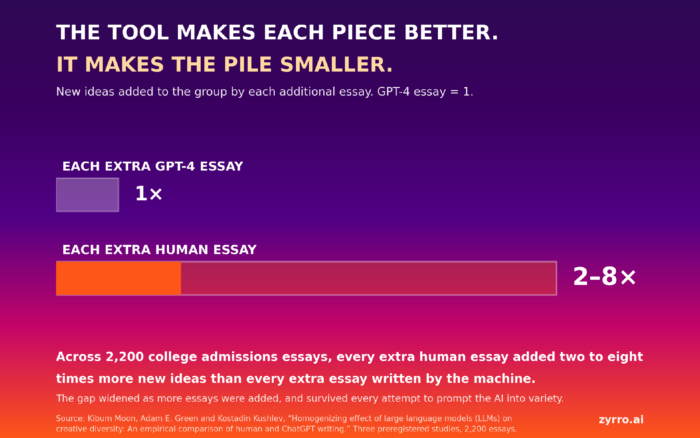
A second team went looking for the same effect at scale. Kibum Moon, Adam Green and Kostadin Kushlev analysed 2,200 college admissions essays across three preregistered studies and published the results.

They built a measure they called the diversity growth rate. It asks a simple question. When you add one more piece of writing to a pile, how many genuinely new ideas does it bring?

Every extra human essay added two to eight times more new ideas than every extra GPT-4 essay.

Two things about that finding matter more than the number itself.

The gap grew wider as more essays were added. The homogenising effect compounds. The bigger the pile, the more the machine repeats itself.

And they tried to fix it. They changed the prompts. They changed the parameters. They pushed the model toward variety in every way they could think of.

The gap survived all of it.

Data: Moon, Green and Kushlev, Journal of Creativity

It is not only writing

You could argue that essays and short stories are a narrow test. So look at raw idea generation, before anyone writes a word. Barrett Anderson, Jash Shah and Max Kreminski ran a study with 36 participants who produced 1,271 ideas between them, and published it at the Creativity and Cognition conference.

Half used ChatGPT. Half used a different creativity tool with no AI in it at all.

The ChatGPT group produced more ideas, and the ideas had more detail. On any individual scorecard they won.

But compared across users, their ideas were less distinct from one another. Each person felt they were exploring. Collectively they were converging.

Then the researchers found the thing that has stayed with me since I read it.

The ChatGPT users felt less responsible for the ideas they had produced.

Not less satisfied. Less responsible. Something about the way the idea arrived loosened their grip on owning it.

An idea you do not feel responsible for is an idea you will not defend, refine, or stake anything on.

The real world

Both of those are studies. Controlled, careful, and small.

So the same group went and looked at the real world.

In a preprint released in early 2026, Moon, Kushlev, Green and colleagues examined the personal statements of 372,793 real college applicants. They compared essays written after ChatGPT was released in late 2022 with essays written before it. You can read the preprint here, with the usual caution that it has not yet completed peer review.

What they found is the strangest result in this whole field.

After ChatGPT arrived, the words in those essays became more varied. The surface got richer. The vocabulary widened.

And underneath, the ideas became more alike. Sentence by sentence and essay by essay, the concepts converged.

They gave it a name. Semantic disjunction.

We are sounding more different from each other than ever, while saying the same thing.

Think about what that does to a reader trying to tell people apart.

The old signals of effort are gone. Polished prose used to mean somebody cared enough to work at it. Now polish is free and arrives in four seconds.

So the surface stops carrying information. And almost nobody notices, because each individual piece looks better than what that person could have made alone.

You cannot detect a collective problem from inside your own document.

It also happens inside your head

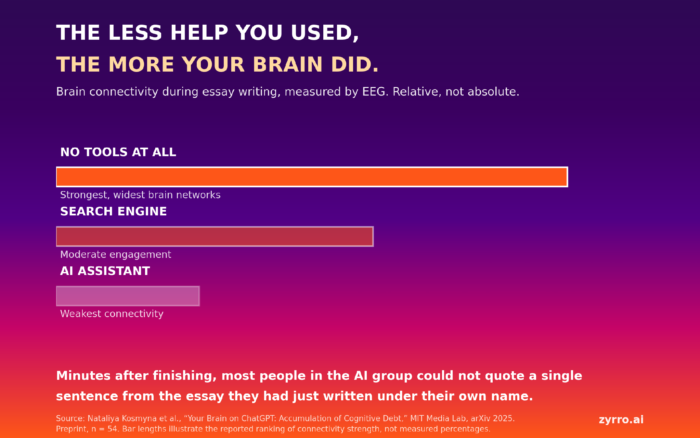
The last study is the one that unsettled me most, because it does not measure the writing at all. It measures the writer. A team at the MIT Media Lab led by Nataliya Kosmyna wired 54 people to an EEG and had them write essays under three conditions: with an AI assistant, with a search engine, or with nothing at all. The paper is called Your Brain on ChatGPT.

Brain connectivity scaled down in step with the amount of help. The people writing alone showed the strongest and widest networks. Search engine users sat in the middle. The AI group showed the weakest coupling of the three.

Their sense of owning what they had written followed the same ladder. Lowest in the AI group. Highest in the group with no tools.

And then a small, terrible detail. Minutes after finishing, most of the AI group could not quote a line from the essay that carried their name.

They had produced it. They had not been through it.

The researchers called what accumulates cognitive debt. You get the output now and pay for it later, in the thinking you did not do.

I want to be careful here. This is a preprint, the sample is small, and other researchers have published a comment asking for the results to be read more conservatively. Treat it as a signal, not a verdict.

But note what else that team found. Inside each group, the essays converged. Same names, same phrases, same topics. The homogenising showed up again, in a different lab, measuring something else entirely.

Data: Kosmyna et al., MIT Media Lab, arXiv 2025 (preprint)

Why nobody notices

The most uncomfortable finding in this research is not the homogenising. It is that the people doing it could not feel it happening.

Writers using the tool reported being satisfied with their work. They were right to be. Judged on its own, each piece was better than what that person would have produced alone.

The question that would have caught it is a different question. Not “is this good?” but “is this different from what everyone else is about to publish?”

Almost nobody asks the second one, because there is no reason to. Nothing prompts you. The tool does not warn you. Your draft does not look like anybody else’s draft, because you cannot see anybody else’s draft.

So the loss happens at a level no individual can observe, to people who are each doing their job well.

That is what makes it a system problem rather than a discipline problem. Telling people to try harder will not touch it.

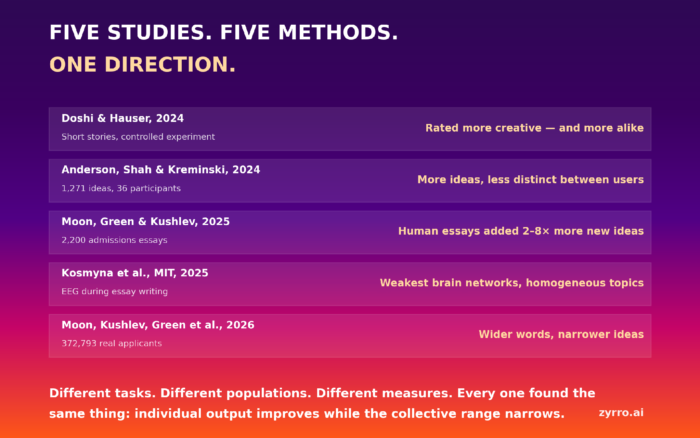
Five independent research groups, five methods, one direction. Sources listed at the end.

Orwell described this eighty years early

In 1946, George Orwell wrote an essay called Politics and the English Language. His argument was not about grammar.

It was that bad language corrupts thought, and corrupted thought produces worse language, and the two feed each other in a loop.

He listed the enemies. Dead metaphors nobody actually pictures. Long phrases doing the work of a single verb. Pretentious words used as camouflage. The passive voice, which hides who did the thing.

And words worn so smooth by use that people can agree on them without agreeing on anything.

Then he gave his rules. Never use a long word where a short one will do. Cut any word you can cut. Use the active voice. Prefer plain English to jargon.

Now read that list again and think about what a language model produces when you ask it to write something for you.

Grammatically perfect. Confident. Full of phrases you have read ten thousand times before. Frictionless, and empty.

Orwell described the failure before the machine existed that would mass-produce it.

What this does to the price of things

Here is where it stops being a writing problem and becomes an economic one.

For twenty years the rule of being found was simple. Blend in. Match the format. Use the words people search for. Look like the other results so the system knows where to file you.

I built an entire business on that rule.

In 2009 I started writing and the product was information. Explain a thing well, structure it clearly, and people arrived from all over the world because the explanation was scarce and I had one.

That trade is finished. Not fading. Finished.

The explanation is now free, instant, personalised and infinite. Nobody needs my clear explanation of anything, and it took me a while to say that out loud.

So the rule flipped, and most people have not noticed.

The machine now produces the average for free, in unlimited quantity, faster than anyone can read it. Competence has stopped being scarce.

And a thing that is not scarce has no price.

If everyone is being lifted to the same competent middle, then the middle is where value goes to die. What survives is whatever could not have come from the tool.

Not better writing. Different writing. Writing with a person inside it who has been somewhere and paid for the trip.

When the machine makes the same for free, the only asset left is the thing it cannot copy.

What I keep and what I hand over

I am not writing this as somebody who refuses the tool. I use it every week and it has made me faster.

But that morning taught me where the line sits, and I have not moved it since.

What I hand over: the research. The structure. The charts. The hunt for a study I half remember. The tedious work of turning a mess into an order.

What I keep, always:

The headline. I write ten before I choose one. The first three are obvious, the next four are worse, and somewhere around eight something honest shows up.

The story. Every piece needs a human in it. Mine, or somebody else’s, or a metaphor carrying the weight of one.

The point of view. What I actually think, including the parts I might be wrong about in public.

The editing. Five to ten passes, cutting the lines I liked most. Stephen King called it killing your babies, and he was not exaggerating.

That last one matters more than it sounds. The passes are not decoration. Writing is how I work out what I believe, and if I hand the sentences over I hand over the thinking with them.

There is a story about Sartre going blind. People suggested he dictate into a tape recorder instead of writing.

He refused. He said that with a machine he would always be either lagging behind it or running ahead of it.

He was not being difficult. He knew the machine would set the pace, and that the pace was where the thinking lived.

The one test

So here is the diagnostic I now run on everything before it goes out.

Could a machine have written this?

If yes, delete it. If no, you are winning.

It sounds harsh. It is the cheapest quality control available, and it takes four seconds.

Look for the parts of a piece that only you could contribute. A decision you regret. A number from your own life. A thing you believed for years and no longer do. A moment you were wrong in front of people who mattered.

The machine has read every story ever written. It has never lived one.

It has no scars, no bad Tuesday, no company that failed, no room that went quiet when it finished speaking.

You have all of those. They used to be the cost of a career. They are now the only part of your work that cannot be generated.

The verdict

The research says the same thing three times from three directions.

Individual work improves. Collective range narrows. Words diversify while ideas converge. And the effect gets stronger as more people join in.

So we are heading toward a world of well-written, well-structured, well-researched pieces that all quietly agree with each other.

Nobody chose this. There is no villain in a room somewhere deciding it. There is only a system that pays for volume, so everyone reaches for the same tool, and the tool has a centre of gravity.

Which leaves one question worth carrying around.

What is one true thing about you that no machine could ever write?

Find that. Then put it in the work.

It is not a style. It is the only thing you own.

This is the ground Zyrro is built on. It reads your own history back to you — the decisions, the failures, the questions you keep returning to — so the thing only you can say stops being invisible to you. The early list is open.

Sources

Anil R. Doshi and Oliver P. Hauser, “Generative AI enhances individual creativity but reduces the collective diversity of novel content,” Science Advances, 2024

Kibum Moon, Adam E. Green and Kostadin Kushlev, “Homogenizing effect of large language models (LLMs) on creative diversity”

Moon, Kushlev, Green et al., “The Link Between Diverse Words and Original Ideas Is Weakening in the AI-Era College Admissions” (preprint, 2026)

Barrett R. Anderson, Jash Hemant Shah and Max Kreminski, “Homogenization Effects of Large Language Models on Human Creative Ideation,” Creativity & Cognition, 2024

Nataliya Kosmyna et al., “Your Brain on ChatGPT: Accumulation of Cognitive Debt,” MIT Media Lab, arXiv, 2025 (preprint)

MiloÅ¡ Stanković et al., comment on “Your Brain on ChatGPT” (2026)

George Orwell, “Politics and the English Language,” Horizon, 1946.

Janet Emig, “Writing as a Mode of Learning,” College Composition and Communication, 1977.

The post AI Made Everyone Better. Originality Became Scarce. appeared first on jeffbullas.com.


* This article was originally published here
Start making $100+ per day this week with the best dfy system - Subscribe here!


This is what 700 Rejections Taught Me

At 51, I applied for 700 jobs. Not 70. Seven hundred. If you allow half an hour for each one — the tailoring, the cover letter, the ...