💡 Start Your Online Business Today

🚀 Ready to Build Your Online Business?
👉 Start Here with This FREE Guide!

Thursday, November 26, 2026

How I Went From 361 to 152,247 Daily Views Without Building a Bigger Audience

In the first six months of 2026, about 560,000 new apps landed on Apple’s App Store. Most were built with AI. That’s nearly as many as in all of 2025. Downloads rose 2%.

Do the sums and it comes to about 3,000 new apps a day. If every new app were a shop, a new one would open on your street every 30 seconds, all day and all night. The number of people walking down that street barely changed.

That’s the new problem. Building has never been cheaper. Getting anyone to notice what you built has never been harder.

The flood

For most of the last decade, fewer new apps came out each year. Building software was slow, expensive and needed skills most people didn’t have. Then AI coding tools arrived. New App Store releases jumped 84% in the first quarter of 2026, and the App Store is on track for more than a million new apps this year, beating its old record from 2016.

People with ideas but no coding skills can now build things over a weekend. I think that’s wonderful. I’m one of them. I’m building an AI startup, Zyrro, and the tools have changed what one person can do.
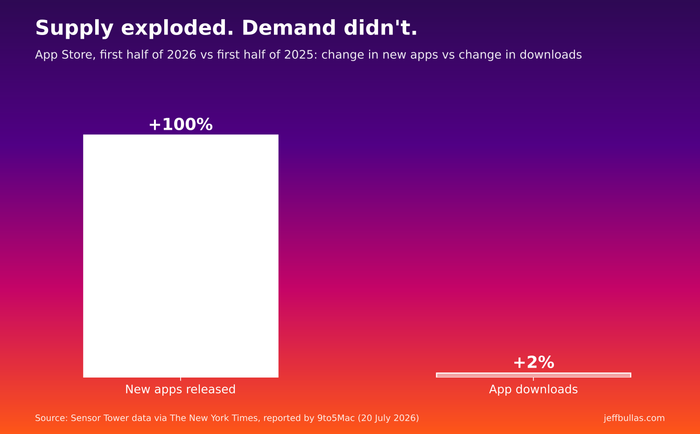
Supply doubled. Demand rose 2%.

But look at that chart again. The number of apps doubled. The number of people downloading them rose 2%. The same is true of newsletters, podcasts, courses and posts. AI has turned up the supply of almost everything. It hasn’t added a single hour to anyone’s day.

So the bottleneck has moved. The hard question is no longer “Can I build it?” It’s “Will anyone see it?”

361 Impressions

I thought I had that question answered. I’ve been publishing online since 2009. I started a blog at 52 with a $10 investment, writing at 4:30am before work, and it reached 33 million readers. I built a following on X of more than 500,000 people.

Then, in June 2026, I came back to X to get attention for Zyrro. On 23 June my whole account got 361 impressions. Not per post. For the whole day. Zero people visited my profile.

It wasn’t the first time I’d been ignored. In 2007, at 50, my business collapsed. At 51 I applied for about 700 jobs, and the word I kept hearing was “overqualified.” Experience I’d spent decades building counted for nothing in the eyes of the people deciding.

That was the old gatekeeper: a hiring manager. In June 2026 the gatekeeper was a feed. Different machine, same lesson.

It stung. But it also taught me the most important lesson of the past six months. The followers I spent 17 years building didn’t carry me. Every view had to be earned again.

The rules changed while I wasn’t looking

When I started on Twitter, the feed was simple. You saw posts from the people you followed. More followers meant more reach. Big accounts won, and new accounts struggled to be heard.

That world is gone. X now runs mostly on its “For You” feed, which X has published as open code. It picks posts for each person based on what they’re likely to enjoy, from anyone, followed or not. A new post is first shown to a small group, and only spreads further if people reply and engage. And the average user sees only 20 to 30 posts a day in that feed.

Think about that. Tens of millions of posts a day, competing for 25 slots on each person’s screen.

This is the shift from the social graph, who you know, to the interest graph, what you care about. It’s brutal for big accounts that coast. It’s a gift for everyone else. Attention has been opened up to anyone.

A 21-year-old creator called Denys proved it. With no famous name and no big following, he went from nothing to his first X payout of $2,639.84. His method wasn’t a trick. He replied to people every day and posted things they wanted to answer.

If a 21-year-old with no audience can do it, and a 69-year-old with half a million followers can’t coast on them, the rules really have changed.

The new scarcity

Here’s the second-order effect most people miss. When anything can be built in a weekend, the thing you build stops being special. Your app, your newsletter, your course: someone else can copy the features by Friday.

What can’t be copied is trust. People don’t download an app because it exists. They download it because someone they’ve come to trust told them it was worth it. In a world drowning in AI-made everything, a real person with a real story becomes the rare thing.

I’ve been calling this the human signal. The more content machines make, the more people look for proof that a human is behind it. Not polish. Not volume. A voice they recognise, with scars they can see.

That changes where builders should spend their time. For years the advice was to perfect the product and the customers would come. Now the product is the easy part. The real work is earning attention, one honest post at a time, before you need it.

What 500 hours taught me

So I treated my own X account as a lab. Since June I’ve put in about 500 hours, around 3 hours a day. I posted, tested formats, read the numbers with AI, kept what worked and dropped what didn’t.
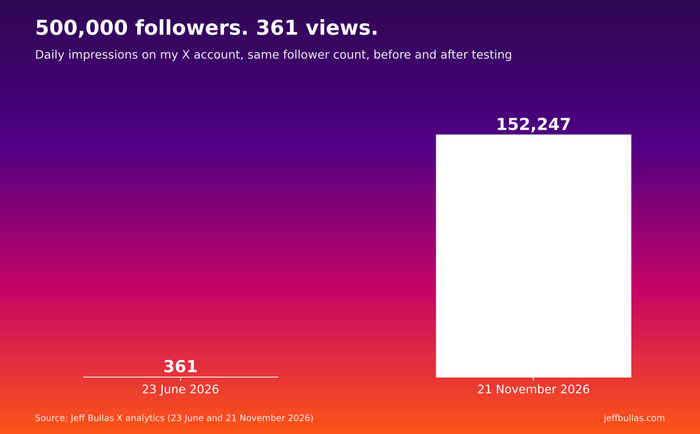
Same follower count. Different approach.

On 21 November my account got 152,247 impressions in a day. On 24 November, 623 people visited my profile and 353 followed me. For the week to 24 November, signups to the Zyrro waitlist ran at about twice their monthly average.

Here’s what I learned, in short.

  1. Views are not the goal. I had a post reach 31,000 people and send only 41 to my profile. Another reached 4,500 people and brought in 100. The number that matters is how many people want to know more about you after reading.
  2. Different posts do different jobs. Some posts are built to travel. A simple scenario like “You’re 55. You win $1 million tomorrow. Do you quit work?” gets thousands of people answering. Those posts earn reach. But they rarely make anyone curious about you.
  3. Stories turn strangers into visitors. The posts that brought people to my profile were personal confessions with real numbers. “In 2007, at 50, my business collapsed. I applied for about 700 jobs. At 52 I started a blog.” Those posts sent 12.8 people to my profile for every 1,000 views. Everything else sent about 2.
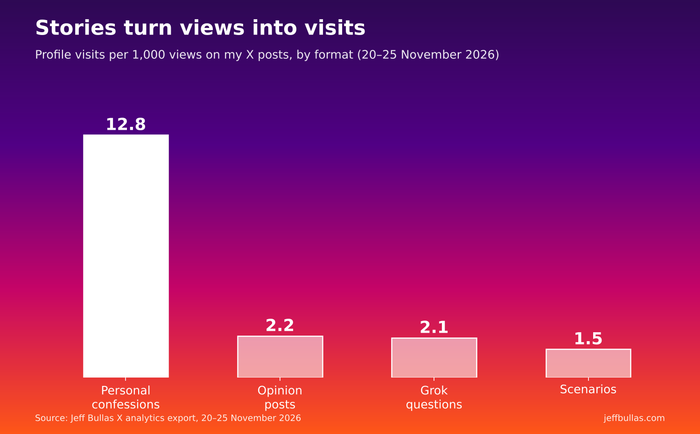
Stories convert six times better.
  1. One post does the selling. When people land on your profile, one pinned post should tell your story and point to one next step. Mine sent 690 people to my profile, gained 150 followers and drove 158 clicks to the waitlist in a single day. 
  2. Your hands matter most. My best results came from things I couldn’t schedule: replying to people and writing my own take on other people’s posts. That’s where trust gets built.

Just as useful was what failed. Time-travel questions, small success stories, single statistics, opinion one-liners and posts that only pitched my product filled the schedule and moved nothing. I cut them.

That’s the other habit: keep score. Every week I look at which posts sent people to my profile, double down on what works, and drop what doesn’t after three honest tries. I wait a full day before judging anything. I once cut a format too early and watched the post nearly double after I’d given up on it.

That’s the engine. Reach posts bring strangers in. Stories make them curious. One pinned post turns curiosity into a signup.

Fighting a machine with a machine

There’s one thing I haven’t told you yet. I didn’t put in those 500 hours alone.

  • The feed is a machine. It’s built to keep people scrolling, not to help you get found. 
  • It holds back posts with links, because links take people away. 
  • It changes its rules without telling anyone. 
  • And it reads signals you and I will never see.

So I brought my own machine. I used AI in three ways. 

  1. It helped me draft posts and replies, and test many versions of the same idea. 
  2. It scheduled posts to go out when my audience was awake, even while I slept in Sydney. 
  3. And every few days it went through my analytics, more than a thousand rows of data, and showed me which posts sent people to my profile and which ones wasted my time.

That last part changed everything. Learning what works used to take me years of trial and error. This time I could see it in weeks.

But there’s a line I didn’t cross. AI never invented a story. Over months, I fed it mine: the business that collapsed, the 700 job applications, the $10 blog, the 4:30am mornings. So when it helps me draft, it starts from my life, not a blank template. That’s why the posts still sound like me. And I edit and send every post and reply myself. AI did the heavy lifting. I did the living.

If you try this, start there. The people I’ve seen struggle with AI content run out of things to say, because they never gave the AI their stories. 

Feed it your life first.

That’s the twist. The same tool that’s flooding the world with apps and posts can help one person cut through the flood, if you use it to understand the system, not to fake being human. 

I’ll share exactly how I set it up in another piece.

The catch

I’d be lying if I said I’ve cracked it.

  • My signup jump is about a week old. I’ll know it’s real when it holds for a month. 
  • My top three posts still bring in about half my views, which means I still depend on the odd post that takes off. 
  • And the formats that work on X today will change, because the platforms always do.

It also takes time. Three hours a day is a lot. The parts that work best, the replies and the stories, are the parts no tool can do for you.

So this is not a hack. It’s a habit.

Why this matters to you

You might not be building an app. Maybe it’s a newsletter, a consulting practice, a book or a new career. It doesn’t matter. The same flood is coming for all of it, because AI makes the making easy for everyone.

What AI can’t make is your story. It can’t copy the year your business collapsed, the 700 rejection letters, or the 4:30am mornings. That’s the one asset that doesn’t get cheaper when everything else does.

If you’re over 50 and starting again, this matters even more. You’ve got decades of stories most 25-year-olds don’t have yet: the job that went wrong, the business that failed, the lesson that took ten years to learn. In the old world, your age might have counted against you. In the interest graph, a true story told well counts for more than a birth year. I’m 69 and building again. The feed didn’t care how old I was. It cared whether people stopped to read.

And here’s the good news. The interest graph doesn’t care how many followers you have. It cares whether your post is worth stopping for. That means you can start today, from zero, and still be seen.

Three things to do this week

Post one true story with one real number. An age, a year, a count, a dollar figure. Real numbers make people stop.

Reply to everyone who answers. Every reply is a small vote that tells the feed to show your post to more people. It’s also how strangers start to trust you.

Watch profile visits, not likes. Likes feel good. Profile visits tell you someone wants to know more.

Then do it again tomorrow. That’s the part most people skip.

Back to 361

I still think about that day in June. 361 impressions. Zero profile visits. Half a million followers who never saw a thing.

It was humbling. It was also the best thing that could have happened, because it made me start again with the same tools as everyone else.

Building is easy now. Attention is hard. But attention isn’t reserved for the famous any more. It goes to whoever shows up with something real to say, again and again.

So here’s my question. What’s the story you’ve been keeping to yourself that someone out there needs to hear?

I’m building Zyrro for people with long careers who can’t see what comes next. You answer 13 questions about your life and work, and it helps you find your next direction. If you’ve got a story you haven’t told yet, it might help you find it.

Join the Zyrro waitlist →

Sources

The post How I Went From 361 to 152,247 Daily Views Without Building a Bigger Audience appeared first on jeffbullas.com.


* This article was originally published here

Start making $100+ per day this week with the best dfy system - Subscribe here!


Thursday, November 12, 2026

I Asked Nearly 100 People About Starting Again After 50. AI Wasn’t the Hard Part

Last Wednesday night I asked a simple question on X: “Anyone over 50 starting something new right now? A business, a course, a craft, a second career. What is it?” I added my own answer. At 69, I’m building Zyrro, an AI startup.

Then I went to bed. By the next afternoon, more than 27,000 people had seen it. Nearly 100 had answered, aged from 45 to 83. More than 400 had clicked through to my profile to see who was asking.

I’ve been writing online since 2009, and I’ve learned that you can’t fake a response like that. People don’t answer a question unless it touches something real. This one did. Here’s what they told me, and what I think it means.

The replies

Some answers made me laugh. Some made me stop and read them twice.

One person wrote that at 83, they’re starting life all over again. 

  • A 70-year-old is working on a wind energy project. 
  • A 55-year-old finished a PhD last year and won a NASA contract this year. 
  • A 64-year-old is bootstrapping a restaurant operations platform that’s approaching $1 million in transactions in under a year.
  • A 73-year-old woman is roasting specialty coffee. A 65-year-old published a first book this year and is turning it into an online workshop. 
  • A 60-year-old has just started writing a first novel. 
  • Someone else is finally starting the band they should have started years ago. On Threads, one person couldn’t find a patch for every baseball stadium, so they made all 83.

These aren’t people winding down. They’re people winding up.

What the numbers say

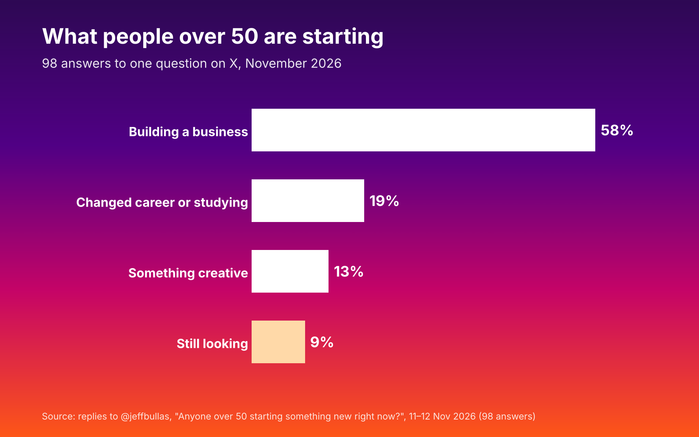
I sorted every real answer into groups. I left out the jokes, the ads and the “good on you” replies, which left 98 answers.

More than half are building a business. About one in five changed careers or went back to study. One in eight took up something creative. And about one in ten said they’re still looking. I’ll come back to them, because they’re the most important group in this story.

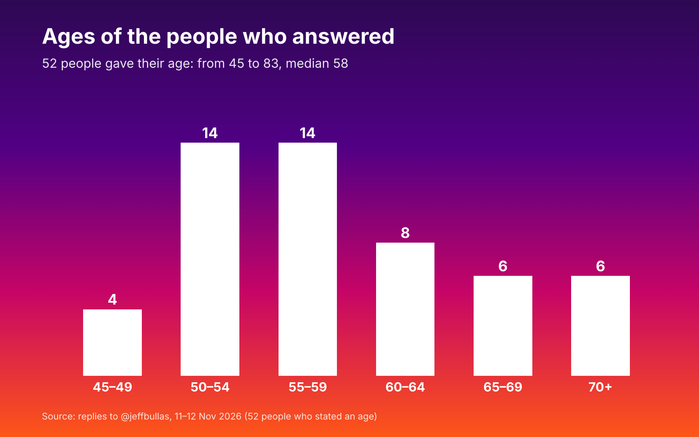
Of the 52 people who told me their age, the youngest was 45 and the oldest was 83. The median was 58.

This isn’t a scientific sample. These are people who follow me on X, and people who start things are more likely to answer a question about starting things. But the pattern matches much bigger studies.

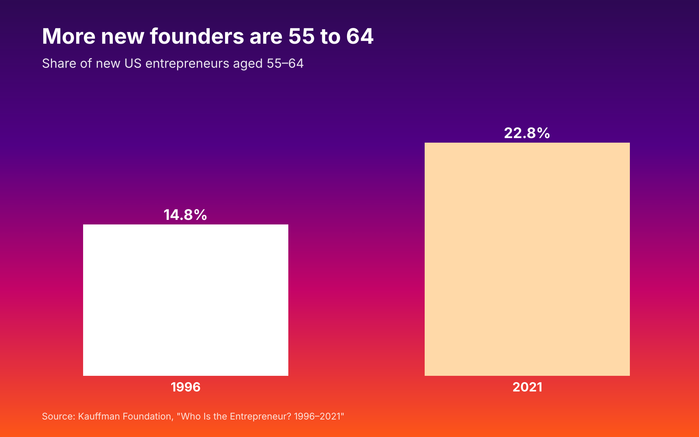
The Kauffman Foundation tracks who starts new businesses in the US. In 1996, people aged 55 to 64 made up 14.8% of new entrepreneurs. By 2021, it was 22.8%.

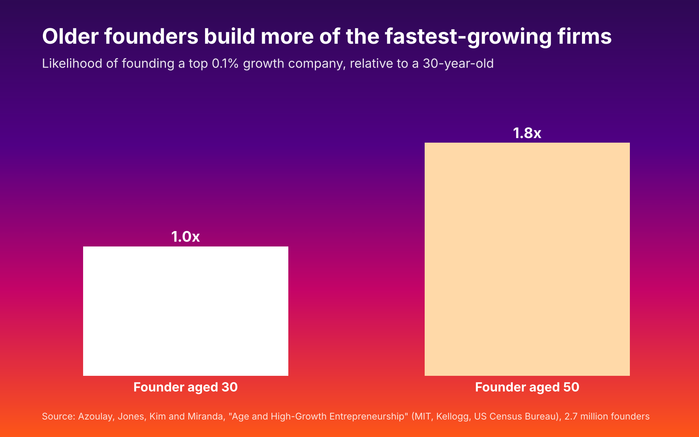
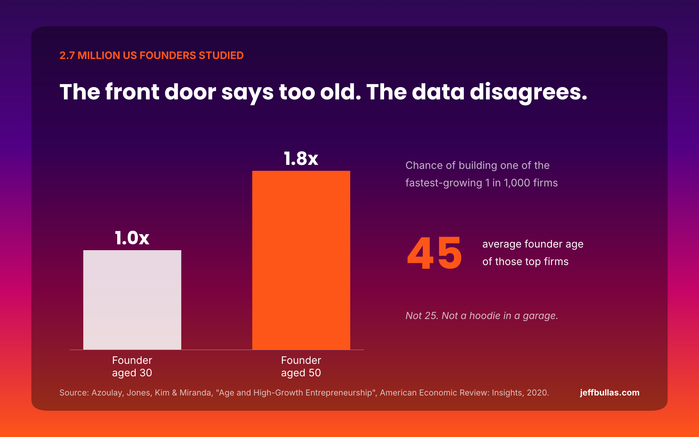
A study of 2.7 million US founders, by researchers from MIT, the Kellogg School of Management and the US Census Bureau, found that the average founder of the fastest-growing new companies was 45 when they started. A 50-year-old founder was 1.8 times more likely to build one of those companies than a 30-year-old.

The picture of the 25-year-old founder in a hoodie is a story, not a fact. Experience counts.

The script that says stop

So why does it feel so hard to start again after 50? Because most of us were handed a script early. Work. Stop. Rest. Get the job, climb the ladder, retire at 65 and fade out quietly.

That script was written for shorter lives and safer jobs. Both are going. And when you try to step off it, the world often pushes back.

In 2009 my business collapsed and my marriage ended in the same year. I was 51. I applied for about 700 jobs, and the word I heard again and again was “overqualified”. For a lot of people over 50, that word really means “too old”.

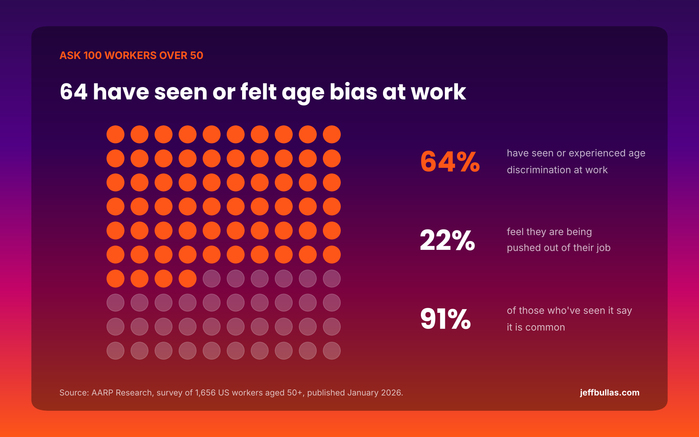
I wasn’t alone then, and people aren’t alone now. In AARP’s 2026 survey, 64% of US workers aged 50 and over said they had seen or experienced age discrimination at work. Researchers at Boston College have also found that since ChatGPT launched, workers aged 55 and over in the jobs most exposed to AI have been leaving work at higher rates. Many of them are still looking for work, not retiring.

Then there’s the fear story. You’ve seen the headlines. AI will take your job. AI will leave you behind. If you’re over 50, the message is that the future has already moved on without you.

The fear story doesn’t match what people say

Over four months I read 3,660 replies to my posts on X, from about 2,000 people, most of them over 40. When I asked people over 50 whether AI had left them behind, only 1% said yes. Most were curious. Many were excited. I wrote about it in my AI Over 50 study.

The replies to last week’s question said the same thing. About four in ten people mentioned AI or software without being asked. They’re building apps, automating their work, making music and teaching other people over 50 how to use AI at work.

Why experience is the edge

There’s another reason people over 50 are doing well with AI, and it’s the one I find most exciting. AI is very good at producing answers. It’s poor at knowing which answer is right.

That takes judgment, and judgment takes years. If you’ve managed people, run a budget, sold to customers or raised a family, you know what good looks like. You can spot when something sounds right but isn’t. That’s the most useful AI skill there is, and you can’t learn it in an afternoon.

You can see it in the replies. One person spent 30 years writing software and now combines that experience with AI tools to build custom software for businesses. Another is building AI teaching materials for the agriculture industry, in two languages, at 72. A filmmaker who switched careers a few years ago is building AI workflows around their stop-motion and time-lapse work.

None of them threw away their experience to use AI. They put the two together. A 25-year-old can learn the tools as fast as anyone. They can’t download 30 years.

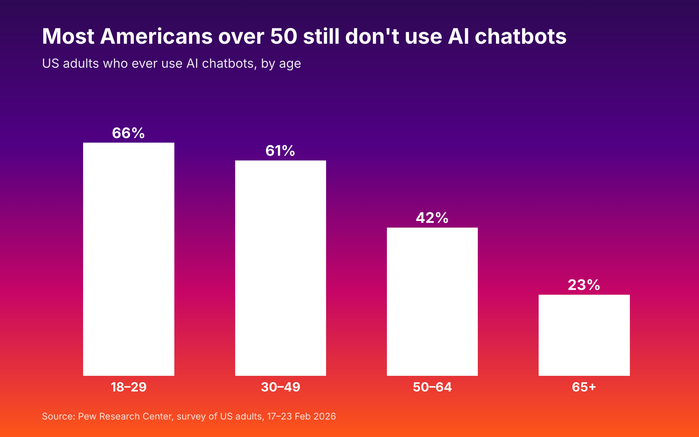
That doesn’t mean everyone is on board. In February 2026, Pew Research found that 58% of Americans aged 50 to 64, and 77% of those 65 and over, don’t use AI chatbots at all.

But here’s what struck me. The tools are no longer the hard part. They now work in plain English, and you can learn the basics in an afternoon. AARP found that 54% of adults over 50 feel confident they can learn and adapt to new technology.

The hard part is something no tool can do for you.

The 9% who are still looking

Read the replies from the people who are still looking, and you hear something different.

“57 here and trying to find something.” “Trying to start something else… have not found the right niche yet.” “Need help. I’m 61. Ex-CEO. Took some time for side projects and looking to resurface.” And the one I keep thinking about: “I’ve never in my life thought so much about my future as I do now at 60. It’s as exciting as it is scary.”

None of them said “I can’t learn AI.” They said, in different ways, “I don’t know what to do next.”

That’s the real gap. AI has made doing things almost free. You can build an app, write a book or start a newsletter in a weekend. But it hasn’t made choosing any easier. When you can do almost anything, it gets harder to decide what to do.

I know that feeling. In 2009 I had no plan. What I had was something I’d always done: explain new technology simply. I’d done it as a teacher and then selling IBM PCs. So at 52 I started a blog, writing at 4:30am before work. It went on to reach 33 million readers. I didn’t become someone new. I went back to something I’d buried.

If you’re over 50 and still looking

If you’re in that 9%, here’s what I’d suggest. None of it needs an app.

  1. Look backwards before you look forwards. Write down three times in your life when you lost track of time. What were you doing, and who were you helping? Your next chapter is often hiding in your last few.
  2. Ask what people always come to you for. The thing you think is ordinary is often what other people find hardest. Mine was explaining technology.
  3. Run a small test, not a big leap. I didn’t quit my job. I wrote before work for four years. Give yourself 30 days and one small project. Make something, and show it to someone.
  4. Use AI as a sparring partner, not a fortune teller. Tell it your story and ask it to point out patterns you can’t see. Then decide for yourself. The judgment is yours, and that’s where 30 years of experience pays off.

Why I’m building Zyrro

This is the problem I’m building Zyrro to solve. Two questions come back again and again after a long career: who am I now, and what should I do next?

Zyrro starts with 13 questions about your life and work. It reads the patterns in your answers and shows you your strengths, what gives you energy and directions that fit who you are now. Then it helps you take small steps, because a direction you never act on changes nothing.

It isn’t a personality test that puts you in a box. It’s closer to a mirror that shows you what’s already there.

We’re opening it first to the people on the waiting list. If you’re over 50 and wondering what comes next, you can join the waiting list here. It’s free, and all it asks for is your first name and email.

The second half is for starting

One simple question told me something the headlines miss. People over 50 aren’t being left behind by AI. Many of them are using it to build the things they always wanted to build.

What holds people back isn’t the technology. It’s the old script, and not knowing what to write in its place.

The 83-year-old starting life all over again didn’t ask permission. Neither did the 73-year-old roasting coffee, or the 55-year-old with the NASA contract.

So here’s my question for you. If the old script disappeared tomorrow, what would you start?

Sources

The post I Asked Nearly 100 People About Starting Again After 50. AI Wasn’t the Hard Part appeared first on jeffbullas.com.


* This article was originally published here
Start making $100+ per day this week with the best dfy system - Subscribe here!


Thursday, November 5, 2026

The Front Door Is Closed. Build a Side Door.

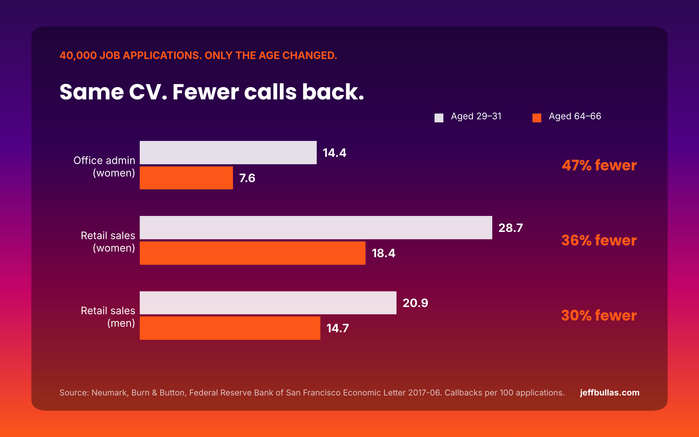
In 2015, three economists sent more than 40,000 job applications to real employers in 12 American cities. The CVs were fake and almost identical. The only thing they changed was the age.

The older applicants got far fewer calls. For office admin jobs, women aged 64 to 66 were called back 47% less often than women in their early thirties. Same skills. Same experience. Different birth year.

I didn’t need a study to tell me that. I lived it.

700 doors

At 51, my business collapsed. My marriage ended in the same season. So I did what you are supposed to do. I wrote a CV and started knocking on doors.

I sent about 700 job applications. I tailored the letters and followed up. Most never replied. The few that did were polite, brief and final.

No one ever wrote “too old.” No one had to. The silence said it for them.

I remember the quiet shame of it. I had run a business. I had sold technology through the early days of the IBM PC. I had more experience than ever, and the market acted as if it counted against me.

In March 2009, at 52, I tried something else. I started a blog with about $10 on a free WordPress site. A week later, a day job finally came through. But the real door had already opened, and it wasn’t the one I had been knocking on.

My first post was a few lines about Twitter and Jennifer Aniston. It ended with three words: “Watch this space.” I had no idea I was really writing them to myself.

The front door

Let’s be clear about the villain. It isn’t a hiring manager or a recruiter. Most of them are decent people doing a hard job with too many applications on their desk.

The villain is the front door itself. It is a system built to sort strangers fast. It reads your CV, counts your years and makes a guess. For people over 50, it keeps making the same guess.

The study I opened with was run by David Neumark, Ian Burn and Patrick Button, and published by the Federal Reserve Bank of San Francisco. They tested five sets of jobs. In every one, the oldest applicants got the fewest calls.

The study looked at lower-skilled jobs, and the gap was largest for women. But the direction never changed. Every time, the oldest CV lost.

This isn’t one old experiment either. In a survey published in January 2026, AARP asked 1,656 American workers over 50 about age bias. 64% said they had seen or experienced it at work. 22% said they felt they were being pushed out of their jobs. And of those who had seen it, 91% said it was common.

That isn’t a few bad bosses. That is a system doing what it was built to do.

A new lock on the door

Here is the part that should worry us. The front door is getting a new lock, and it is made of software.

Many large employers now use AI to score, sort and rank applicants before a person ever sees them. In 2023, a job seeker named Derek Mobley sued Workday, a company that makes these screening tools. He said he applied for more than 100 jobs at companies using its software and was rejected every time.

In May 2025, a federal judge in California allowed his age claim to go forward as a nationwide collective action for applicants aged 40 and over. Nothing has been proven yet, and Workday says the case lacks merit. But the question in that courtroom is the question of our time. What happens when an old bias is copied into a faster machine?

It stops being silence from one employer. It becomes silence at scale.

The filter doesn’t hate you

This is the sentence I wish someone had said to me at 51.

“The filter doesn’t hate you. It just counts you”.

It counts your years. It counts the gaps. It counts the keywords you forgot to use. It has no idea who you are, what you have survived or what you could build next. It was never built to know.

That changes what you should do about it. You can’t argue with a filter, and you can’t charm it. You can spend two years polishing your CV for a machine that has already decided. Or you can stop knocking on that door and find another one.

The side door

The blog was my side door. Nobody screened me. Nobody asked my age. People read what I wrote, and if it helped them, they came back.

My first big invitation didn’t come from a recruiter. It came from a reader. Jonny, who owned a golf resort in New Zealand, emailed to ask me to run a paid workshop there. The next invitation was to speak in Italy, and they flew me business class.

No CV was involved. The work was the CV.

What kept me going in those early years wasn’t confidence. It was evidence. A comment from a stranger. A reader in a country I had never visited. An email from someone who had tried what I wrote about, and it worked.

Every small reply was proof that someone could see me, even when the front door couldn’t.

Over the next decade, that blog reached 33 million readers in about 190 countries. The front door said I was finished. The side door said I was just getting started.

I’m not telling you this to boast. I’m telling you because the data says my story is less rare than it looks.

Economists Pierre Azoulay, Benjamin Jones, J. Daniel Kim and Javier Miranda studied about 2.7 million US founders. Among the fastest-growing new firms, the average founder was 45, not 25. A 50-year-old founder was about 1.8 times as likely as a 30-year-old to build one of the fastest-growing 1 in 1,000 firms.

Think about that. The same market that won’t call you back is being built, quietly, by people your age.

Experience doesn’t stop being valuable at 50. It just stops being readable at the front door.

What AI changes

This is where I part ways with the gloom.

AI is putting a stronger lock on the front door. But it is also handing out keys to the side door, to anyone who wants one.

When I started in 2009, the hardest part wasn’t the writing. It was the technology. I didn’t know how to set up WordPress, and some days I wanted to throw the computer out the window. Today that wall has gone. You can ask AI to help you build a website, shape an idea, draft a plan or turn 30 years of experience into something people can see.

I’ve watched this happen in real time. Since July I have been running an experiment on X, and with AI’s help I analysed 3,660 replies from about 2,020 people. One theme kept coming back, most of all from people over 50. In their own words, they said some version of the same thing: AI had let them back in.

Back into skills they thought they had lost. Back into ideas they had shelved for years. Back into work that felt like theirs.

Last month I posted two short lines on X: “I’m 69. I’m supposed to be thinking about retirement.” It became one of my best posts of the year, with more than 18,000 views, 358 likes and 185 replies. The replies were not really about retirement. They were about being written off, and refusing to accept it.

It isn’t only my readers. A report from LinkedIn and AARP found that over five years, the number of workers over 50 listing skills like AI on LinkedIn grew by 25%. That is nearly double the growth rate for younger workers.

The story that older people can’t keep up with technology is out of date. Many are not just keeping up. They are using it to build a way around the door that shut them out.

The hard part

I want to be honest about what a side door costs.

“Just start something” can sound easy when you are not the one paying the rent. I know it isn’t. That is why I am suggesting small steps, not a leap off a cliff.

A side door isn’t a guaranteed paycheck. My blog paid nothing for a long time. I wrote at 4:30am, five days a week, with hardly any readers and no proof it would work. Most side doors look like dead ends for the first year.

And not everyone can wait. If you need income next month, keep applying. Knock on the front door, and push back on age bias where you find it.

Just don’t make the front door your only door. That is the trap. It hands a system that was never built to see you the final word on what you are worth.

Three ways to start your side door

  1. Make one thing people can see. Not a CV, but a piece of work. Write about a problem you have solved fifty times. Record a short video. Build a simple tool with AI. A CV tells people what you did. Visible work shows them what you can do.
  2. Use AI to build, not just to apply. Most people over 50 use AI to polish job applications for the filter. Flip that. Use it to help you make the thing itself: the website, the first draft, the plan. Let it handle the technology that used to stop you.
  3. Share it where people gather. Post it. Send it to ten people who would care. Reply to people in your field with something useful. Each small act opens a door that no filter controls.

You don’t need 700 doors. You need one that answers.

The question

At 51, I thought the front door was the only door. I knocked 700 times and blamed myself for the silence.

At 69, I see it differently. The silence wasn’t a verdict on me. It was a system doing what it was built to do: counting instead of seeing.

The front door may stay shut. That doesn’t end your story. It may be where the next chapter starts.

So here is my question for you. If no one were checking your age, what would you build?

P.S. Not sure what your side door is?

That is the question I built Zyrro to help answer. You answer 13 open questions about your life and work. Zyrro reads the patterns in your story: what energises you, what drains you and the themes that keep coming back. Then it helps you choose a path and take small steps in the real world.

Zyrro is opening soon to a small group of early testers. If you would like to be one of them, join the waiting list at zyrro.ai.

Sources

  1. Neumark, Burn & Button, “Age Discrimination and Hiring of Older Workers”, FRBSF Economic Letter 2017-06
  2. AARP Research, age bias survey of workers 50+, January 2026
  3. Holland & Knight, “Federal Court Allows Collective Action Lawsuit Over Alleged AI Hiring Bias” (Mobley v. Workday), May 2025
  4. Azoulay, Jones, Kim & Miranda, “Age and High-Growth Entrepreneurship”, NBER Working Paper 24489 / AER: Insights 2020

The post The Front Door Is Closed. Build a Side Door. appeared first on jeffbullas.com.


* This article was originally published here
Start making $100+ per day this week with the best dfy system - Subscribe here!


How I Went From 361 to 152,247 Daily Views Without Building a Bigger Audience

In the first six months of 2026, about 560,000 new apps landed on Apple’s App Store. Most were built with AI. That’s nearly as many as in al...