There is a number that the smartest money in the world and the venture capitalists keep ignoring.
The number is 45.
That is the average age of the founder behind the fastest-growing companies in the country. Not 25. Not 30. Forty-five.
Now think about who the whole system is built to serve. Walk through any startup accelerator. Look at the faces on the magazine covers. Sit in on a pitch night.
Almost everyone in the room is chasing the 25-year-old founder.
There is a gap between what is true and what gets funded. That gap has a price. And someone is paying it.
The machine that worships youth
There is a machine inside technology. You cannot see it, but you can feel its pull the moment you try to raise money after a certain age.
It is built from three parts. The venture money that wants a young founder who will work through the night for a decade and not ask for a life. The tech press that loves a dropout in a dorm room far more than a builder in his fifties. The accelerator model that treats being under thirty as if it were a skill on a résumé.
Put those three together and you get one message. Loud. Repeated. Never questioned.
Young is the future. Old is the past.
The machine never says this out loud. It just funds one kind of person and quietly passes over the other. The silence does the talking.
And the strange thing about a machine is that it never stops to ask whether it is right.
What they asked me in 1985
Let me take you back, because I have seen this doubt before.
In the mid-1980s I sold personal computers. IBM machines. Beige boxes that cost more than a small car.
I would sit across a desk from someone and explain why they might want one in their home. And almost every time, they asked me the same honest question.
“What would I do with a computer at home?”
They were not slow. They just could not see it yet. The future had already walked into the room. It was only wearing a disguise.
The objections never changed. Too dear. Too hard. Nobody I know has one. What is wrong with the way we do it now?
I would hear those same four lines again when the internet arrived. And again with social media. I am hearing them right now with AI.
The doubt never changes. Only the machine it is aimed at changes.
I did not know it at the time, but I was being trained. Not in selling. In watching.
I watched the personal computer change the desk. I watched the internet change the shop. I watched social media change the crowd. And now I am watching AI change the mind.
Four revolutions. One front-row seat.
You do not forget a pattern like that. It gets into your bones. And that is not a handicap to carry into a new venture. It is a library to build one from.
That question — who we become as the machines rise — is the one my next company is built around. It is called Zyrro, and the early list is open.
But stay with me. The story comes first.
Then two researchers decided to check
For years, all of this was just a feeling. The young get the money. The experienced get passed over. Nobody had the hard proof.
Then two researchers went and got it.
Pierre Azoulay from MIT. Benjamin Jones from Kellogg. Working with J. Daniel Kim and Javier Miranda from the U.S. Census Bureau.
They did not run a survey or ask a room full of founders to guess their own odds. Surveys flatter the people who answer them.
Instead they opened the United States Census records and studied 2.7 million company founders. Real people. Real companies. Real growth, measured over years.
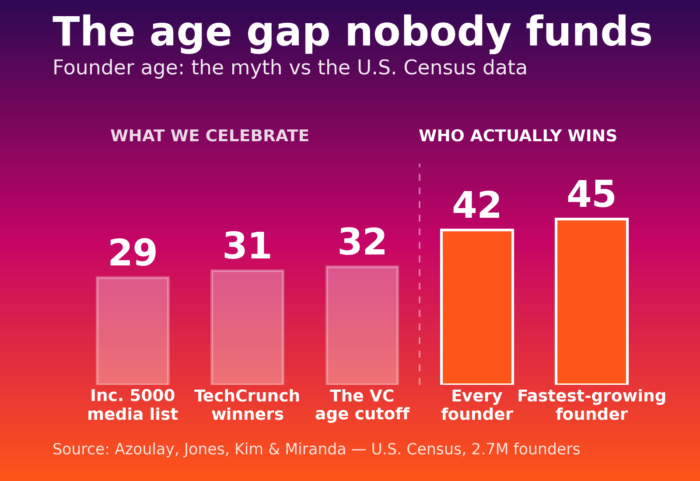
And the number that came back was 45. The founders behind the fastest-growing new companies were middle-aged.
Meanwhile the media was telling the opposite story. The founders on the Inc. 5000 list averaged 29. The TechCrunch award winners averaged 31. One famous investor said the cutoff in his head was 32. After that, he grew skeptical.
Look at the gap between what we celebrate and who actually wins.
They did not stop at the average. They looked at the very top, the rarest and fastest winners of all. The pattern did not break. It grew stronger.
They even looked inside technology, the one field that swears youth is king. Same answer. The successful tech founder is not a kid. He is a grown-up who has already been somewhere.
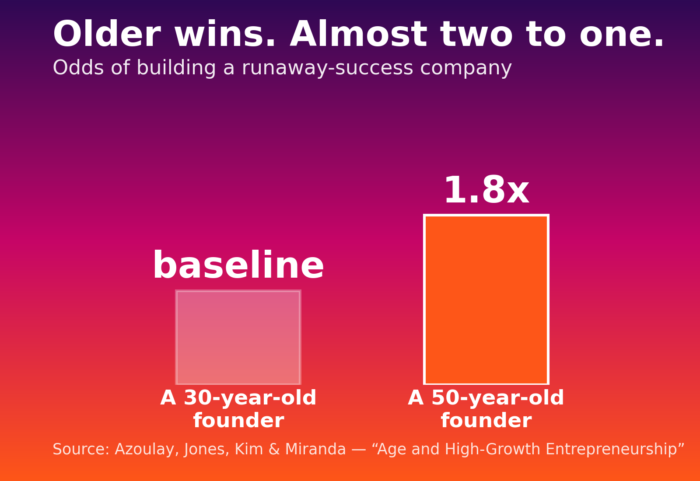
And then the finding got sharper. A 50-year-old founder is 1.8 times more likely to build a runaway success than a 30-year-old.
Read that line again. The older founder is not hanging on. The older founder is pulling ahead. Almost two to one.
Put a face on the number
A number is easy to argue with. A face is harder. So let me give you two of them.
A man goes broke at 65. A new highway has just bypassed the little roadside diner he ran for years, and the customers are gone. All he has left is a pressure cooker, a chicken recipe, and a small Social Security cheque.
He climbs into his car and starts driving from town to town, cooking his chicken for anyone who will taste it. He is turned away again and again. Hundreds of times, the story goes, before one person finally says yes.
His name was Harland Sanders. The recipe became the chicken now sold in more than a hundred countries as KFC. He was past 60 when the whole thing began.
Now picture a second man. He is 48, in post-war Japan, working in a small shed in his own backyard. Food is short, and he wants to make a meal anyone could afford and cook in minutes. He works in that shed for a year until he cracks it, and calls it instant ramen.
Then, at 61, on a flight to America, he watches someone eat noodles from a paper cup, flies home, and reinvents the whole idea again. That was Cup Noodles. His name was Momofuku Ando, and his invention now feeds the world more than a hundred billion times a year.
Neither of them was too late. They were right on time. They simply had not heard that the world expected them to stop.
The part that should stop you
Now here is the part that should stop you cold, because it is the quiet cost of this whole bias.
The people funding the next decade have decided that the most valuable thing a founder can have is the one thing they have had the least time to acquire.
They are paying a premium for youth. But youth, by its nature, is the one asset that guarantees a shortage of everything else.
Less failure survived. Less timing learned. Less of the quiet knowing that only comes from being wrong a hundred times and standing back up.
The money is buying the empty shelf and calling it potential.
How smart people believed a wrong thing
So how did such clever people get it so backwards? They fell in love with a handful of stories. The dropout who built an empire from a dorm room. The kid in a hoodie who changed the world before he was old enough to rent a car.
These stories are real. They are also rare. We remember the one who made it and forget the thousands who looked exactly like him and vanished without a trace. That is not evidence. It is a highlight reel, and the machine mistook it for the whole game.
Underneath it sits an older habit that every culture used to know. We honoured the master. The blacksmith. The winemaker. The surgeon. The pilot you want in the storm is the one with grey hair and ten thousand landings. Technology is the first trade in history to fire the master and promote the apprentice.
Your years are your training data
Now let me hand you the idea that ties all of this together. It comes from the very machine that is supposed to make you obsolete.
You have heard how AI learns. It is fed data. The more it sees, the better it gets at knowing what comes next. A human being runs on the same rule. Every year you have lived is data.
Every deal that fell apart. Every boss who lied to your face. Every product that flopped in front of everyone you knew. That is your training data. The young founder is a fresh model with almost nothing to learn from yet. You have been gathering data for decades.
Experience is not a handicap. It is the training data.
The clearest shape it takes is pattern recognition. You have seen this movie before, so you do not panic when everyone around you does. Let me show you one pattern I know in my bones, because I paid for it.
Years ago I built a huge audience on Facebook. Hundreds of thousands of people. The reach was free and it felt endless, so I thought I owned that ground.
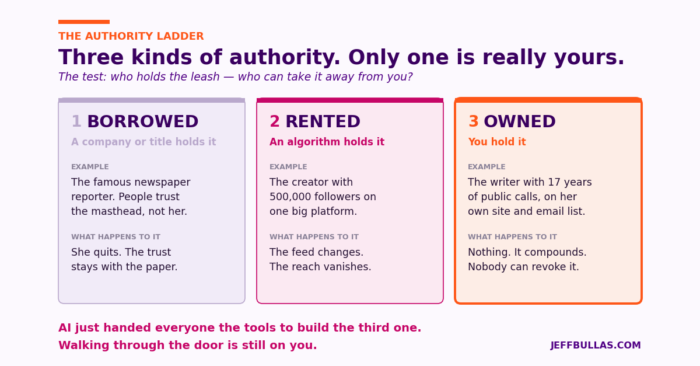
Then, after the company went public in 2012, the free reach quietly disappeared. A post that once reached a hundred thousand people now reached a few hundred. The rules had changed overnight, and there was nothing I could do about it.
The land I had built my house on had been rented all along. I just did not know it until the rent came due.
So now, when a new platform arrives promising free reach, I feel the pattern before I feel the excitement. A young founder meets that trap for the first time. I met it more than a decade ago, and it cost me.
That kind of knowing sits on no résumé. It does not fit on a hoodie. But it is worth more than most of what does.
And then AI changed the math
Here is where the story turns, and it turns in your favour.
Remember, that Census study was finished in 2018, back when the founders were counting on a world that AI had not yet touched. It measured a time before the machines could build. Now they can. And that quietly rewrites the whole contest.
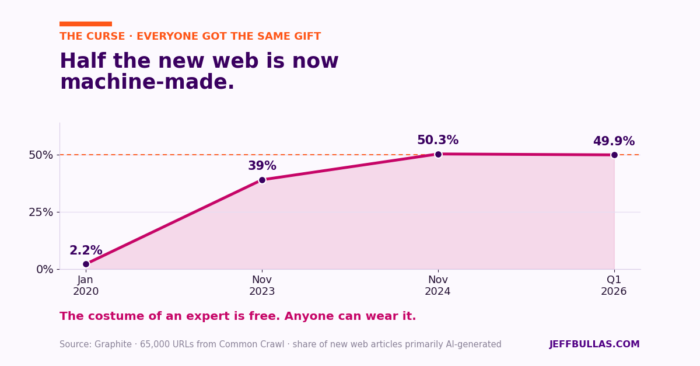
AI writes the code. It builds in a weekend what used to take a team a year. It answers the hard technical question in seconds.
Think about what that does to the young founder, because for years he had three real weapons.
Speed. Raw technical skill. A shorter road to market.
AI just handed all three to everyone. For free.
Speed is free now, because the machine never sleeps. The code is free now, because you describe it and it appears. The head start is free now, because everyone begins at the same line.
The young founder’s moat did not shrink. It drained. And that forces the real question.
When the building is free, what is left? What cannot be downloaded?
The things the machine cannot hold
The machine can build anything. It still cannot tell you what is worth building. That is taste, and taste is slow. It is made from a thousand times you got it wrong and finally learned why.
The machine has read every story ever written. It has never lived one.
AI has no scars. It never lost the company it loved. It never had the deal die the night before it closed. It never sat alone in the quiet after a room full of people said no.
You have. And that is not damage you carry. That is data the machine will never own. The old Greek playwrights had a phrase for it: wisdom comes through suffering. You do not read your way to it. You live your way to it.
Let me tell you something I used to envy, because it makes this real.
My brother remembers everything. Tell him a story from forty years ago and he plays it back like an elephant, every detail in its place. My partner can name the artist the moment a song begins, and tell you the shop where she bought a dress on the far side of the world.
For most of my life I wished I had that memory. It felt like the gift I had been born without.
Then AI arrived and handed that gift to everyone. Perfect recall. Every fact, every date, every quote, on demand. The very thing I envied is now free for all of us.
And here is what I finally understood. Memory was never the prize.
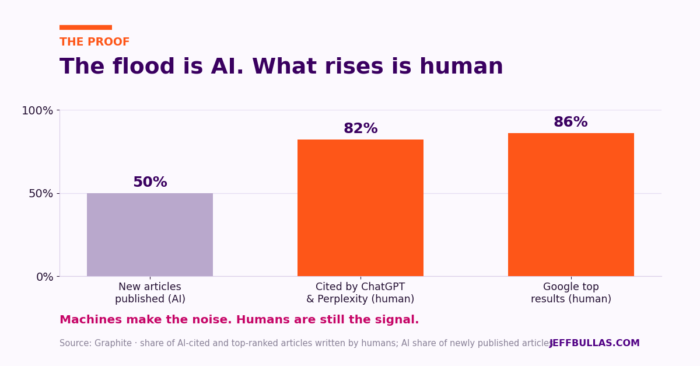
AI holds every fact in the world. It cannot hold a life. It has the information. You have the wisdom. Those are not the same thing.
The Greeks had a word for the difference. Aristotle called it phronesis, or practical wisdom. He said a young person could master geometry and be brilliant with numbers, yet could not be wise, because wisdom comes only from living through things. It cannot be taught. It has to be earned, slowly, by a life.
That was true 2,300 years ago. It is just as true now. Only time makes wisdom, and time will not be hurried.
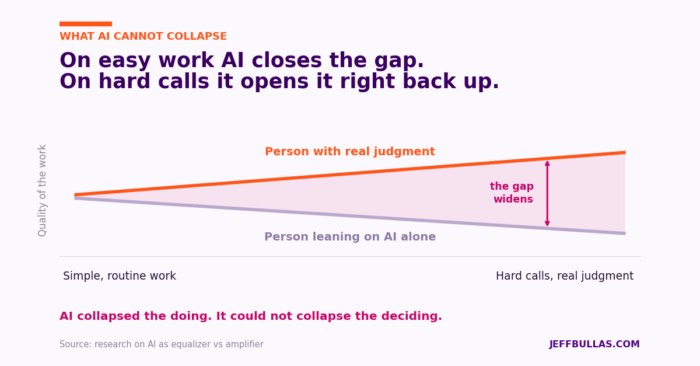
The young founder has speed and no scars. The machine has knowledge and no story. You have both. And now the machine does, in seconds, the heavy technical lifting the young founder once did faster than you.
The one edge the young had is gone. The one edge you have cannot be copied.
Being older in what looks like a young person’s game used to be a disadvantage. The machine just erased that disadvantage.
This is the ground Zyrro is built on.
The taste, the wisdom and the story only you carry. You can step onto the waitlist if it speaks to you.
The founder who has already died once
There is one more thing the data can count but cannot explain. Why does the middle-aged founder win?
It is not only the industry knowledge. It is not only the network. It is that the 45-year-old is rarely on their first life.
They have already been someone else. A different job. A different city. A different belief about who they were and what they were for. And at some point, they outgrew it.
The old self got too small. So they let it go, and they built a new one. That is the muscle no accelerator can teach. Reinvention.
The young founder has never had to do it. They have only ever been one person. The older founder has already stood at the edge of a life that no longer fit, and jumped. Once you have made that leap, you stop fearing it, because you have made it before.
Heraclitus said it 2,500 years ago. You cannot step into the same river twice, because it is not the same river, and you are not the same person. We were built to keep becoming. The container was always meant to be outgrown.
I know this one from the inside. I started my blog at 52, rising at 4:30 in the morning for five years. People thought that was late. I am building an AI company now, on the far side of that again.
Each time, the same thing was true. The old container had grown too small. The world inside me had become bigger than the world around me. So I climbed out, into a bigger one.
That is not a story about age. It is a story about an identity that refuses to sit still. And it is exactly the thing the money keeps refusing to buy.
The young pay too
And here is the cruelty the machine hides. It does not only fail the experienced. It crushes the young as well. It tells a 24-year-old that if he has not built an empire by 30 he has already failed. It hands him money and a countdown in the same breath.
The young founder is not the villain here. He is a victim of the same story. The villain is the story itself, the one that says your worth has an expiry date. Nobody wins under it. Not the old. Not the young. Only the story wins.
To the person who thinks the door has closed
Now I want to talk to one person. Maybe it is you.
You are past 40. Maybe past 50. Maybe past 60. And somewhere along the way, a quiet voice told you your window had closed. That the game belongs to the young now. That your best chapter is already behind you.
That voice is a container. A machine built it, a machine that profits from your silence. And the container is too small.
Joseph Campbell, who spent his life studying the great myths, had a name for this exact moment. He called it the refusal of the call.
The adventure knocks at your door. And something in you whispers: not me, not now, too late, too old, too settled. In every myth, the whole story turns on what the hero does next.
Every year you spent believing you were falling behind, you were quietly filling the shelf. Loading the data. Learning the patterns the young founder has not even met. You were not running out of time. You were becoming the one thing the money is too blind to price.
The walls you feel are not the edge of what is possible. They are only the edge of what you were told.
The verdict
The machine got the math backwards. It priced the empty shelf, ignored the full one, and left the winning bet on the table. Then it called that caution.
The evidence is in now. 2.7 million founders. Average age 45. The experienced founder winning almost two to one. Youth was never the qualification.
The qualification is everything youth has not had time to earn. And the deepest thing on that list is the one the data can only hint at: the proven power to become someone new.
AI can collapse the time to build. It cannot collapse the time to become.
If you have been waiting for permission, this is not permission. Permission is for children. This is the evidence. Do with it what you want.
The world is still building for 25. You already have what 25 does not.
Climb out. There is a bigger container waiting.
So….start.
If this is the question you are living too, it is the one Zyrro was built for. The early list is open here.
Sources
- Azoulay, Jones, Kim & Miranda — “Age and High-Growth Entrepreneurship,” NBER Working Paper 24489
- Harvard Business Review — “The Average Age of a Successful Startup Founder Is 45”
- Kellogg Insight — “How Old Are Successful Tech Entrepreneurs?”
- American Economic Review: Insights — “Age and High-Growth Entrepreneurship”
The post AI Erased the Young Founder’s Biggest Advantage appeared first on jeffbullas.com.
* This article was originally published here