💡 Start Your Online Business Today

🚀 Ready to Build Your Online Business?
👉 Start Here with This FREE Guide!

Tuesday, November 16, 2021

How to Start a Side Gig the Right Way in 2022

How to Start a Side Gig the Right Way in 2022

Are you looking to start a side gig this year?

Well, you’re not alone…

Earning a side income is a hot trend at the moment with almost 60% of Americans planning to get in on the action.

And I’m not surprised. I started my own side gig over 10 years ago and it was the best decision of my life.

It started as a creative outlet. Then I met some cool people and traveled the world. And yes, I stabilized my income and captured the freedom I was craving.

None of which would’ve been possible if I never started. So take the leap, you won’t regret it.

Over those ten years, I’ve learned a whole lot about myself and a range of new and interesting topics that I never imagined possible.

All-in-all, starting a side gig helped me find my passion and spend every day doing something I love.

But how do you find something you’re passionate about? What side gigs can you start in 2022?

Here are some ideas.

Get your own .ONLINE domain at 90% OFF, today!

One new domain extension that checks all the boxes is .ONLINE. It's the domain name for anything that's online and could be the perfect addition to your marketing efforts.

Click here to claim your own .ONLINE domain today!
90% OFF for the 1st year
Promo code: JEFF

5 Side Gig Ideas for 2022

There are numerous ways you can sink your teeth into a side gig in 2022.

#1. Teach courses

Rather than coming up with something completely new, why not use the skills you already have to teach others?

The great thing about teaching courses is that once you’ve created a course it can earn you side income for months or years into the future.

It’s also super-easy to start a course-based side gig with sites such as Udemy designed specifically for this purpose.

Udemy

#2. Take on freelance work

Another easy way to start a side gig is to work as a freelancer. Much like teaching courses, working as a freelancer allows you to use your current skills to make additional income without launching an entirely new business.

With freelance marketplaces, such as Fiverr, you can start an account and begin selling your skills in minutes. A gig is purchased every 4 seconds on Fiverr, with freelancers and experts making anywhere from $5 to $15,000+ per project. You can make money on Fiverr with just about ANY skillset – from graphic design to legal and finance consulting, there’s a business that needs your skills.

Fiverr

#3. Promote products as an affiliate

Affiliate marketing is a proven way of making a side income online. The concept is fairly simple, you promote someone else’s product or service and earn a commission for any sales you refer.

Being successful at affiliate marketing is a little more time-intensive than selling courses or completing freelance work – in the beginning at least. Before you can earn affiliate commissions you need to build an audience and gain their trust, so they respect your recommendations.

At the core of affiliate marketing is great content. Be that on social media, a blog, a YouTube channel, or some other targeted form of audience development.

Once you have the audience, you can find businesses to promote by using affiliate networks, such as Impact.

Impact

#4. Sell physical products

If you’ve really got the itch to start something entrepreneurial you may want to sell physical products. Of course, launching an eCommerce business will take a bit more nous and gruntwork than the other side gigs I’ve mentioned above.

For starters, you’ll likely need a bit of capital to purchase stock, advertise your products, and build a customer base. You’ll also need to determine where you will sell your products. On a website? On eBay? Etsy? Amazon? All are worthy options but have a cost and learning curve that is unique.

Alternatively, you can start a dropshipping business – which has the lowest barrier to entry. The way dropshipping works is that you sell the products of other brands on your website and when a customer places an order the brand handles shipment for you. It sounds good in theory but comes with a range of complications in terms of quality control, shipping times, and customer returns.

If you want to start a dropshipping business, check out Modalyst for finding products.

Modalyst

#5. Buy an online business

If you like the idea of affiliate marketing or running an eCommerce business but don’t want to invest the time into growing it from scratch, you could buy an already established brand. Of course, this requires capital!

Flippa is an online marketplace where you can buy and sell online businesses. It gives you a data-backed analysis of the business for sale and lets you make an educated decision about which one is right for you.

Flippa

You could even use a marketplace such as this to “flip” your own websites, apps, or eCommerce businesses as they grow.

5 Tips to Brand Your Side Gig the Right Way

Choosing a type of side gig to start is one thing, but preparing for launch is a challenge in itself. Many new side hustlers underestimate how important branding is – even if you are just a freelancer. Your brand identity is what makes you memorable or easily forgotten – which one do you want?

Here are some important things to consider when branding your side gig:

  • Choose a name and design a logo – Your brand name, colors, and logo all need to be in sync so that they leave an impression on prospective customers. Simplicity is important when choosing these elements of your business.
  • Build a website – Even as a freelancer you need a website. Your website acts as a central place for people to find out about you and your side gig. It may be a portfolio, a store, or even just a bio page.
  • Get a branded domain name – A short, unique, and memorable domain name adds value to your brand. My choice is .ONLINE because it’s refreshing and many of the best domain names are still available.
Wouldnt- A-Cookie-Taste
  • Establish a social media presence – As well as a website, your side gig should have a social media presence. Social media is where people hang out online and by being present, it adds a layer of credibility to your brand. Another reason I choose .ONLINE for my domain is it works as a link shortener on social media, too. This significantly increases brand recall and builds trust. Here’s how it looks in one of my Tweets:
Jeff-Bullas
  • Reach out to your network – Once you’ve got a name, logo, website, and social media presence, kickstart your side hustle by reaching out to your network and proliferating the message or asking for referrals. Don’t be shy – your biggest advocates will be those closest to you at the beginning, so take a leap of faith.

Wrapping up

The gig economy is going from strength to strength. There have never been more opportunities to start a side hustle than there is today. From freelance businesses to fully-fledged eCommerce stores, people all over the world are looking for ways to supplement their income and achieve their life goals.

When will you get started? What’s holding you back?

Get your own .ONLINE domain at 90% OFF, today!

One new domain extension that checks all the boxes is .ONLINE. It's the domain name for anything that's online and could be the perfect addition to your marketing efforts.

Click here to claim your own .ONLINE domain today!
90% OFF for the 1st year
Promo code: JEFF

The post How to Start a Side Gig the Right Way in 2022 appeared first on Jeffbullas's Blog.


* This article was originally published here

Start making $100+ per day this week with the best dfy system - Subscribe here!


Monday, November 15, 2021

How to Handle Crisis Communication in Your Business

How to Handle Crisis Communication in Your Business

In 2019 something strange happened to the world. The Covid 19 virus struck. While much of the virus dynamics and its aftermath will go down in the annals of history, what will also be important is how we went about living with the new work (and world) order created by Covid. 

The new world order challenged several businesses. Travel, hospitality, and retail businesses that depended on human contact felt the punch almost immediately. That said, these were the companies that probably understood the impact of the crisis early on. These were the companies that realized it was imperative to communicate openly and transparently with customers and stakeholders to ensure that everyone involved was taken into confidence. For instance, global eCommerce companies announced a depleted staff presence to communicate a possible delay in service. 

The pandemic forced companies to relook at their workplace policies. But this relook was not restricted to just working but also to ensure that a work-life balance was maintained. Communication executives were on overdrive disseminating messages of well-being at regular intervals to their internal and external publics. 

Image 1

Most of these messages were directed to customers, stakeholders, and government organizations. With Covid being the central theme, the communication pattern changed from the plain HR messaging to a more sensitive and sophisticated form of communication acknowledging the Work From Home (WFH) effort. So much so that companies went ahead to thank family members for their contribution.  

Not that WFM as a concept did not exist before the pandemic, but WFM professionals were in the majority this time around. In many cases, the senior executives of the company were also doing business from their homes. Hence this time, the messages were more inclusive, or let’s say, empathetic. 

The question remains, did it require a pandemic for organizations to display such collective empathy? 

The answer to that question lies in the DNA of organizational behavior, wherein employee communication is usually an executive order or a harbinger of some unsavory news. In times of crisis, there are a couple of factors that determine the quality of information. One, of course, is the clarity of information that people seek – second, allaying their fears about insecurities arising from the crisis. These insecurities come in many shapes and sizes, but the chief among them revolves around job security. 

Image 4

Centralization and clarity of communication 

Most communication during the pandemic focused on giving clarity around the business. Companies identified their key audiences to precision and communicated in the medium where they were most likely to be found. Key audiences can be a handful if one goes deep. For example, they could be employees, stakeholders, customers, suppliers, government, academia, and media. 

Broad communication framework

Identify your target audience 

Ideally, the communication strategy must address the needs of all these constituents. Any weak link here could mean a misfire that can breed inconsistency and have unfavorable brand and reputation consequences. The idea is to keep communication flowing from a trustworthy hub (ideally, a cross-functional communication hub) rather than a parallel organizational entity without any locus standi. 

While it’s essential to be cautious about business disclosure for statutory reasons, companies need to be transparent as a lack of information at the right time may erode brand equity and open the business to unnecessary speculation. 

Sidebar: The funny part is the regulators did not mandate anything from listed corporates about sharing business information. So, in the end, it was left to speculation whether it was business as usual or it was slow.  

Be transparent 

If we look at behavioural science, a crisis usually prompts an exponential desire, from the prospect, for openness while invoking the exact opposite reaction from the entity, disseminating the information. 

Although many organizations did not use a framework, they stuck to the traditional route keeping their communication channels open with the sole objective to lower anxiety and rumours. 

Choose the right medium

Social media became the platform of choice for many companies to talk about their Covid policies. Not surprisingly, LinkedIn became the medium where companies announced their Covid policies. FB, Twitter saw much fewer employee communication announcements. 

If we were to look at the content in many of these communication pieces, most of them were top-down with a regular cadence. 

Leaders at the helm made those statements giving a sense of authenticity to the communication. Company spokespersons were used, but they were adjuncts to the CEO, reassuring the stakeholders and customers that all is well. 

Include customer touchpoints

Image 3

While the pandemic was ravaging most businesses, companies were looking beyond quarters. For example, companies like Google took a long-term view of their workforce policies and allowed their staff to work from home for an extended period. Another seemingly benign-looking crisis, that of mental health, and well-being, also raised its head during the intensity of the pandemic. In both these cases, companies that got this (communication) right brought up the issues of employee well-being and health during the WFH. And, these were addressed by leaders themselves, which made it inclusive. 

If employees were on one side of the spectrum, customers were at the other end. And, for both, the information needs were different. Ideally, a customer communication checklist should include customer touchpoints and messages disseminated at these touchpoints and when the next update is expected. For instance, a bank customer would like to know the working hours of the bank, complaint process, time and date of the next update, etc. It’s essential that these messages are developed centrally and cascaded downwards (via a robust workflow) to the line managers for implementation. 

Reassure your audience

Probably the one thing that exemplifies empathy in both customers and internal audiences is reassurances. Messaging with a degree of reassurance is a consolation. It does more good than any other messaging that you may have. Reassurance is not a commitment but a forward-looking statement that stems out of transparency, vision, and purpose. 

They say one should seek opportunity in adversity. Covid taught us that. Some companies changed their way of working while some transformed. But one thing remains unchanged… 80% of business is still communication. 

Guest author: Trishna Patnaik, a BSc (in Life Sciences) and MBA (in Marketing) by qualification but an artist by choice. A self-taught artist based in Mumbai, Trishna has been practising art for over 14 years. After she had a professional stint in various reputed corporates, she realised that she wanted to do something more meaningful. She found her true calling in her passion that is painting. Trishna is now a full-time professional painter pursuing her passion to create and explore to the fullest. She says, “It’s a road less travelled but a journey that I look forward to every day.” Trishna also conducts painting workshops across Mumbai and other metropolitan cities of India. Trishna is an art therapist and healer. She works with clients on a one-on-one basis in Mumbai. Trishna fancies the art of creative writing and is dappling her hands in that too, to soak in the experience and have an engagement with readers, wanderers and thinkers. 

The post How to Handle Crisis Communication in Your Business appeared first on Jeffbullas's Blog.


* This article was originally published here

Start making $100+ per day this week with the best dfy system - Subscribe here!


Thursday, November 11, 2021

How to Start an Amazon FBA Business That Earns 10k+ a Month in Passive Income

How to Start an Amazon FBA Business That Earns 10k+ a Month in Passive Income

In the last ten years, the words ‘passive income’ have become extremely popular in the digital space we now live in. Everyone loves the idea of being able to generate income while they sleep, but few ever reach that point.

Earning passive income is totally possible – provided you have the right amount of determination and a good business model.

With this in mind, I’ve put together an in-depth guide to get you on the path to earning passive income in a way that’s perfect for beginners and doesn’t require a huge up-front investment like many other business models do!

BONUS: Access FREE training on The SIMPLEST Way For Beginners to Make $10k+ Every Single Month Selling Products On Amazon In 2021 & Beyond! (Exclusive to JeffBullas.com readers)

Before we dive in, I want you to do a short exercise that my mentor Jay Abraham taught me.

Take a pencil and paper if you’re at home or at your office, and draw, first of all, a diagram of a diving board – a little short vertical line with a very long horizontal board on the top.

I want you to envision that, right now, the long line represents your job and career.

If you’re just supporting that aspect of your life with one way of seeing things, or doing things, you’re compromising your ability to have so much more achievement, so much more wealth and so much more control of your life.

Now, for the next picture, (turn it over and draw on the other side if you need to) I’d like you to draw your version of the famous Greek Parthenon.

It’s that building with many, many columns supporting it. You can have seven columns. You can have eight columns. You can have ten columns. You can have all the columns you want.

Think of those columns or pillars as additional income streams, as different ways you can add value in the world.

If you’re relying on just one source of income or just one way of contributing, then your business or career looks like a diving board.

Because it’s long and only held up by one pillar, it doesn’t take much to simply knock it over.

However, if you have multiple streams of income, your business or career looks more like Greek Parthenon. And because of its design, it’s much harder to knock down, right!??

We’ve all seen businesses fail, and people losing their jobs in recent times. Today I want to talk to you about one way that you can slowly, and steadily build an additional passive income stream that will better support your livelihood by building your own version of the Greek Parthenon.

The answer?

Multiple Streams of income.

And today I want to talk about one in particular…

Amazon FBA.

I hear you asking…

What does FBA even mean?

Isn’t Amazon completely over-saturated?

(HINT: it’s definitely not!)

Is it even profitable?

And if it is, how do I get started?

My goal in this post is to explain everything above so you can get a much better understanding of what Amazon FBA actually is, and show you just how possible it is to create a seriously profitable side income stream (or replace your income completely) with this simple online business model.

Are you ready?

Great!


Let’s get started.

What is Amazon FBA?

FBA is short for Fulfillment by Amazon.

And as individual third-party sellers, it’s a great way of using Amazon’s infrastructure to sell our own branded products on the Amazon platform through something known as Private Labeling.

A private label product is manufactured by a supplier (usually in China), then sold under a brand name. You can specify everything about the product – what goes in it, how it’s packaged, what the label looks like – and pay to have it produced and shipped to you.

(The shipping part is very straightforward, especially when you ship products into one of our SuperHero Freight hubs, outside of Amazon. More on shipping later in the guide.)

The great thing about Amazon FBA is that 80% of the work is done for you, on your behalf. You don’t need to worry about packaging products, sending those products out to customers, or dealing with customer support and returns.

You don’t need:

  • A warehouse (and all those expensive overheads!)
  • A multilingual customer support team
  • Or staff to run your warehouse

Amazon provides all this for you.

So Why Amazon?

Amazon is the world’s #1 eCommerce marketplace.

Marketplace = a place you can ‘plug in’ as an individual seller to sell your own branded products.

And right now, Amazon (and e-commerce as a whole) is BOOMING — even during the pandemic…

Amazon currently averages about 300 – 600 sales a second, depending on the time of year on Amazon.

MIND-BLOWING!

There are approximately 350,000,000 different products for sale on Amazon as well. It’s inevitable that these numbers will only continue to grow and demand will rise with it!

Basically, hundreds of millions of people use and trust Amazon. 

They aren’t skeptical and you won’t need to convince them to purchase from Amazon.

People go to Amazon to BUY products

And what’s more is that YOU get to leverage their name and brand, making it WAY easier than selling anywhere else.

Amazon is essentially a search engine, which allows you to get organic traffic and sales by knowing how to rank your product in search.  They also have an advertising platform that helps you attract additional customers to your Amazon listing.

The benefits to selling on Amazon literally are endless…. and you don’t have to do much compared to any other business out there. And once you have a product selling on Amazon and consistently making sales for you, there isn’t much required to keep it going.

We’ve got hundreds of our members inside the Marketplace SuperHeroes community generating thousands of dollars (on autopilot) with hardly any maintenance because it just remains steady and consistent.

Put simply: starting a business based on Amazon is a HUGE opportunity right now that’s available to practically anybody looking to ‘plug in’ and make a part or full-time income.

Selling In More Than One Country

At the time of writing, Amazon has 18 marketplaces worldwide, all of which allow third-party sellers like you and me to list and sell our products. And through these marketplaces, Amazon offers over 350 million products (that’s a LOT of items!)

Whether you’re based in the USA, the UK, or another country, you can easily set up and sell your products in more than one Amazon marketplace (and it’s really straightforward to do!)

That exposes you to millions of customers across the world, making it possible for you to multiply your profits with practically no extra work involved.

Gary


This ‘marketplace multiplication’ can completely transform your business.

In fact, we created a simple formula to show you its potential…

The Rule Of 5

At Marketplace SuperHeroes, whenever we are explaining how our business model works, we talk about the rule of five.

In simple terms, we’re saying that if you’re:

  • Selling 5 units per day,
  • 30 days a month,
  • In 5 different countries,
  • At an average of $5 net profit per sale…

You’re running a net profit of $18,750 per month!

Now that’s impressive!

A lot of people get excited when we talk about the rule of five, but in order to achieve it, we have to make sure our profit margin is at the right level.

So if you’re selling something for $20, your profit margin must be 30% of the sale price. That’s how much we have to be making in net profit before tax.

In other words, after all, is said and done, we must be putting 30% of the sales price back in our pocket…

Or invest it back into our business…

Wherever you want to put it!

That’s the beauty of doing this on a global scale.

Why Invest In Physical Products?

As you can see, this business model itself is built like the Parthenon, with multiple pillars of income coming from multiple products in multiple markets.

But there’s one more aspect of this that I’d like to explain, and that is why this business is VERY much like investing.

People even build this type of business as part of a retirement plan.

When we invest in physical products using our model we are typically looking for a 100% growth in the capital we spent to purchase the products. That means when we invest $3,000 for example we expect to get back $6,000 once Amazon’s selling fees have been deducted from the sales price.

Now imagine you can do this 2-4 times per year, per product. You’re not only seeing 100% ROI, you can see 200-400% returns depending on how long it takes for your product to sell out.

You’ll be hard-pressed to find these figures for ANY investment you make. 

When you can do this repeatedly and systematically, what you are really building is an investment vehicle.

Dale
Bryan-Potter
Craig

We get this question all the time
We are all about building long-term wealth. Building this type of business is definitely not a get-rich-quick scheme. Nor will it take 20 years for you to see returns. But it is something that you can absolutely do on the side to begin. In fact, we encourage our members to do this alongside their current job or business.

Khab
Mike

Before I head off, I want to draw your attention to two powerful case studies from fellow digital marketers who have built hugely successful Amazon businesses on the side.

Jesse, who owns his own digital marketing agency, has built a 7-figure Amazon business on the side.


And Alex, who is actually our head copywriter on the team has built his Amazon business on the side too, while continuing to freelance as an email copywriter, travel the world, and build his own YouTube channel!

Wrapping up

To wrap this up, I’m sure you can now see how real the idea of generating a healthy passive income really is with an Amazon FBA business. Don’t just let this sit gathering digital dust!

Of course, it will involve some upfront work, but the rewards are definitely worth it. So what are you waiting for? Start now and begin creating a new stream of passive income today.

Register here for our free training. See you there!

Guest author: Stephen Somers is CEO and co-founder of Marketplace Superheroes – an 8-figure online education and services platform that teaches people how to build a 5-7 figure business selling simple, everyday items globally on Amazon.  

The post How to Start an Amazon FBA Business That Earns 10k+ a Month in Passive Income appeared first on Jeffbullas's Blog.


* This article was originally published here

Start making $100+ per day this week with the best dfy system - Subscribe here!


Wednesday, November 10, 2021

Motivational Marketing: Can it Solve a B2B Marketer’s Biggest Problems?

Motivational Marketing: Can it Solve a B2B Marketer's Biggest Problems?

Motivational marketing is not a new concept, but it is controversial. This strategy marries classic behavioral science, psychology, and the basic needs and desires of humanity into a marketing approach that goes beyond the product or service it’s selling.

Motivational marketing goes beyond the basic features and functionalities of a product or service, addressing the intrinsic desires and self-identity of the consumer. It takes the powerful human desire for self-determination and uses it as a tool to tie a product in with the inspirations and aspirations of the consumer. Most importantly, it provides a clear image of how the product ties in with the customer’s own vision of their future and view of themselves.

In this article, we will further define what motivational marketing is, provide some examples, and discuss the benefits and criticisms of this marketing theory.

Customer demographics and buyer persona

There is a reason why tech companies have been at the forefront of marketing in the past decade. Catering to an increasingly young audience, tech companies such as Apple, Facebook, and Beats by Dr. Dre have been known to use attention-grabbing and sometimes outright bizarre marketing strategies to gain attention.

Target-Markets

Image Source

Consider the fact that according to recent surveys the average web developer working in the United States today has less than five years of working experience because they began their careers in a completely unrelated field. It’s clear that the tech industry is dominated by young professionals with different motivations and ideas than their parents. Understanding your customer demographic and what motivates them – and, as a marketer, being careful not to inject any of your own personal perceptions and ideas into that vision – is key to motivational marketing.

All marketing professionals understand the importance of being aware of your core customer demographics. In motivational marketing, however, it’s important to boil this demographic down to several key buyer personas: a certain type of person rather than a diverse group of people. This enables marketers to have a deeper understanding of the typical buyer for their product or service. It allows them to truly delve deeper into the motivation behind the purchase of their product.

Let’s say you are a company that sells gear for outdoor recreational activities. Your customer demographic on social media can be described as middle to upper-middle-class individuals from suburban locations aged 25-55 years old. To gain a deeper understanding of this customer segment, you try delving deeper into certain buyer personas. One such buyer persona is a 42-year old married professional male with children who value physical fitness. Let’s call him Harry the Hiker.

Let’s take a look at how you could use motivational marketing to inspire Harry the Hiker to choose your outdoor gear over all the different options available.

The buyer’s journey

In order to use motivational marketing to inspire Harry to choose your brand over all the others, you must have a deeper understanding of the buyer’s journey. According to marketing experts, there are three stages to a buyer’s journey that every brand needs to understand: the awareness stage, the consideration stage, and the decision stage.

The awareness stage revolves around a problem or needs the buyer has. It is the marketer’s job to help raise awareness of this problem or need in a way that draws attention to their product as a potential solution. Let’s turn our focus back to Harry the Hiker. As a married professional with children, he probably has a lot of responsibilities and experiences some long hours at the office. He’s a person who enjoys seeing the fruit of his labors and does not shy away from challenges.

Awareness-Stage

Image Source

Harry is energetic and driven, but long days at the office have him feeling a little more drained than usual. Harry feels like he is missing something in life: an outlet for his naturally energetic, upbeat personality that is not tied to work or family responsibilities. Maybe he wants to feel the thrill of accomplishment for his own sake, which is what used to motivate him in his younger years. Making Harry aware of this need is key in motivational marketing.

The next step in this buyer journey is to make Harry consider what his options are for solving this problem. In our scenario, encouraging Harry to embrace the beauty, rigor, and solace of hiking could be presented as an answer. By contrasting the wild outdoors to the restricting, stuffy confines of an office setting, Harry can be motivated to learn more about hiking options near him.

Finally, in the consideration stage, Harry is fully committed to starting hiking as a recreational activity. He is researching the gear he needs to buy and is watching videos from social media influencers active in the outdoor recreation scene. By making Harry feel like he is in control, while also inspiring him to make a decision in favor of your brand, motivational marketing utilizes a balanced approach between the product and the consumer.

Your outdoor gear company can use imagery and carefully crafted copy on your website and social media to draw attention to your online store and compel your buyer persona to embrace your product as a solution to their needs. Consider the popular outdoor clothing outfitter North Face, whose slogan is ‘Never Stop Exploring’. This simple slogan is inspirational, motivational, and catchy. It encourages even older and less physically active people to engage in outdoor activities.

It also subconsciously causes the reader to contrast the outdoor aficionado’s life with someone who has “stopped exploring,” perhaps a person who is immobile, uninterested, or uninspired by adventure. Sometimes bringing a customer’s attention to a persona that they don’t want to identify with is as powerful as doing it the other way around.

Drawbacks of motivational marketing

There are some drawbacks to motivational marketing, however. Motivational marketing must be subtle and, most of all, it must show an intense understanding of your customer demographic and their wants and needs. If you want to be effective, it can’t come off as exploitative, fear-inducing, or guilt-tripping.

McDonald made this mistake in a UK advertisement targeting one of their prime customer demographics: mothers and their children. In the advertisement, a young boy is seen asking his mother about what his father was like, who presumably died before the boy could remember. After rattling off qualities the boy could not relate to, the mother then says his father’s favorite sandwich was the Filet-O-Fish, just like the boy’s. This advertisement was widely decried as exploitative and triggered extremely negative connotations among viewers who had lost a father when they were young.

On the other side, motivational marketing can be entirely too effective, perhaps in a way that compromises a brand’s integrity. We have all seen how the cosmetics and diet companies of the 90’s encouraged young women to compare themselves unfavorably to mostly air-brushed, idealistic visions of feminine beauty. The unfortunate message there was that, although you are a lot uglier and heavier than this beautiful model, if you buy our product, you can be attractive, too!

Although this message may have translated into high sales for a little while, it also helped fuel an epidemic of depression and eating disorders. Plus, it caused these same women to have negative perceptions of these brands when they were older and wiser – and had more money to spend. Compare that to, say, the athletic wear brands today that show a more diverse group of strong, active women and you will see the problem with the former campaigns.

From these examples, it is clear that motivational marketing can be dangerous for brands and consumers. It’s not only important to use the right tools, but to use them in a way that prioritizes emotional intelligence and ethics.

Benefits of motivational marketing

Motivational marketing is the key ingredient that creates brand loyalty for many of the world’s most popular brands. It can increase a brand’s level of customer intimacy and help them create bonds with their communities that go beyond marketing. It can also give a brand purpose beyond the product they sell and a meaningful place in customer’s hearts.

Take, for example, Dawn hand soap. During the tragic BP oil spill, the company donated over twelve thousand bottles of their hand soap. They were used to help clean wildlife that had been submerged in the sticky and dangerous oil. They documented the rescue efforts in their commercials in a way that was sensitive to the tragedy yet hopeful that humans could fix it. It subtly highlighted how tough their hand soap was on grease, yet how gentle it was that it could even be used on baby birds.

Customers wanted an effective hand wash, but they also wanted to feel like they were supporting a company that was making a difference. The commercial helped raise awareness of both an international and a personal problem, presenting a solution while also inspiring feelings of charitability and brand loyalty among customers.

Conclusion

Motivational marketing is a highly effective marketing tool that utilizes classic behavioral science and psychology to urge consumers to buy your product. When employed as a subtle and emotionally-intelligent tactic, motivational marketing can help bring brands closer to their customers and facilitate a deeper understanding of their wants and needs.

Guest author: Nahla Davies is a software developer and tech writer. Before devoting her work full time to technical writing, she managed — among other intriguing things — to serve as a lead programmer at an Inc. 5,000 experiential branding organization whose clients include Samsung, Time Warner, Netflix, and Sony.

The post Motivational Marketing: Can it Solve a B2B Marketer’s Biggest Problems? appeared first on Jeffbullas's Blog.


* This article was originally published here

Start making $100+ per day this week with the best dfy system - Subscribe here!


Tuesday, November 9, 2021

9 Proven Ways to Make Business Emails More Enticing

9 Proven Ways to Make Business Emails More Enticing

Every business owner knows the indispensable value of email marketing. From promotional emails, newsletters to advertisements, the scope is endless for well-crafted emails. It’s safe to say that this trend is here to stay.

In 2019, Campaign Monitor reported an exciting finding: On average, an individual receives over 121 emails each day. And marketing/promotional emails comprise the lion’s share of them.

In the face of such stiff competition, marketing emails need to be informative, intriguing, and entertaining, all rolled into one. To find out the various ways to make your business emails more alluring, continue reading this post.

A Guide to Crafting the Best Business Emails

Everything about emails and email marketing is an art. And, just like any other art, there are various nuances to it. From nailing the subject line to focusing on the audience, a lot goes into a successful business email. See for yourself!

1. Create an Irresistible Subject Line

47 - percent

Image Source: https://6elrmjmsbs335jwbeybarrry-wpengine.netdna-ssl.com/

The subject line of your email is your opening salvo, and you need to get it right. Statistics show that by sending out emails with personalized subject lines, the consumers are 22.2% more likely to open them.

Even the length of your subject line has a vital role to play. For instance, research has shown that 6-10 words long email subject lines have the highest open rates, at 21%.

Here’s a list of the other things you can do to develop a winning email subject line:

  • Use action words to create a sense of urgency
  • Convey a powerful message
  • Prompt consumers into taking action by promoting the value

2. Make the Customer Feel Important

Often, business emails go overboard with their marketing. Look at it this way. If you only talk about your products and business in the emails, there is no room for your customer.

That’s why it is essential to place your customers at the very center of the emails.

For instance, don’t talk about how you developed the fabric for the new range of jeans that your business is launching. Instead, tell your customers how comfortable the jeans are going to be.

3. Create and Provide Value

It’s effortless. If you want consumers to open and read the email, you need to entice them with the promise of value. This is precisely what the shoe retailers TOMS did.

When customers subscribe to the TOMS mailing list, they get sent 2-5 successive emails. These emails are a part of their automated welcome email series, which include the following:

  • A vivid narration of their brand story
  • A discount coupon or code
  • Links to different sections of their website
  • A mention about the social cause that’s dear to them

In short, TOMS welcome emails are jam-packed with value and are customer-centric. And that’s what makes them wildly successful.

Even Shane Barker, a digital marketing consultant, believes that companies should not underestimate the power of welcome emails and be used to nurture strong customer relationships.

4. Check Your Email Domains

Check-You-Email-Domains

Image Source: https://lh4.googleusercontent.com/

This is important if you want your marketing emails to avoid the dreaded spam folders. Evaluate your business email domain reputation. You can use many online tools in this regard, like SenderScore.org, TrustedSource, Postmaster Tools, etc.

Alternatively, you can create an account solely meant for your business’ email marketing campaigns.

Get this: If your reputation score falls between 91-100, there’s a 92% chance that your marketing emails will land safely in the customer’s inbox.

5. Nail the Right Frequency

Nail-The-Right-Frequency

Image Source: https://cdn.snov.io/

It’s time for the million-dollar question: How often should businesses send marketing emails? Well, it entirely depends on the nature of your products and services and the preferences of your target demographics.

Monitor the consumer response to your emails for a while. Identify a frequency that works. Maybe it’s twice a month. Perhaps it’s once a week. Finally, stick to the schedule.

By doing so, you’ll generate anticipation amongst your customers, and your emails will be well-received.

6. Include Button CTAs

Here’s a fun fact: People are obsessed with pushing buttons. Also, they are a great choice if you want to encourage customers to buy from you. Thus, it would be a good idea to include button CTAs in your emails.

To make your CTAs more actionable, keep the following in mind:

  • Use action words to create a sense of urgency
  • Choose contrasting colors
  • Keep it short
  • Provide value

And, et voila, you’ll have more people opening your company’s marketing emails. 

7. Visual Appeal Matters a Lot

A lot has been said about the attention span of customers. For emails, the span is pegged at 11-15 seconds. Your email needs to do something incredible in this tiny time frame to bait the customers into reading further.

This is where your email’s visual appeal will matter a lot. It would be great to go all out. Listed below are a couple of things you can do:

  • Use interesting fonts that are easy to read
  • Throw in images, videos, animations – anything to break the text trail
  • Think long and hard about the mobile and PC layouts
  • Select a great color combination

8. Segmentation is the Key

Segmentation-Is-The-Key

Image Source: https://www.smartinsights.com/

Are the products of your business targeted at different demographics? Then, segmented email marketing is an absolute necessity.

Not only is this a tremendous data-driven marketing strategy, but it is also helpful in sending meaningful emails across your vast customer base. Eventually, as the open email rates improve, so will the conversion rates.

Segment your customers, understand their needs and send them emails accordingly.

9. Mix up Your Content

No, uniformity is not a good policy when it comes to email content. Don’t use your emails to send your customers newsletters all the time. Think differently. Given the versatility that email as a medium brings to the table, there’s a lot you can send:

  • Infographics
  • Offer-specific emails
  • Emails that tell a story

Put on your thinking hats. Rest assured, it will be a rewarding endeavor.

Wrapping Up

With sufficient planning, you can easily make your emails more enticing to customers. In addition to the nine ways mentioned above, focusing on email deliverability is also a good idea.

Even if your customers only open a few promotional emails a day, make sure that yours is one of them!

Guest Author: Shirley Stark currently working at InfoCleance as a Marketing Team Lead. She Has hands-on experience in B2B marketing and loves to write blogs, tips, reading b2b articles, Creating Business strategies, and traveling

The post 9 Proven Ways to Make Business Emails More Enticing appeared first on Jeffbullas's Blog.


* This article was originally published here

Start making $100+ per day this week with the best dfy system - Subscribe here!


Monday, November 8, 2021

How to Use Content Amplification to Reach More of Your Target Audience

How to Use Content Amplification to Reach More of Your Target Audience

You’ve written killer content on topics that are relevant to your audience. They’re SEO-optimized, engaging, and unique. But, you’re still not seeing growth in organic website traffic.

In fact, it seems like nobody is reading the content you have worked so hard to produce at all.

What gives?

You see, while great content can certainly have a positive impact on your brand for those who read it, it doesn’t, unfortunately, amplify itself. And without proper amplification, it’ll likely get lost in the void after it has been published (after all, 7.5 million blog posts are published every single day).

And content that has no visibility means low views, low engagement, and low traffic. Hardly the ROI you were looking for.

The sad fact is that even the best-written content will only get seen by a small group of people if it isn’t amplified. To illustrate this point, in a study by BuzzSumo, they found that 85% of all content gets less than 10 shares.

Less than 10.

To add to that, in a study done by Backlinko, they found that 94% of blog content gets no links at all. And most of the 6% that do, get just 1.

And finally, to really hammer the message home, according to an ahrefs study, 91% of all content gets ZERO Google traffic.

ZERO.

So, while there’s always the possibility that the next piece of content you create will catch fire and go viral, you’re betting against the house if that’s your strategy.

What’s that saying about the house and winning? You get the point.

But before you start to panic as you consider how anyone is going to see, never mind engage with your content, there is a solution.

Content amplification.

What is content amplification?

Content amplification is the act of amplifying the content you produce – be it blog posts, videos, ebooks, or other resources – via free, organic channels, like your social media accounts, your website’s blog, and your email newsletter, as well as paid channels like PPC, PR, newsletter/magazine sponsorships and content amplification/syndication platforms.

You might also think of content amplification as “content promotion” or “content distribution”.

How do I amplify my content?

In the same way, you don’t expect your business service or product to market itself, you can’t expect to hit publish and let content catch fire by itself – it won’t go far. But with the right amplification plan, you can light the spark…

So, grab a cup or a glass of whatever is most time-appropriate for when you’re reading this, and let’s get into how to properly amplify your content.

What’s stopping you?

Let’s tackle the potential elephant in the room first – the reason(s) why you’re not already amplifying content.

In our recent Content Amplification Report, we found out that the vast majority of people (85%) who completed our survey admitted they weren’t amplifying their content enough or at all.

And, of that 85%, 80% said it was due to a lack of time due to other tasks.

Other reasons included a lack of buy-in from stakeholders, a lack of budget to do it, and concern about over-promotion, but the biggest factor, by far, was a lack of time.

Content-Amflipication-Report

1. Find the time

Easier said than done, I know. But it’s essential, right? Because if the content you’re producing isn’t generating results, you may as well not bother creating it in the first place.

One of the easiest ways to find more time is to stop dedicating so much of your working week to creating more content and instead focus on amplifying the stuff you’ve already published. You’ve likely already got a library of great content – go and find it a suitable audience.

Tip – Include the amplification of your content as part of the plan from the beginning and add it to your schedule. If it’s treated as an integral part of the process and not an afterthought, it’ll get done. And the content you produce, while there might be less of it, will likely generate better results.

2. Research is key

Before you start amplifying your content, you should know where it needs to go. In fact, before you even start creating any content, you should have your amplification strategy sorted – understanding the places your content will be published may have an impact on the content itself.

So, spend some time finding out the places your target audience likes to hang out.

Is your audience drawn mainly from B2B industries? Try to find media platforms and social media platforms that cater to that audience. Perhaps your audience is made up of dog walkers? Are there Facebook groups or Subreddits that you can join and be a part of?

What if they’re mainly muscle car enthusiasts? Can you submit some content to a popular magazine and try to get published in that?

Tip – Make sure you stop short at trying to be everywhere – your content must be relevant to the audience you’re putting it in front of or you’ll get zero response. Don’t spend lots of time doing ineffectual things (which is surprisingly easy to do). Rather, find the places that work and double down on them.

Trying to amplify your content on platforms that don’t align with your target audience just adds more noise and dilutes its effectiveness.

3. Lean on your owned audiences

There’s no better ambassador for your brand or your content than your current customers and audiences. They choose you because they believe you offer value to them. And if they’re happy with the value you provide, then they’ll be more than happy to tell others about you.

So, use the trust and loyalty you’ve already earned to get your content into new places and in front of new audiences by asking your current audience to engage with and share your content.

When they do that, by liking, commenting, sharing, or forwarding, it puts your content in front of their networks. That means exposure to new audiences.

And the best part about this tactic is it’s really easy to implement. You just need to ask.

For example, if you have a list of newsletter subscribers, you can make it easy for them to forward your content or pass it on to their friends with calls to action and share buttons within the email.

Tip – The more personal you can get with your ask, the better the response will be. It will take more time to do it this way, but the results will make up for it.

4. Use considered outreach

Yes, outreach can be a powerful tool, but only if done right. Spamming people and asking them to share your content isn’t going to work, so you’ve got to be considered.

Find the right people and make sure you really personalize the email you’re going to send. Do some research on that person, the work they do, and the type of content they like to consume. If done well, the email you send will resonate far more with them and they’ll appreciate the effort, leading to a much higher chance you’ll get a reply.

Don’t ever be pushy, but do try to make sharing your content as easy as possible for them. That could mean creating a template for a tweet or LinkedIn message that they just need to tweak a little, or even giving them a few ready-made options that they could choose from.

Tip – Make sure to thank the people you email for their time and offer to return the favor too. Reciprocity is always appreciated.

5. Pay to play

Free is great. And if you can generate the results you want solely from using free amplification methods, then fantastic! However, you might find that organic reach these days isn’t what it was, and your content might need a little extra help to ensure it gets seen and engaged with.

And that’s why you should consider using paid amplification methods as well.

Content-Amflipication-Report - 2

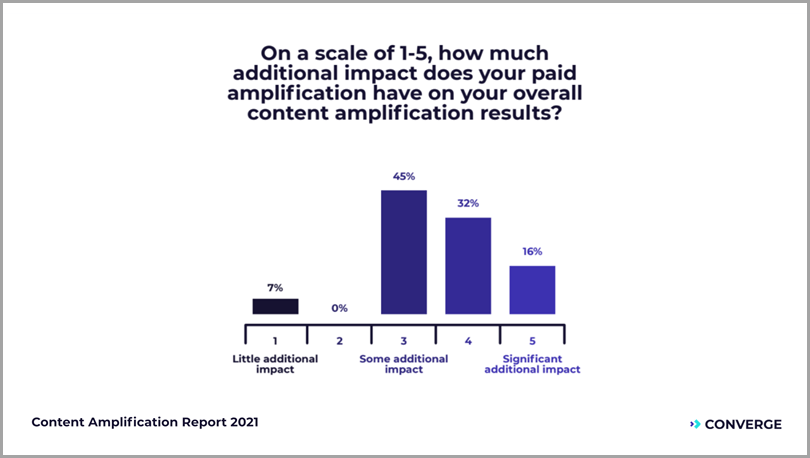
Going back to our Content Amplification Report, of those that took part in the survey only 32% had a budget for content amplification. The fact that such a small percentage of our respondents have a budget could highlight an opportunity for businesses to take advantage of – there’ll be less competition for the places you want to be seen. And paying to be seen might yield better results while competition is low.

To reinforce that point, of the 32% that do pay for amplification, 93% said that it had an additional impact on their content marketing results.

On-A-Scale

The lesson? Nearly every person that pays to amplify their content believes it has a positive impact on their overall amplification efforts. With that in mind, it might be time to allocate more budget towards this to see if it can lead to better results for your own content amplification.

But what paid methods are there? Loads…

  • Search Engine Advertising
  • Social Media Advertising
  • Newsletter sponsorship
  • Native advertising
  • Influencer advertising
  • Publishing platforms and content amplification platforms
  • Event sponsorships
  • And more…

In fact, pretty much everywhere that your audience can be found, there’ll likely be some way for you to pay to boost your exposure to them, so do some research and find out what your options are.

Tip – According to our report, of the paid channels being used, Social Media Advertising (100%) and Search Engine Advertising (53%) were the most popular. Whether these channels are so popular amongst those with budget because of their effectiveness, or because they’re the most obvious channels to use, isn’t known. However, they are likely to be the most competitive spaces for your paid amplification – so it could be worth looking for more niche channels, too.

What-Paid-For-Channels

In summary, commit

If there’s one thing to be learned from this article it’s that getting our content seen is a task that is becoming more and more difficult. Organic results are on the decline and the big boys holding all the keys aren’t going to help you unless you pay them handsomely.

So, without a proper amplification strategy, the outlook for our content is grim.

In today’s uber-competitive content landscape, we have to fight for our work to be seen, continuously. Ad-hoc, when it comes to content marketing, is never the right move, and that’s the same with content amplification. You need to be consistent and committed to the cause.

If you want more of the right people to see and engage with your content, then you’re going to have to put in the work to make sure that happens. Ensure a proper content amplification strategy is part of your future campaigns and you’ll absolutely guarantee a better ROI from all of your future content.

Guest author: James Tennant is a content marketer and copywriter of over 11 years and has worked with brands such as eBay, Universal Studios, and the UK Government. He loves to geek out over marketing reports and is endlessly curious about how businesses can get a better ROI from their content. Twitter – @JamesConverge and LinkedIn.

The post How to Use Content Amplification to Reach More of Your Target Audience appeared first on Jeffbullas's Blog.


* This article was originally published here

Start making $100+ per day this week with the best dfy system - Subscribe here!


I Had 535,000 Followers. Why Was Nobody Seeing Me?

In 2009 I cracked the code on  how to grow an audience on Twitter. Followers were everything then when the social media algorithm  was the s...