💡 Start Your Online Business Today

🚀 Ready to Build Your Online Business?
👉 Start Here with This FREE Guide!

Friday, November 4, 2022

6 Compelling Reasons to Start an Online Side Hustle

6 Compelling Reasons to Start an Online Side Hustle

Did you know that over 40% of American households have someone engaged in a side hustle to stay on top of bills? People are in survival mode and living paycheck to paycheck. Most people start a side hustle for one very important reason: Money!

Why it matters

Our high inflation, expensive, expanding and consumerist society has created a culture that leaves people always “wanting more”. And that “more” needs to be paid for. 

Sure, a side hustle can help ease the pain of excess bills, but it’s also an opportunity to change your life. A side hustle can allow you to design a life where you work without the commuting grind and the corporate slavery.

Good news, right? 

And on top of that, it’s never been easier to start an online side hustle. The digital and technology ecosystem has provided the tools to start, manage and market to the world. This wasn’t available just over a decade ago.

There are so many options to make money online; all you need is an idea, a laptop, and a good internet connection. 

Start Your Digital

Let’s dive deeper

Is a side hustle really just about the money? 

In my opinion, starting an online side hustle is about more than just the money. Let’s take a look at some other reasons you might want to start one.

  1. To achieve independence
  2. To have time and space to pursue your dreams.
  3. To escape the time suck that is commuting, so you can spend more hours with your partner and children. 
  4. To create a life of freedom that allows you to work from anywhere (by the way, the “digital nomad” is a very real and rewarding experience as I have done it and it beats working from a high-rise office block!).
  5. To do something that you’re passionate about rather than just work for the money.

Here’s another great reason why you should consider starting a side hustle. Fulfilment. To become a fulfilled creator. 

All humans were designed to create. And there is something about transforming imagination into a personal creation that is shared with a global digital tribe. 

It’s “you” revealed to the world. That is a powerful affirmation. This is not often on people’s radar. But it sits deep inside all of us.

To tease you, let’s look at the four elements that make up a perfect online side hustle: 

  1. Fulfilled creator (Happy)  
  2. Living and working in a beautiful exotic location (Beauty) 
  3. Make enough money that pays for your life (Abundance)
  4. Able to work from anywhere in the world (Freedom)

The intersection of these elements provides what I would call an optimal side hustle.

This is what a digital (or online) business can provide. And this wasn’t possible just a few years ago. But the reality is that you can design your life for happiness. You just need to start. 

Some interesting data on online side hustles

Here is what the data shows about the “growing interest in an online side hustle” as revealed by Google Trends.

Google Trends

Some of the breakout sub-trends include the following:

  • Side hustle jobs from home
  • Online jobs from home
  • Freelance

The “old” versus the “new” side hustles

Side Hustles can be put into two categories. Old and new. What do I mean by that? 

The Old Way

Let’s take a closer look at the old way. 

A side hustle taken on in the old way might look like an after-hours cleaning job, waiting on tables, or walking dogs. It requires you to show up at a physical location. It is location trapped and therefore means you trade time for money. And I don’t know about you but that sounds like hard work!

These side hustles are analog and mean we need to show up after a hard day’s work. It doesn’t scale, you need to arrive and commute. 

Same treadmill, same old habits. So….last century!

The New Way 

These side hustles are based upon an online digital world and it’s global. So what does an online side hustle look like?

The fast-changing digital world is reinventing how we work and live.

It’s transforming how we do business in plain sight. It’s overwhelming, yet we often take it for granted. In just a generation we have seen the rise of the internet, the emergence of social media and the smartphone. It’s a perfect storm. 

The digital world breaks the norms and comfort zones of how we have worked, created and shared information for centuries. It is a new way. It’s a digital business. And it is global and scalable.

What are some online side hustle opportunities?

Coming up with ideas is easy. Turning them into reality is another thing. And some are easier to start than others. 

Here is a quick cheat sheet of online side hustle businesses you could start: 

  1. A blog – This could be where you travel the world and share your stories and become something like a travel influencer.  
  2. Affiliate website – Sell other people’s products and take a commission for every sale. 
  3. Virtual assistant – You might like helping support other businesses, CEOs and founders. You look after the daily details to help them be more productive and profitable.  
  4. Online consulting – 40%+ of the world’s employees are knowledge workers and have specialist skills. This can be turned into an online consulting services business. Showing up to consult in a physical location to have a chat is now done by Zoom.    
  5. Youtube influencer – The video version of a blogger. 
  6. Sell E-books – Creating an online book and selling it on Amazon is a popular way to make money online.  
  7. Create an online course – Education is no longer restricted to a physical classroom. 

And the list goes on!

Here are some more online side hustles that you may want to explore:

The best online side hustle opportunities

There are some intriguing and tempting online business ideas out there, but that doesn’t mean they’re all worth exploring. 

The best online side hustle for you sits at the intersection of the following:

  • What you are good at.  
  • What you have some experience in. 
  • What you enjoy doing. 
  • What the world will pay you for.

Some side hustles are easier to start than others but you also need to be prepared for the long game and that will require resilience and persistence. Overnight success is very rare.

Opportunity 1: Freelancing as an online side hustle 

Freelancing is where you share and sell your expertise online on sites like Upwork, Freelancer.com or Fiverr.com. And it is one of the easiest ways to start a side hustle. 

The top 4 revenue results by sales for freelancers were the following:

  1. Illustration – $406,000+ (Design)
  2. Proofreading and editing –  $341,000+ (Writing)
  3. Animation – $309,000+ (Design)
  4. Video editor – $280,000+ (Design)

Here are the Top 10 Paying Freelancing “Side Hustles” as listed by Canva and they are all digital. 

Top 10 Ranking Of Jobs

Opportunity 2: ECommerce side hustle 

Online stores have been with us for 2-3 decades now but the platforms to build your own have never been easier or cheaper. 

You don’t have to create an online store from scratch today as platforms like Shopify and BigCommerce have a monthly subscription service that makes it as easy as possible for you to start in just a few hours.    

To add to that you can launch your own Amazon store and let them do the heavy lifting from helping you find the products, providing storage and giving you access to global shipping and fulfilment. The acronym for that is (FBA) which is code for “Fulfillment By Amazon”. 

According to Marketplace Pulse modelling:

  • The Amazon seller eCommerce distribution by sales volume estimated that there was $390 billion in collective sales 
  • Approximately 350,000 sellers exceeded $100,000
  • 60,000 sellers sold over $1 million 
  • Over 3,000 had more than $10 million in sales in 2021
Number of Amazon

Image Source

Opportunity 3: YouTuber side hustle 

Now before you start getting too excited (and salivating) this type of online business requires a certain type of personality. So you need to make sure that the side hustle you settle on is something that suits your skills, experience and personality.   

YouTube has been with us since 2005. That was only 17 years ago. And you thought it was all about cat videos and cute videos of babies. But it is now a serious business. And it is a side hustle option worth investigating.

You have a lot more chance of making money on YouTube than joining the Global Tennis circuit. 

Below is the revenue of the top 10 YouTubers:

Youtuber

Image Source

So how do they make money?

There are some key factors that determine success:

  • The number of views your video receives
  • The number of clicks an ad receives
  • Ad quality
  • Ad blockers
  • Video length

But…what do they actually do?

Taking a video of your baby or cat isn’t the answer. 

#1 MrBeast 

Jimmy Donaldson is only 22 years old and started his YouTube career in 2014. 

For 2-3 years he struggled to get any traction as he tried to crack the secrets of the algorithms for getting attention and traffic. But persistence paid off. His first video to go viral was a video showing himself counting to 100,000. That took 44 hours!   

Today his go-to strategy and tactics are about big-scale philanthropic giveaways. Designed to go viral.

#2  Markiplier

This side hustler experimented with different content creation ideas and now records and streams himself playing different types of games.

#3 Nastya (7 Years old)

She sang, danced and shared her day-to-day activities with followers, and for her parents, it was exactly what the channel was made for. 

In just one year, she amassed 107 million subscribers across seven of her channels. In 2020, Anastasia earned an estimated $25.8 million, and in 2021 – her projected income reached $39 million.

#4: Rhett and Link – The Duo

YouTube fame tends to be counted in hours, days, weeks or, possibly, months if all goes right. It doesn’t often stretch much further—into something delineated by years. 

This makes the ongoing nine-year run by comedians Rhett and Link, whose daily show, Good Mythical Morning, counts 17.1 million subscribers, surprising even to them.

Wrapping it up

Money is one big reason to start a side hustle. But there are other, deeper reasons to start a side hustle too. Many side hustlers are motivated by freedom, independence and getting their time back.

What drives you?

Start Your Digital

The post 6 Compelling Reasons to Start an Online Side Hustle appeared first on Jeffbullas's Blog.


* This article was originally published here

Start making $100+ per day this week with the best dfy system - Subscribe here!


Tuesday, November 1, 2022

Isn’t it Time Your Business Reintroduced In-Person Marketing?

As we all know, the world changed in March 2020.

In the uncertainty of the lockdowns, many traditional in-person marketing methods were not viable. Other traditional in-person marketing opportunities, like trade shows for the B2B market, went virtual.

Most brands quickly switched focus to adopt a near-all-digital approach, which made sense since people were online much more frequently. This had been the case until recently.

Today, there is optimism that the worst of the pandemic is behind us. While digital marketing is always going to play a major role, the time has come for brands to reintegrate physical marketing into their campaigns.

There are many opportunities for companies to return to their physical space, though these will depend on factors like the target audience (B2B or B2C) or industry (goods or services). In this article, we’ll explore some different in-person marketing methods.

Guerilla marketing

Guerilla marketing is something most established brands don’t typically embrace.

However, it can be very effective. Guerilla marketing is about interacting with people in a surprising or unconventional way that could lead to your brand message going viral on social media.

The beauty of it is that if your efforts go viral, you can reach thousands with little effort on your part. This type of marketing is hyper-localized but must be well-timed to surprise the targeted customer when they least expect it. Some guerilla marketing examples include colorful chalk drawings on streets or sidewalks that grab attention or projecting images on the side of buildings at night.

While guerilla marketing can be affordable, it is not without its risks. Take for example what happened to a pair of marketers in the Boston area in 2007. They were looking to build attention for the Aqua Teen Hunger Force movie by placing battery-powered LED placards throughout the city and surrounding area. Unfortunately, people mistook these lights for improvised explosive devices which caused some panic in the area and resulted in a police investigation. Tread carefully!

Sticker marketing

Stickers are highly effective marketing tools. Brands can create different types and styles to help promote their products.

Stickers can be included in purchases or handed out at trade shows. Best of all, they can be placed literally anywhere. They could be placed on the back of a street sign, sidewalk, lamp post, benches, or the bumpers of vehicles. If enough of these stickers are spread across an area, the constant exposure could result in people contacting the company as possible new leads.

Stickers are an affordable marketing tool because today’s technologies allow companies to print in various formats and styles in the quantity they require. They can be die-cut on durable, weather-resistant vinyl, come in all shapes and sizes, and can be removed without leaving a sticky residue or damaging property. However, care must be taken when plastering public areas because people can be charged with vandalism if stickers are placed on private property.

In-store or point-of-sale (POS) marketing

Businesses can build awareness of special offers, events, sales, or new or upcoming products through a creative window display, signage, stickers, posters, videos, or merchandise displays.

Point-of-sale (POS) marketing attempts to get the customer to purchase additional products or services they were not originally planning to buy. For a quick-service restaurant, it could be a side dish or dessert. A clothing retailer could suggest accessories like socks or gloves, a bookstore could push items like magazines or bookmarks, and an electronics retailer can offer gift cards or extended warranties.

POS marketing is designed to appeal to impulse buying. But even if an item isn’t purchased, the customer can engage with the brand and see messaging or a call to action to visit websites or return for upcoming sales.

Billboard ads

The first billboards appeared in the 1830s, and nearly 200 years later, they are still a very effective and popular advertising format. However, when the first lockdowns started, brands that paid for a billboard on the side of a busy road may have seen little return on that investment.

This type of marketing works best when it is constantly seen by people every day during a campaign. Billboard marketing is ripe for a return.

People can find billboards on benches, on bus shelters, and even on the bus themselves. They are a phenomenal tool to build brand awareness and help make purchasing decisions. Small businesses or major corporations can use billboards to promote products and services. Companies can buy space at one location or across a wider area, depending on the size and scope of their marketing plan.

Wrapping it up

The world is slowly returning to a life that’s closer to the pre-pandemic norm. This gives brands a chance to return to traditional marketing methods and engage people physically.

There are some advantages to this because, unlike digital marketing, there are no ad blockers or pop-up ads that block out content and annoy users. A strong physical and digital marketing strategy can pay significant dividends to businesses and brands, regardless of size or location. Best of all, it does not have to be expensive or complicated to be effective.

Guest Author: Andrew Witkin is the founder and CEO of StickerYou, a global eCommerce leader in custom-printed, die-cut products that empower consumers and businesses to create high-quality materials for personal expression, marketing, and packaging.

The post Isn’t it Time Your Business Reintroduced In-Person Marketing? appeared first on Jeffbullas's Blog.


* This article was originally published here

Start making $100+ per day this week with the best dfy system - Subscribe here!


Tuesday, October 25, 2022

The 3 Biggest Challenges for Creators Monetizing Their Brand

The creator economy has taken significant steps in recent years, both in terms of size and viability, with each year seeing more and more creators jumping into the field.

This significant momentum has resulted in an estimated 50 million people currently taking part in the multibillion-dollar creator economy market, according to a report from SignalFire.

Yet, a vast majority of those creators are only doing so part-time, and of the minority of creators who do make content full-time, many of them are unable to leverage this into an income stream that could replace their current full-time job.

Of the two million creators who make content on a full-time/professional basis, only 12% earn more than $50,000 according to research from Linktree.

This has left many questioning what is holding back those 48 million amateur content creators from attempting to transition this into a full-time career, and of the 2 million who already do so professionally, what are the major hurdles holding creators back from monetizing their brand into a livable income?

Let’s take a look at the three biggest challenges creators face when looking to monetize their brand – more specifically through the sales of merchandise, in this case – and how they can shortcut some of these hurdles with the technology available in the market today.

1. Defining your brand and identity

Defining your brand and identity

Often the biggest hurdle for many creators looking to monetize their brand is to define exactly what their brand identity is, what it represents, and how it should be represented, both in terms of design as well as the choice of product.

This requires creators to take a deeper look into who they are, what they aim to create, and what their audience wants; with the goal of finding an intersection between these three main factors that will best represent their brand in the merchandise they sell.

But luckily, as the creator, nobody has a better sense of you, your content, and your audience than you do; making you the best person to define your brand and brand identity.

With a brand identity in mind, you can begin to look for the right designs for your brand. Here are a few key outcomes that you should be aiming for.

Your merchandise and the designs on it should connect you with your audience (and vice versa), foster a sense of community among you and your audience, and spark conversation about your brand and its content.

For example, if you are looking to design a t-shirt for your brand, you should ask yourself questions like:

  • “What makes my content unique and should be represented on my merchandise?”
  • “What would I, as the creator, be proud to wear or see others wear?”
  • “What would my audience be proud to wear?”
  • “What design would inspire the most conversation around my content?”

Let’s say, for example, you are a video game streamer with a good-sized audience that you want to monetize by selling t-shirts or mugs with a custom design on them. Honing in on images and phrases associated with the games you are most known for playing, or basing a design on an inside joke you have with your audience, can be great ideas to begin monetizing your brand with merchandise.

Along with choosing the right designs to connect your brand with your audience, it is vital that you also pick the right types of products to represent your brand and display your designs on.

While most commonly creators choose to sell apparel items like t-shirts or household items like coffee mugs, aligning your brand identity with your choice of merchandise items can set you aside from your competitors.

For example, if you produce content around travel, you should be looking to sell merchandise that would be useful to travelers like travel planners, travel mugs, or document pouches.

Or, for example, if you produce content about winter sports, you should be looking to sell merchandise that aligns with that, like toques or mittens.

For any creators who do not want to sell such specific merchandise types, there are more general, time-tested merchandise options for monetization, such as stickers, which can be quickly, easily, and cheaply produced through companies like StickerYou with the custom design of your choice.

2. Leveraging data and design

Leveraging data and design

While the approach to defining your brand and its identity we have described above is an integral first step, relying solely on this strategy can be limiting, especially when there are countless streams of data that can help you to pinpoint the best designs for you, your brand, and your audience.

But how can creators who are limited on time and manpower be expected to harness the power of this data, especially without the technical or industry expertise needed to truly analyze market trends and other data trends?

This is where technology can play a huge role!

With data-driven design engines available to creators, you can leverage the oceans of data available in the market – such as global trends, search trends, consumer audience insights, and much more – as an essential step in ensuring any merchandise designs you use will resonate with the biggest trends of the day, but even more importantly, with you and your audience.

While there are numerous options, it is vital to find a data-driven design engine that is powered by the analysis of your target audience through various aspects like global trends, search trends, download transactions, and subscriber requests, with a prime example being the data-driven design engine from Vexels.

3. Finding the right tools and platforms

With your brand identity defined and the right data-driven design engine at your disposal, the time has come to turn all of that into physical merchandise to sell to your audience.

Now’s the time for you to find the right tools, platforms, or partners to manufacture your products, set up and manage an eCommerce shop, and finally, distribute your products to your consumers and handle any customer service requests.

Failing to make the right decisions in these vital areas can have serious consequences for your brand reputation and your ability to monetize your audience.

Without the right manufacturer for your products, you could be left with low-quality products that either don’t sell or leave your audience unsatisfied with the product they purchased, thus damaging your brand reputation and hindering any future attempts to monetize your business.

Without a functioning eCommerce platform, your audience will be limited in their options to purchase your products, and you will likely turn off potentially interested consumers from buying your products, with many choosing the convenience of eCommerce over any other options.

And finally, without a good distribution system in place, you will struggle to ensure all of those who bought your products have their orders fulfilled properly and in a timely fashion. Failure to deliver on purchases properly will seriously damage your brand reputation and turn off any future potential buyers.

Setting up all of this yourself, or finding the right tools, platforms, or partners to do so, can be a daunting task, especially for those who are not yet full-time creators and have limited time to dedicate to their content creation.

But these are essential steps to monetizing your brand successfully!

If you’re a creator and want to shortcut these processes with the support of industry experts and connections with the best manufacturing, eCommerce, and distribution platforms and partners, you should consider The Creator Program by Vexels as the end-to-end solution to take your brand to the next level and allow you to become the full-time, monetized creator you want to be.

Guest Author: Matias Colotuzzo is the co-founder and Chief Executive Officer of Vexels, a graphic design company focused on merch, print-on-demand, and unique designs. He is a born entrepreneur, launching his first web design company at 19. His business intelligence and interest in development propelled him to join the Uruguayan Chamber of Information Technologies (CUTI), a non-profit incubator that helps businesses and mentors entrepreneurs. He served as both a director and board member at CUTI.  

Matias has overseen the considerable growth in Vexels, which started with seven teammates in 2016 to more than 100 employees today. He is constantly looking for new ways to combine technology with daily tasks while improving the web experience.  

The post The 3 Biggest Challenges for Creators Monetizing Their Brand appeared first on Jeffbullas's Blog.


* This article was originally published here

Start making $100+ per day this week with the best dfy system - Subscribe here!


Tuesday, October 18, 2022

How to Bulletproof Your Ecommerce Website by Improving Security

Having an eCommerce store is great. It allows you to make sales, generate revenue and build your brand. 

But there’s a lot going on behind the curtains to keep this machine running smooth and especially keeping it safe from threats online.

In this article, you’ll learn some common threats that eCommerce websites are susceptible to and how to make your website bulletproof against them. 

Let’s get started.

Common threats eCommerce websites experience

Did you know more than 30% of all eCommerce websites experience hacking? Business owners can lose valuable customer data, get a virus or even worse, lose access to their accounts and website.

DDoS and Brute force attacks are common for all websites. But what are these attacks exactly? In a nutshell:

  1. DDoS attacks are jamming your website’s traffic with a stream of bots. Your servers will experience a ton of incoming traffic, not from customers but from malicious devices that want to bring your server down.
  2. Brute Force, as the name implies, is where hackers forcibly send login requests using a program. The goal is to get control of your account and shut you out from gaining access.

Let’s look at two other threats that are common with eCommerce stores.

SQL injection

We know that hackers love to steal data. SQL queries are used to access your database. By forcibly injecting a query through a form, hackers can steal database records.

SQL Injection

Image Source

Once they get what they want, they’ll disrupt your database and you will have no clue. You lose data and access to your database. Nobody wants that!

Phishing emails

If you’ve ever worked for any organization, you would have received this common security advice: never open an email or attachment from an unknown source. 

These emails contain links that lead to other sites which slow down your server’s performance and make your website bait for future attacks.

Now you get warnings from your email service provider to be cautious before opening such emails. Commonly called “phishing emails”, hackers mail your customers from your business’s name, asking them to “verify the details” to get the critical information they want, damaging your brand’s reputation in the process.

So how can improve your eCommerce website’s security?

There are a few different ways. Let’s explore them.  

1. Strengthen your vulnerable areas

Whether you have a small business or a Fortune 500 company, your website is prone to get attacked. Hackers want the data more than your website and that’s why it’s important to never lose access to your account.

This report from Wordfence shows how WordPress websites were hacked:

Strengthen Your Vulnerable Areas

Image Source

As you can see, any of these areas in your website can become the doorway for a hacker to enter.

For eCommerce stores, precious customer data is what hackers want. This includes details about customer credit cards, addresses and phone numbers. For the sake of your business reputation, you don’t want this information to fall into the wrong hands.

2. Make your passwords hack-proof

Passwords are the first point of entry to directly hack into your accounts.

The easiest way to protect your accounts? Change your passwords frequently. Top organizations insist their employees change their passwords at least once a month.

Make Your Passwords Hack-Proof

Image Source

The more complex your password is, the harder it will be to hack. If you can’t come up with a complex one, use a password generator. This gives you strong passwords that are virtually impossible to hack, keeping your accounts safe.

The pro tip here’s to never save your passwords in any document, sheet, or anywhere online.

3. Award and restrict privileges to users

In a team, not all users have the same privileges. In fact, they shouldn’t because that’s how you distinguish between users and their access to the software. 

The first step is to restrict admin access to very few users. This includes access to sensitive data, certain software, accessing other accounts and anything that’s too big to handle for a normal user.

The next step is to outright deny access to customers’ data to your users. This is sensitive information that your team shouldn’t be working with.

Most web development teams have different environments of fake data to work and test. Live customer data isn’t one of them.

This brings us to the third step and that’s to build a strong admin team. They have the control to award and restrict users’ privileges. This means they should have a clear idea of your eCommerce business, what to do and what not to do.

The pro tip here is to keep the admin privileges to as few people as possible.

4. Encryption and multi-factor authentication

Remember how strong passwords help with your eCommerce security? MFA is the second step.

Multi-factor authentication is the second line of defence where you verify the user’s identity again.

“So it’s like a second password, right?” Well, not exactly.

For MFA, you can verify through a One Time Password (OTP) which can be valid only for a few minutes. There are authenticator apps like Duo Push that send an approval request that is valid only for a few seconds.

This little window restricts any hacker from hacking your accounts. By that time, the request becomes invalid and you have to login again. Simple but very effective.

5. Build and monitor your firewall

As a business owner, you want traffic. A ton of traffic. This is a great camouflage for hackers because they can disguise themselves as potential customers and sneak in.

This is why you need to build a firewall. A proxy firewall acts like a protective shield, preventing clients from unknown servers from sending data packets to your website. This means, no potentially harmful connection can be made so your website stays safe. 

Here’s a simple illustration of a firewall:

Build And Monitor Your Firewall

Image Source

This eliminates the “middleman” threat where a hacker will monitor the calls made from user to server. A firewall prevents this because there’s no way for them to identify the IP the user or the server is sending from.

6. Backup what you need, discard what you don’t need

I kept the obvious one for the last. Let me explain why every eCommerce store has to backup its data.

Having a backup keeps your system up-to-date with new software and features. The most important part here is if you get attacked by malware, you’ll have a backup that’s ready to go online.

On the other hand, you don’t want to keep cache and legacy data. 

Don’t get me wrong. Caching is great because it makes everything fast. But this data can also be intercepted by a hacker who can then create havoc. 

Once they’ve cached, they can insert malicious javascript code, affecting all the users who later visit your website. The result? Loss of traffic, data, and even potential customers.

Wrapping it up

Website security is key and keeping your eCommerce site secure should be a high priority for every business owner.

If you are interested in building an eCommerce store of your own, check out this ultimate eCommerce checklist guide. 

Guest Author: Rahul Gulati is an eCommerce design expert at GyanDevignTech Services. He helps small businesses make professional eCommerce stores that follow a minimalist design approach and security standards.

The post How to Bulletproof Your Ecommerce Website by Improving Security appeared first on Jeffbullas's Blog.


* This article was originally published here

Start making $100+ per day this week with the best dfy system - Subscribe here!


Monday, October 17, 2022

Creating Winning Holiday Email Campaigns with 10 Actionable Tips

The holiday season offers you a golden opportunity to win over your customers and make more money.

However, with that opportunity comes cutthroat competition. Every business is in a race to drive maximum conversions and stay ahead of their competitors.

Email marketing is no exception. Subscribers are inundated with hundreds of emails in their inboxes throughout the year. But inboxes are even more inundated right before and during the holidays. 

That’s why we’ve put together some actionable tips to help you create high-converting holiday email campaigns that cut through the inbox noise. 

Plan early

I can’t emphasize this point enough. You must start planning in early fall. Take time to conceptualize your email campaigns and come up with something that will grab your subscribers’ attention.

Also, re-evaluate your ESP (email service provider) and its features. Having the right ESP partner can make a huge difference in how your campaigns perform during the festive season. 

Review your segmentation criteria

Shoppers behave differently during the holiday season. They are buying a range of gifts for their loved ones rather than themselves.

Therefore, it is wise to review your segmentation criteria. If needed, you can even pause some of your current segmentation strategies. This will help in targeting the users with more relevant content in accordance with the holiday season. 

Create unique subject lines

This one goes without saying. Your subject lines should be unique, engaging, and aligned with the holiday mood.

However, remember that your readers are bored of seeing the same old Holiday puns like spooktacular and trick or treat. So, make sure you serve them something unique that compels them to open the email. 

Take a look at these Thanksgiving email subject lines for inspiration.

Use rich media elements in holiday emails

Holidays are all about spreading joy. So, make your holiday emails fun by including attractive visuals. You can include animations and even videos to increase subscriber engagement.

Some brands also take the route of interactivity and gamification in the holiday season. With TikTok, YouTube, and Instagram gaining more popularity, your subscribers expect visual richness in their email inbox too. 

Here’s how Email Uplers uses the power of gamification to make their holiday emails fun for readers. 

uplers

You can experience the live email here. 

Write short yet engaging copy

Your subscribers are extremely occupied during the holiday season. Don’t make them work harder by writing long email copy. Make it as crisp and succint as possible. 

Let me share an interesting email with you by Postable. 

It requests the users to update their addresses for the holidays. The short and sweet copy instantly informs the readers what it is about. 

postable

Talk about the customer’s pain points through the content. For instance: If you are in the eCommerce industry, highlight free shipping, easy returns, and gift-wrapping features in your emails.

On the other hand, travel agencies can call attention to free cancellation offers to increase conversions. 

Make your emails accessible for all

Accessibility is of paramount importance if you want your emails to reach everyone. Follow these email accessibility best practices below:

  1. Avoid using animations flashing between 2 to 55 Hz. 
  2. Add suitable alt-text with every visual you add. 
  3. Choose the right color contrast according to WCAG guidelines.
  4. Design dark mode compatible emails.

Another important aspect to remember is inclusiveness. Make sure you consider that different cultures have different religious beliefs.

For example Hanukkah and Christmas fall at the same time. So, you must segment your subscribers and send relevant emails accordingly. 

Use AMP (Accelerated Mobile Pages) technology to stand out

If you want to take a step ahead from interactivity, AMP technology is for you. It allows users to complete an action from the email itself.

For example: You can use AMP in your cart recovery emails. It allows users to checkout and complete their purchase without going to the landing page.  

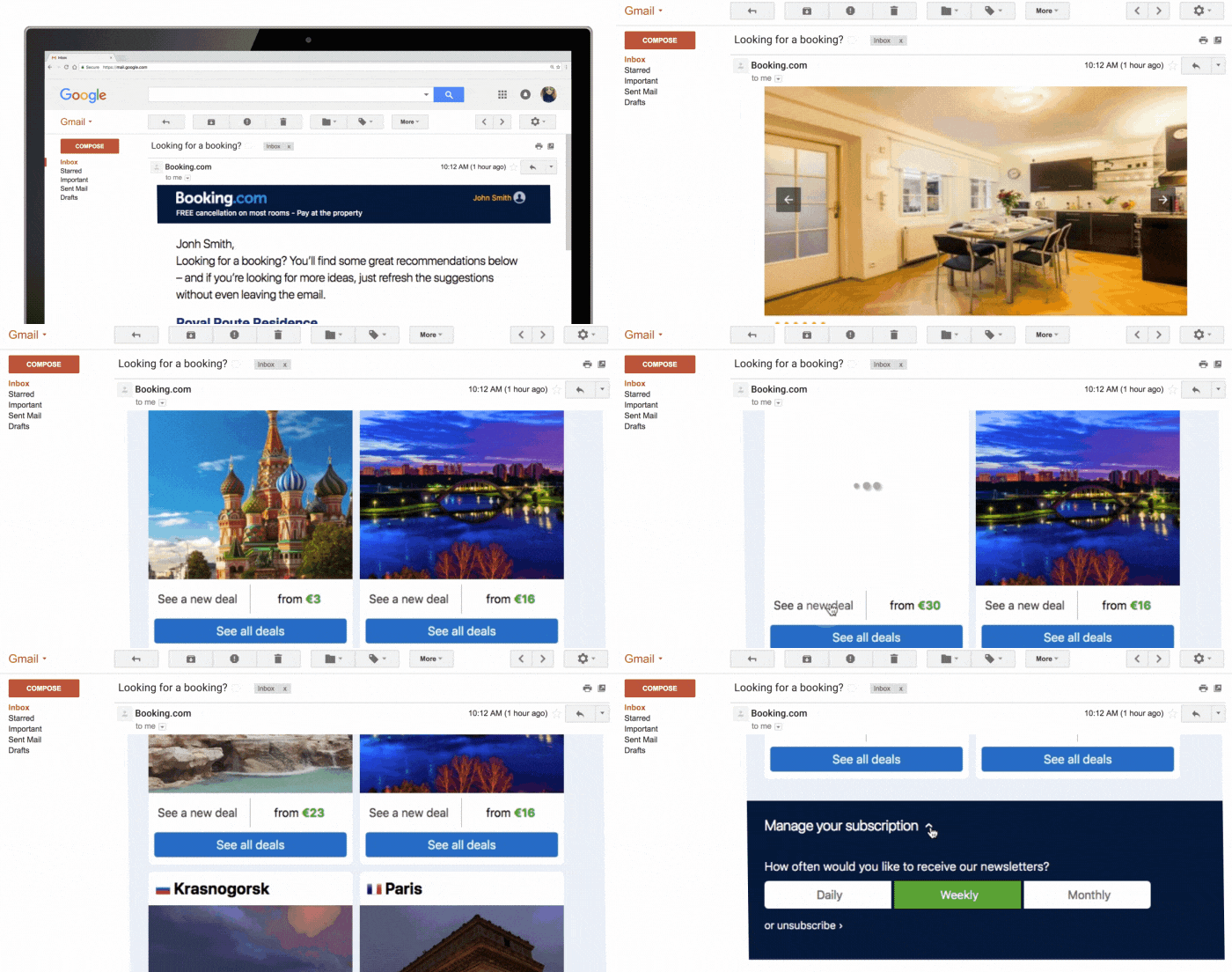
Here’s an example of an AMP email by Booking.com that allows users to view the rooms and book deals directly in the email. 

Image Source

Revamp your email automation strategy

Your subscribers are already receiving too many emails during the holiday season. So, you must keep close tabs on your automation emails.

Ensure that users do not receive any redundant communications or too many emails. You can pause your automated emails if needed.

Refrain from resending emails automatically to the non-openers. The reason being that Apple’s MPP does not allow accurate recording of the open rate. This puts you at risk of sending repetitive emails to people who have already opened your emails.  

In addition, revamp the existing automation workflows. Include an exclusive sign-up offer for the people who join your list during the holidays.

The holiday season presents a great chance to re-engage dormant subscribers. Try to win them back with an attractive holiday offer they can’t say no to. In case they still remain inactive, remove them from the list. This is good for your data hygiene and email deliverability. 

Invest in an exclusive subdomain for the holidays

ESPs and ISPs get extra vigilant during the holidays because of the huge email volume. To avoid triggering the spam filters, you can set up a special subdomain for the holiday season.

Just remember not to start using it without proper IP warming and whitelisting. Create sufficient sending history before employing a full-fledged holiday email marketing strategy. 

Monitor the performance of your emails

Monitor the previous year’s holiday emails and see what worked, then make necessary changes and optimize the emails for this season.

Feel free to try something new and see whether it resonates with your subscribers. And even though you already have a calendar in place, be open to modifying your strategy in accordance with the email analytics. Lastly, testing and trial-and-error methods will help your business win in the holiday season. 

Guest Author: Kevin George is Head of Marketing at Email Uplers, one of the fastest growing custom email design and coding companies, and specializes in crafting professional email templates, PSD to HTML email conversion and free responsive HTML email templates in addition to providing email automation, campaign management, and data integration & migration services. He loves gadgets, bikes, jazz and eats and breathes email marketing. He enjoys sharing his insights and thoughts on email marketing best practices on his blog.

The post Creating Winning Holiday Email Campaigns with 10 Actionable Tips appeared first on Jeffbullas's Blog.


* This article was originally published here

Start making $100+ per day this week with the best dfy system - Subscribe here!


Tuesday, October 11, 2022

Data Mining Methods in Social Media

More than three billion people use social media today, with an average of 11 new accounts being created every second.

And, by the time you finish reading this article, there will have been tens of thousands of new posts on various social media platforms.

We can safely say that social media is a major source of big data, but what can you do with it all? How can businesses make sense of the data available to them?

With the amount of data being generated and accumulated through social media, data mining is useful for businesses to gather insights and other information about their audience.

Through social media data mining, you can uncover hidden information. That’s why in this article, we’ll be taking you through some different methods to mine data from social media.

What is social media data mining?

The term ‘social media data mining’ refers to the process of extracting information or ‘data’ from social media. For the first time, social media data mining goes beyond the confines of a company’s internal databases and systems.

Data from various social media platforms, such as Facebook, Instagram, Twitter, TikTok, LinkedIn, YouTube, and others, are typically used in this process to discover patterns and trends, draw conclusions, and provide useful and actionable information for businesses.

Data about consumers has long been gathered by businesses. Keeping track of who purchased what and when allows vendors to plan their sales accordingly.

At first, this information was collected through simple observation, noting information about a consumer when they were shopping and what they purchased. Now, in the age of digitalization, social media is one of the most important sources of information, along with data gathered from e-commerce platforms and others.

Social media data mining is based on the collection of what data?

It is a non-negotiable for businesses to be interested in learning more about their target audience and this is where you can use social media data mining to gather information about your target demographics and their interests.

People’s attitudes, connections, behaviors, and feelings toward a particular subject matter, product, or service are typically reflected in the collected data.

You can use this data to figure out how many people are following you on social media and how many of those people are commenting on your posts, as well as how many people are liking your posts and how many people are sharing your posts if you’re looking at Facebook data for example.

This is important to understand what kind of content and what products (or services) are garnering more interest in terms of their social media performance. This should be considered a direct audience survey.

How does social media data mining work?

Statistical techniques, mathematics, and machine learning are commonly used in the mining of social data. 

As the first step, it is necessary to gather and analyze social media data from various sources. Apart from Facebook, Twitter, or any other social media platform where users interact and leave comments, a data mining expert can also extract data from various blogs, news sites, or forums.

Before moving on to the next step, all of this data must be processed. The methods you employ would depend on the amount of data you have and the quality (and intensity) of insights you’re looking to gather through the practice.

You may wish to analyze the data yourself to get a better understanding of your audience, however, if you have major decisions like expansion policies dependent on these results, then you might want experts to conduct the analysis.

social media data mining work

Once the data has been gathered and processed, various data mining techniques can be used to identify common patterns and correlate various data points in large datasets more quickly and easily. It’s not uncommon for social media data mining techniques such as keyword extraction and sentiment analysis to be combined with other techniques like classifying, associating, tracking patterns, and forecasting.

A number of social media data mining software solutions are also used to optimize the social media data mining process. Microsoft SharePoint, Sisense, IBM Cognos, RapidMiner, and Dundas BI are some of the most popular data mining software solutions. Machine learning may also be used by data miners if a more in-depth analysis of data is needed.

Visualization is a final step in the data mining process, and it’s used as a way to convey information to those who need it most. Data visualization tools like Infogram, ChartBlocks, Tableau, and Datawrapper are some examples of tools commonly used for this purpose, as are social media analytics.

Examples of data mining software for social media

A wide variety of social media data mining software options are available. The primary function of data mining software platforms is to provide you with important metrics and formulas that you can use to make comparisons and measurements. Using data mining, as with most other business intelligence tools, it is possible to discover the connections between a range of business indicators.

Listed here are some examples of data mining software applications:

Sisense

Sisense is the best BI software for quickly transforming your data into actionable information. Interactive BI dashboards allow you to filter, drill down, and further explore your data. You can easily prepare and analyze large or disparate data sets using the software’s tools. In addition to being an AI-driven business analytics tool, Sisense has a user-friendly UI designed to help you dig deeper into your data.

It’s possible to build interactive dashboards using a drag-and-drop web user interface that combines multiple data sources into one model. To quickly test out new ideas, the platform also has features that let you add new data sources to already-governed models.

RapidMiner

Faster than any other data preparation and analytics system on the market today, RapidMiner has over 1,500 built-in algorithms and functions.

The platform is also an end-to-end data ingest and transformation platform, allowing you to work with data from multiple sources.

Using pre-created use-case templates, the software provides a simplified solution accelerator. With RapidMiner, you can select, validate, deploy, and optimize ML models in production processes automatically.

You can use the software to increase revenue, reduce financial costs, and avoid potential risks. Sharing predictive analytics processes and valuable and repeatable data pipelines with your team can also be accomplished by organizing team-based data science projects.

Microsoft’s SharePoint

Microsoft SharePoint is one of the best options for both commercial and non-commercial users when it comes to analyzing large amounts of data. It integrates seamlessly into all Microsoft Office products and provides a wide range of customization options. Predictive analytics and powerful data models can be built using Microsoft Sharepoint.

A variety of development scenarios are available to you thanks to the software’s information management and security features. Data visualization and exploration is also possible using this tool.

Conclusion

Your social media accounts are a great place to engage and interact with your customers. But there is a lot more you can do to stay ahead of your rivals. Even though data mining is yet another task to add to your marketing plans, you’ll soon discover that the additional effort is well worth it.

It’s important to know how to use the data you can gather from social media platforms to your advantage. We don’t have these social media data mining tools by accident. For data-driven business decisions, use these tools and techniques.

Guest Author: Neeraj Agarwal is a founder of Algoscale, a data consulting company covering data engineering, applied AI, data science, and product engineering. He has over 9 years of experience in the field and has helped a wide range of organizations from start-ups to Fortune  100 companies ingest and store enormous amounts of raw data in order to translate it into actionable insights for better decision-making and faster business value.

The post Data Mining Methods in Social Media appeared first on Jeffbullas's Blog.


* This article was originally published here

Start making $100+ per day this week with the best dfy system - Subscribe here!


Tuesday, October 4, 2022

Maximize Conversions With These Call-to-Action Phrases

.

The call-to-action (CTA) button is vital for your website or landing page. The primary purpose of a CTA is to optimize the conversion rate.

Think of it as the magical door to the next step of your sales funnel. Your customers must click on your CTA button to get one step closer to buying.

It’s tempting to use generic copy such as ‘submit’ or ‘click here’ on the button and call it a day, but it’s important that your CTA phrase makes sense for what you’re offering.

This article looks at some tried-and-tested, conversion-boosting CTA phrases that get you the results you want. 

Action words to maximize your conversion rates

The right words and phrases in your CTA can increase your conversion rate and ROI in any online marketplace. Let’s look at 15 famous CTA phrases we see every day.

1. Start Your Free Trial

Websites that offer services like software or applications usually offer a free 30-day trial. It’s a great way to get the customer’s attention, and most take advantage of the trial for the given time. The word ‘free’ in itself is an eye-catcher. 

The free trial allows a customer to get a feel of a product. If they find your product or service useful, they may convert to a paying customer.

A notable example of this CTA in action is on the Amazon Prime Video home page.

2. Get Started 

We can say that “Get Started” or “Get Started Now” is one of the most widely used calls to action.

It is simple yet effective. Businesses that classify themselves in service sectors like software developers, cyber security providers, or SaaS service providers use this term frequently on their websites.

For businesses who want to keep their CTA simple, adding “Get Started” or “Get Started Now” is a good start.

Get Started 

Image Source

3. Order Now

Online stores and restaurants can increase sales by adding an “Order Now” button to their website or their product page.

This CTA works best with an attractive image and video promotion of the product, which grabs the audience’s attention.

Adding “Order Now” as a CTA immediately after the product promotion is a move that can skyrocket sales. 

4. Sign Up

“Sign Up” is another simple, quick, and effective CTA for websites that want to offer their services like cloud storage. The ideal method for adding a sign-up CTA is explaining the service, its benefits, and the number of users on the product page with the CTA.

A prominent example is GitHub; they have added a simple “Sign Up for GitHub” CTA in green with black-bluish background, making it prominent and clear. 

5. Create a Free Account

Create a Free Account

Image Source

Adding the word “free” to your CTA pushes the visitor to perform our desired action. This simple CTA increases conversions and gets valuable leads. 

“Create a Free Account” as a CTA worked very well for Smartsupp. They provide online shopping assistance and Chatbot services, encouraging clients to register for a free account first. 

6. Book an Appointment 

“Book an Appointment” as a CTA is simple and explains its purpose clearly. Businesses offering medical services like orthodontic clinics can benefit from this CTA to boost their marketing and get more customers. 

“Book an Appointment” is also necessary for businesses like law firms, hair salons, beauticians, and other businesses focused on serving customers in person. 

7. Add to Cart

For e-commerce stores, “Add to Cart” is their favorite CTA.

Like the “Order Now” CTA, “Add to Cart” works well by advertising product images or videos and then adding the CTA button. E-commerce giants like Amazon and eBay, have placed add-to-cart options on all of their product pages.

8. Learn More

If your product or service needs further explanation, adding “Learn More” is the right thing to do. Explain your offering with this CTA by giving the customers a meta description or introductory paragraph.

Leaving the element of suspense and curiosity for readers or viewers tempts them to click the “Learn More” CTA. Apple has added the “Learn More” box to all its products on its homepage.

9. Request a Demo

Websites often share a demo of their products or software before people can buy the full version. The “Request a Demo” CTA is a valuable asset for promoting products with demo versions.

A good example of this CTA in action is on the popular platform Zoom. Zoom introduces their product and its advantages and then has a CTA “Request a Demo” at the end of the home page. 

Most people want to test the product first before buying it. You can have good conversion rates with this simple CTA and a demo version of your service or product. 

10. Shop Now

This CTA is commonly used in product-based websites. The “Shop Now” CTA is also an effective term like “Buy Now” or “Add to Cart” and plays the same role in increasing the conversion rate. 

11. Explore

The CTA “Explore” is simple yet convincing. It provides curiosity to viewers and teases that there is something new waiting for them. Product websites, fashion brands, blogs, and many other platforms use this CTA. 

For example, Levis, a famous clothing brand, has added “Explore Collection” to their home page to attract new visitors to its store and collection.

12. Buy Now

Buy Now

Image Source

“Buy Now” is similar to “Order Now” and “Add to Cart.” Again it is a short, compelling CTA. It persuades viewers to take action and buy the product after viewing its details.

Smartphone giant Samsung has placed this CTA right at the top of their website banner, and not only that, but they also have this CTA with each of their products. 

13. Subscribe 

Subscription models have great benefits. It is a popular CTA used widely on web pages, applications, and social media. The “Subscription” CTA works best with content creation platforms like YouTube, and newsletters also greatly benefit from this CTA. 

14. Download 

For websites that want to promote their application for smartphones or websites, use this CTA to entice people to download the application. An example here is Spotify which has a “Download” CTA button on the download webpage of their website.

15. Get % Off

Businesses that give discounts and a percentage off on their online stores have good ROI and increased sales.

Many celebrations, events, and festivals happen worldwide, and offering a discount or percentage off as a CTA on the front web page is a wise step to have extra sales and increased conversion rates during peak shopping times.

Conclusion

It’s important to choose the right CTA to add to your webpage, social media pages, and anywhere else.

These small phrases have a massive impact on sales, ROI, and conversions. You don’t want to miss out on any opportunity to increase your sales and customer pool so make sure you have a clear call to action now. Your marketing efforts will pay off with this one little button!

Guest Author: Lee Li is a project manager and B2B copywriter with a decade of experience in the Chinese fintech startup space as a PM for TaoBao, MeitTuan, and TikTok.

The post Maximize Conversions With These Call-to-Action Phrases appeared first on Jeffbullas's Blog.


* This article was originally published here

Start making $100+ per day this week with the best dfy system - Subscribe here!


The One-Person AI Company’s Biggest Problem Is Being Found

In space, no one can hear you scream. In the AI economy, no one can hear you launch. There is a new dream moving through the technolog...