💡 Start Your Online Business Today

🚀 Ready to Build Your Online Business?
👉 Start Here with This FREE Guide!

Monday, February 16, 2026

How to Track Someone on Facebook (8 Tools Reviewed)

If you’ve ever searched how to track someone on Facebook, you probably realized fast that most advice online is vague, outdated, or unrealistic. Some guides promise instant access. Others avoid explaining what is actually possible. 

We decided to do it properly. We reviewed the tools, we tested their Facebook monitoring features, and we looked at how they handle Messenger, activity logs, and location signals in real conditions. 

In this guide, you’ll get clear answers, realistic expectations, and detailed breakdowns of eight tools that claim to track Facebook activity so you can make an informed decision.

8 Best Tools to Track Facebook Activity (Detailed Reviews)

Below, we break down how each tool handles Facebook activity tracking, Messenger monitoring, and location signals so you can understand what actually works in practice.

1. uMobix
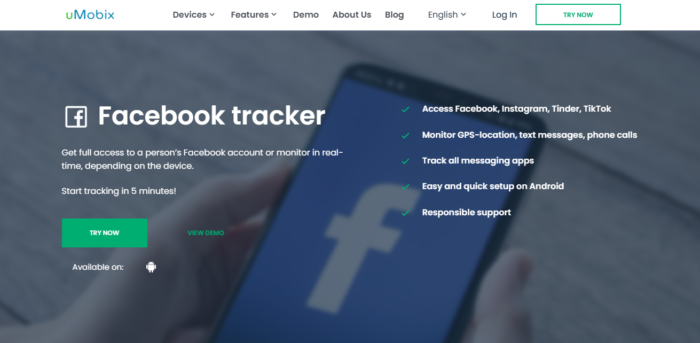
uMobix focuses on device-level monitoring, which means it does not rely on public profile visibility. It captures Facebook app activity, Messenger conversations, timestamps, and contact identifiers once properly installed on the target device with authorization. 

If you’re researching how to track someone from Facebook or can you track someone on Facebook beyond public posts, this type of setup is what enables deeper visibility.

Data updates depend on device permissions and background refresh settings. On Android, updates are typically faster. On iOS, synchronization can depend on cloud backups and app permissions. Gaps usually appear when battery optimization restricts background activity or when permissions are revoked.

Reporting is structured into timelines with searchable logs and message threads sorted by date and contact. Timestamps are clearly labeled, which helps when reviewing patterns instead of isolated screenshots.

Key Features

  • Facebook Messenger monitoring with message threads and timestamps
  • App activity logs showing usage duration and frequency
  • GPS-based Facebook location tracker functionality (device-level)
  • Searchable dashboard with structured timeline view
  • Remote access panel with permission management

2. XNSPY
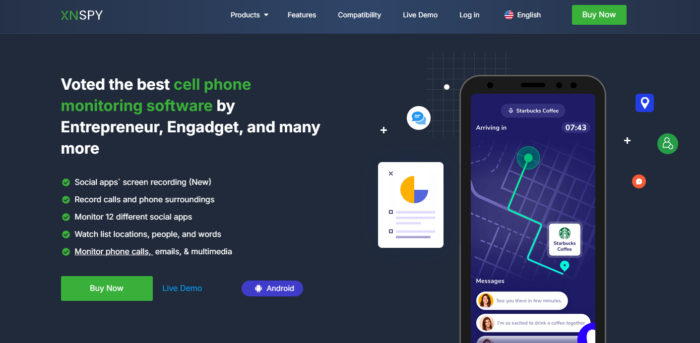
XNSPY is built around structured device monitoring, which gives it strong coverage of Facebook and Messenger activity once installed on an authorized device. It records chat logs, media exchanges, and interaction timestamps in categorized dashboards. 

If your goal is how to find location on Facebook indirectly through device data, XNSPY connects Facebook usage with GPS tracking logs.

Messenger visibility is displayed in organized threads with contact details and message flow preserved. Attachments are separated into media logs for easier review. Update frequency depends on internet access and device connectivity, with Android devices typically offering more consistent data flow.

The dashboard allows filtering by app, contact, and time window. Export options support structured review for record-keeping. Plan transparency is clearly outlined, with visible feature breakdowns and support documentation.

Key Features

  • Categorized Facebook and Messenger logs
  • GPS location history with route mapping
  • Keyword alerts for Messenger activity
  • Filterable dashboard with export options
  • Clear subscription tiers and documentation

3. xMobi
xMobi positions its Facebook tracking under broader social media monitoring. It captures Messenger conversations, app activity duration, and device-level data when installed correctly. 

If someone searches how to see someone location on Facebook, xMobi does not pull location directly from Facebook but instead connects it through device GPS logs.

Messaging coverage includes contact names, timestamps, and message content. Media visibility depends on OS permissions. Common setup mistakes include incomplete permission approval and disabled background refresh, both of which create update delays.

Consistency is strongest when the device remains connected to stable internet and battery optimization is disabled for monitoring services. Privacy footprint includes required accessibility permissions and device-level access, which must be authorized properly.

Key Features

  • Messenger chat monitoring with timestamps
  • App usage tracking for Facebook activity
  • GPS location logs tied to device data
  • Activity timelines with search filters
  • Remote dashboard with multi-device access

4. AccountViewer

AccountViewer is positioned differently. Instead of deep device-level access, it focuses on account visibility and structured activity insights. Users exploring how to track someone on Facebook without installing software often look at services like this.

Capabilities vary depending on account privacy settings. It may provide access to visible profile updates, interaction patterns, and activity signals that are otherwise limited by Facebook’s interface. 

It does not function as a direct device-based Facebook location tracker, and expectations must align with public or account-level visibility limits.

Results are typically delivered through a web-based interface. Reporting depth depends on the account’s privacy level. Before paying, verify what data categories are explicitly included in the plan.

Key Features

  • Web-based Facebook account visibility access
  • Structured activity summaries
  • No app installation required
  • Dashboard-based results delivery
  • Clear plan descriptions before purchase

5. PeekViewer

PeekViewer fits best when the goal is account-level access rather than device monitoring. It allows structured viewing of Facebook-related content tied to an account, without installing monitoring software.

It consistently displays accessible profile data, posts, and visible interactions depending on privacy settings. 

If your question is can you track someone on Facebook without installing software, PeekViewer addresses visibility rather than device tracking. It does not provide GPS-based how to locate someone on Facebook functionality because it does not access device hardware.

Navigation is simple, and time to first result is usually quick after setup. Messenger and real-time location monitoring are limited compared to device-installed tools.

Key Features

  • Browser-based Facebook viewing
  • No device installation required
  • Quick dashboard navigation
  • Search and profile filtering
  • Transparent subscription model

6. PhonySpy

PhonySpy operates as a device monitoring tool that includes Facebook and Messenger logging within broader tracking coverage. Once installed with authorization, it captures message threads, timestamps, and app activity data.

Monitoring controls include alerts for selected keywords, history windows for reviewing older activity, and categorized logs by app. If someone wants deeper answers to how to track someone from Facebook, this type of tool connects Facebook usage with broader device context.

Reporting clarity depends on dashboard layout. Logs are separated into categories, though interface complexity can require adjustment time. Plan boundaries and refund policies should be reviewed carefully before subscription.

Key Features

  • Messenger message logs with timestamps
  • Keyword alerts for Facebook conversations
  • App activity duration tracking
  • GPS location tracking via device
  • Categorized dashboard panels

7. mSpy

mSpy emphasizes Facebook and Messenger monitoring as part of its core functionality. Once properly installed with consent, it logs chat content, shared media, timestamps, and contact identifiers. 

For those researching how to find location on Facebook, mSpy provides GPS tracking based on device-level access rather than pulling location directly from Facebook.

The dashboard organizes activity into timelines, with filtering options for app type and date range. Updates depend on connectivity and system permissions. Accuracy improves when all required permissions remain active.

Documentation is extensive, and support materials clearly outline feature scope. Subscription plans define included monitoring categories.

Key Features

  • Detailed Messenger conversation logs
  • GPS-based location history tracking
  • Timeline-based dashboard interface
  • App activity frequency reports
  • Structured plan descriptions

8. Eyezy

Eyezy focuses on social media monitoring with structured Messenger coverage. It captures conversation threads, timestamps, and selected app activity logs when installed on an authorized device.

Update consistency depends on operating system restrictions and background permissions. The term “real-time” generally means near-scheduled sync intervals rather than instant live streaming. For users asking how to see someone location on Facebook, Eyezy links device GPS tracking with app activity timelines.

Reporting combines message logs with searchable filters and export options. Setup requires device access and permission approval. Transparency indicators include visible plan breakdowns and support access.

Key Features

  • Messenger chat monitoring with timestamps
  • Device-level GPS location tracking
  • Searchable activity logs
  • Exportable reports
  • Clear subscription structure

Quick Comparison Table (8 Tools)

Here’s a concise pricing and feature focus overview to help you compare the tools that can assist with how to track someone on Facebook or how to locate someone on Facebook.

ToolPricingBest for Facebook Tracking FocusAccess Model
uMobixApprox. $49.99/mo*Messenger, activity, locationInstalled app
XNSPYApprox. $4.99–$7.49/mo*Structured logs, Messenger, locationInstalled app
xMobiSubscription variesAccount visibility & activity signalsCloud/dashboard
AccountViewerSubscription variesAccount activity overviewCloud/dashboard
PeekViewerSubscription variesQuick account visibilityCloud/dashboard
PhonySpySubscription variesAccount snapshot & basic signalsCloud/dashboard
mSpyApprox. $48.99/mo*Messenger, device data, locationInstalled app
EyezyApprox. $1/day (~$30–$60/mo)*Social monitoring & locationInstalled app

How We Tested and Ranked These Facebook Tracking Tools

We tested each tool in real-world conditions instead of relying on marketing claims. Our goal was simple: measure how well each platform performs when someone genuinely wants to understand how to track someone on Facebook in a legal and authorized context.

Setup Friction and Access Requirements

We measured time to first usable data. After installation or activation, we tracked how long it took for Facebook activity, Messenger logs, and timestamps to appear inside the dashboard. Some tools populated data within minutes. Others required several sync cycles before usable logs became available.

We also evaluated login and password requests. Tools that ask for Facebook account passwords raise immediate concerns. Installed monitoring apps usually require device-level access instead of account credentials. Cloud-based viewers operate differently and depend on visible account data.

Device access level matters. Installed apps require physical access and system permissions. Dashboard-based services do not. That difference directly impacts what data becomes visible and how reliable it is over time.

Facebook Coverage Depth

We separated basic account visibility from deeper Messenger monitoring. Browser-based tools typically show profile activity and visible interactions. Installed apps provide access to Messenger conversations, contact identifiers, timestamps, and usage duration once properly configured.

We also reviewed media and attachment visibility. Some tools capture text only. Others log shared images and files, depending on system permissions. Not every platform preserves full conversation threads, and very few handle deleted content reliably.

Performance differed across operating systems. Android devices generally allow broader access. iPhone setups depend heavily on permissions and system limitations, which can affect consistency.

Location and Activity Reliability

When testing location functionality, we examined how each tool handles device-level GPS tracking. Most platforms do not extract location directly from Facebook. Instead, they rely on the phone’s GPS logs.

Accurate timelines depend on stable internet connection, enabled permissions, and background activity allowances. We observed gaps when battery optimization restricted background processes or when operating system updates changed permission behavior.

Reliable tracking requires continuous permission integrity. Once a required setting is disabled, data flow often slows or stops entirely.

Reporting and Usability

We evaluated timeline clarity and dashboard structure. Clean organization makes a major difference when reviewing long Messenger conversations or activity logs. Tools that separate logs by app, date, and contact scored higher in usability.

Search and filtering functions were tested using keyword queries and date-range filtering. Export options were also reviewed to determine whether logs could be saved for documentation purposes.

We examined multi-device dashboards where available. Platforms that allow centralized access to multiple monitored devices provide stronger administrative control and easier review.

Evidence quality also matters. Clear timestamps, labeled contacts, and readable formatting improve reliability and reduce confusion.

Risk Signals and Transparency

We looked closely at overpromising claims. Any tool suggesting instant access without device permission raises red flags. Clear feature explanations indicate stronger transparency.

Support responsiveness was tested through pre-sales and technical questions. Platforms with documented help centers and structured replies scored higher.

Refund clarity was also reviewed. Transparent billing cycles and clearly defined plan boundaries reduce financial risk. Ambiguous pricing pages lower trust immediately.

Final Verdict

Understanding how to track someone on Facebook requires realistic expectations, proper authorization, and the right tool for your specific goal. Some platforms focus on Messenger logs and device-level visibility. 

Others provide account-based viewing with lighter access. We reviewed installation depth, reporting clarity, location reliability, and transparency before ranking them. If you need structured Messenger monitoring and location data, installed apps deliver stronger coverage. 

Frequently Asked Questions

How to track someone on Facebook legally?

You can track someone on Facebook legally only if you have proper authorization, such as parental responsibility for a minor or written consent for device monitoring. Installing monitoring software without permission can violate privacy laws and platform policies.

Can you track Facebook Messenger messages with these tools?

Yes, installed monitoring apps can log Messenger conversations once properly configured with device permissions. Browser-based tools usually cannot access private Messenger content.

Which tool works best for Facebook tracking on iPhone?

Tools that support iOS monitoring through proper installation or secure backup synchronization tend to perform better on iPhone. Results depend heavily on enabled permissions and background refresh settings.

Do these tools show real-time location?

Most tools provide scheduled GPS updates rather than true live tracking. Update frequency depends on device connectivity, battery settings, and system restrictions.

What causes gaps in Facebook tracking data?

Common causes include disabled permissions, battery optimization settings, operating system updates, and unstable internet connections. Once permissions are restricted, data collection often slows or stops.

How can you verify a Facebook tracking tool is working properly?

Send a test message, check timestamps in the dashboard, and confirm location logs update within expected sync intervals. Consistent timestamp updates usually indicate the system is functioning correctly.

Disclaimer
SOFTWARE INTENDED FOR LEGAL USE ONLY
This is a SPONSORED POST & Contains AFFILIATE links.
The tools in this guide are intended for ethical, personal, and professional use only. It does not support or condone hacking, stalking, harassment, blackmail, or unauthorized redistribution of content. Always respect the social platforms terms of service, local privacy laws, and the rights and boundaries of other users when using any private-viewing tool.

The post How to Track Someone on Facebook (8 Tools Reviewed) appeared first on jeffbullas.com.


* This article was originally published here

Start making $100+ per day this week with the best dfy system - Subscribe here!


Sunday, February 15, 2026

AI Lacks Curiosity. Here’s How to Make That Your Human Superpower

In an age where AI gets better and better at answering all our questions, our innate curiosity and relentless questioning will become even more essential.

Aravind Srinivas, CEO of Perplexity and Claude

Children have what seems like an infinite curiosity loop that drives their parents to the edge of madness. This includes questions on a road trip that has a never ending stream of  just one question. “When will we get there?” as the endless bitumen horizon becomes a relentless barrage of a singular question.  

And even when we get back home there is also a one syllable question that raises the question why we had children.  “Why?

But what looks like a human foible has now become a human superpower in a world of AI. 

Smart questions matter

Here’s what’s happening: AI is good at answers. It has been called “The Answer machine” 

But AI lacks something really vital.

You can ask it anything and get a plausible response in seconds. Market analysis? Done. Code debugging? Solved. Career advice? Generated.

But this creates a paradox that most people haven’t noticed yet: 

The easier it becomes to get answers, the more important it becomes to know what to ask, why it matters, and what you’ll do with what you learn.

And Aravind’s short summation about AI’s weakness.AI lacks curiosity.”

So… we need to become better at asking questions. And we also need to power it with curiosity frameworks.

Infinite information 

We’re entering an era where the bottleneck isn’t information access because information is now infinite

The challenge is information judgment. The constraint isn’t computing power, it’s knowing what’s worth computing. The skill that separates signal from noise isn’t technical fluency, it’s disciplined curiosity.

That is the heart of a Human Curiosity Machine: a personal operating system that turns wonder into inquiry, inquiry into truth, and truth into action, using AI as scaffold, not a substitute.

Because Srinivas is right: AI lacks curiosity. It can simulate questions. It can generate infinite “interesting angles.” But it doesn’t want to know. 

It doesn’t:

  • Feel the itch of uncertainty 
  • The thrill of discovery, 
  • The moral weight of consequences.

 It has no skin in the game. No values at stake. No future it’s trying to build.

Humans do.

So the winning move isn’t to worship the answer machine or outsource your thinking to it. It’s to build an inquiry machine inside yourself—with AI as your co-pilot, not your autopilot.

Why This Matters Right Now

Three forces make curiosity a modern superpower:

  1. Answers are abundant, wisdom is becoming scarce. When AI can output plausible explanations in seconds, the differentiator isn’t access to information, it’s judgment. Framing the problem. Testing claims. Deciding what to do next.
  2. We live inside infinite information gaps. Psychologist George Loewenstein described curiosity as driven by the information gap: when you perceive a gap between what you know and what you want to know, it creates motivating tension—like an itch you want to scratch. AI can make those gaps endless. One question becomes ten. Ten become a thousand. Without guardrails, curiosity degrades into compulsion.
  3. Curiosity “is” agency. It’s the opposite of passivity. It’s how you escape echo chambers, update your worldview, build empathy, create original work, and stay alive to possibility. Curiosity is not a vibe. It’s a life skill.

What Curiosity Actually Is (And Why It’s Harder Than It Looks)

Curiosity looks simple until you inspect it. 

Researchers note that curiosity is hard to define cleanly because it contains multiple related processes. A child asking “why?” seems straightforward. But when you’re trying to build a systematic practice of curiosity—especially one that leverages AI—the distinctions matter.

A useful working definition: Curiosity is the drive to seek information or experience that reduces uncertainty or expands possibility because you sense a meaningful gap.

But it’s a suitcase word—one label carrying several distinct modes:

  • Epistemic curiosity: hunger for understanding (truth, explanations, models). This is the “I want to know how this works” drive. It’s deep, patient, and builds mental models.
  • Perceptual curiosity: hunger for novelty (sensory experiences, surprises). This is the “ooh, shiny!” reflex. It’s shallow, fast, and seeks stimulation.
  • Specific curiosity: “I need this answer.” Focused, urgent, practical. You’re trying to solve a concrete problem or close a specific knowledge gap.
  • Diversive curiosity: “Show me something interesting.” Broad, exploratory, undirected. You’re browsing, not hunting.

This taxonomy matters because AI tends to feed diversive curiosity (more novelty), while human flourishing usually requires epistemic curiosity (more depth).

Think about it: recommendation algorithms are optimized for diverse curiosity. They serve you the next interesting thing. But they don’t help you build a coherent understanding. They don’t support the slow, iterative process of going from confusion to clarity to mastery.

Your curiosity machine must help you convert novelty into meaning. It must resist the pull of infinite distraction and channel your attention toward growth that compounds.

The Science: What Curiosity Does to Your Brain

The most useful thing science says about curiosity: Curiosity is a learning state.

Classic research showed that being in a high-curiosity state improves learning not only for what you’re curious about, but also for incidental information encountered along the way—curiosity primes the brain for broader encoding. Recent neuroscience maps curiosity’s network effects, showing it recruits reward-related circuitry and hippocampal mechanisms associated with memory formation.

But curiosity isn’t always helpful—context matters. Different curiosity states can sometimes interfere with memory for certain stimuli. And curiosity and boredom work as linked motivational signals: boredom pushes you to seek novelty; curiosity pulls you toward specific information gaps.

Practical takeaway: Curiosity is trainable because it’s a state you can reliably induce by creating the right kind of gap, then channeling it into a learning loop.

The Two Sides of Curiosity: Light and Shadow

Curiosity is like fire. It can cook your food or burn your house down.

Light curiosity expands you:

  • Learning, mastery, creativity
  • Empathy (“help me understand you”)
  • Better decisions (seeking disconfirming evidence)
  • Resilience (turning fear into inquiry)

Shadow curiosity consumes you:

  • Doomscrolling and threat-binging
  • Compulsive novelty loops
  • Voyeurism and extraction
  • Conspiracy spirals (questions without standards)
  • “Research” as procrastination

Here’s the diagnostic rule: If curiosity increases your agency, it’s growth. If curiosity decreases your agency, it’s a compulsion loop.

A Human Curiosity Machine must include constraints and ethics, not as dampeners, but as a hearth that keeps the fire useful.

Ancient Wisdom: Curiosity as Disciplined Attention

Long before fMRI, wisdom traditions understood something crucial: curiosity is not merely intellectual. It’s a quality of attention.

Socrates: disciplined inquiry. The Socratic method is structured curiosity—define terms, surface assumptions, test contradictions, follow implications, revise beliefs. It’s curiosity with integrity, questions aimed at becoming more truthful, not more performative.

Zen: beginner’s mind. Beginner’s mind restores openness—the ability to see what’s there rather than what you assume is there. It’s the antidote to expertise becoming a cage.

Dadirri: Deep listening. This Aboriginal practice of inner deep listening reminds us that curiosity isn’t only outward—collecting facts. It’s inward: noticing, receiving, sensing meaning. In an age of machine “listening,” human deep listening becomes a differentiator.

Modern translation: a curiosity machine isn’t just a questioning tool. It’s an attention practice.

Can Curiosity Be Trained?

Yes, especially the behaviors that generate and sustain it.

Research in psychology and education suggests curiosity can be supported through question-generation, carefully designed “gaps,” and learning environments that reward inquiry rather than mere performance. In computational cognitive science, curiosity is modeled as intrinsic motivation—a drive toward finding patterns and learning progress.

The key distinction: you don’t train curiosity by “trying to be curious.” You train it by practicing the moves curiosity uses:

  • Noticing confusion without numbing it
  • Asking better questions
  • Tolerating uncertainty longer
  • Seeking disconfirming evidence
  • Running small experiments
  • Reflecting on what you learned

That’s the basis of the system below.

The Human Curiosity Machine: Six Steps

This is the operating system that we can all use to turns wonder into wisdom and curiosity into a ocean of learning

Step 1: Frame the Unknown

Ask: What kind of problem is this?

  • Simple: best practices exist
  • Complicated: expert analysis helps
  • Complex: experiments are required
  • Chaotic: stabilize first

If you frame wrong, you’ll ask the wrong questions.

Step 2: Define Your Terms (Socratic Clarity)

Ask: What do I mean by the key words? Most confusion lives in unexamined definitions.

Step 3: Surface Assumptions

Ask: What am I assuming is true? Assumptions are the invisible rails of your inquiry.

Step 4: Run Epistemic Guardrails

Ask two questions every time:

  • What would change my mind? (falsifiability)
  • What’s the base rate? (reference class reality)

Step 5: Model the System

Ask: What are the incentives, feedback loops, delays, and second-order effects? This is how you go from trivia to insight.

Step 6: Act—Small, Fast, Real

Ask: What’s the smallest experiment that produces new information in 48 hours? Curiosity that never acts becomes entertainment.

Where AI Fits (and Why the Division of Labor Is Everything)

AI lacks curiosity. But AI is phenomenal at supporting curiosity—if you assign it the right roles and refuse to hand over what only humans can do.

The mistake most people make: they treat AI like an oracle. Ask it anything, trust the output, move on. This is efficient but ultimately hollow. You get answers without understanding. Solutions without judgment. Information without transformation.

The better approach: treat AI like a thinking partner with specific strengths—and specific limits.

Humans bring:

  • Meaning: “Why does this matter?” AI can’t tell you what’s worth caring about. That’s a human call, rooted in values, consequences, and the life you’re trying to build.
  • Values: “What’s worth pursuing?” AI optimizes for whatever you tell it to optimize for. But deciding what should be optimized? That’s on you.
  • Ethics: Consent, care, consequences. AI can simulate ethical reasoning but it has no stake in outcomes. It doesn’t experience harm. You do, and so do the people affected by what you create.
  • Taste: What’s signal versus noise. AI can surface patterns, but it can’t tell you which patterns matter or which insights are profound versus merely clever.
  • Courage: To sit with uncertainty, to ask unpopular questions, to challenge your own assumptions even when it’s uncomfortable.
  • Responsibility: To act on what you learn—and to live with the results.

AI brings:

  • Breadth: Generate angles, questions, and possibilities you didn’t see. AI is tireless at ideation and can hold more variables than human working memory allows.
  • Synthesis: Compress complexity, find patterns across domains, connect dots that span different knowledge bases.
  • Critique: Steelman arguments, red-team your thinking, find holes in your logic. AI is excellent at playing devil’s advocate without ego.
  • Experimentation: Propose tests, design routines, suggest small next steps. AI can scaffold your learning process.
  • Scaffolding: Track decisions, hypotheses, learnings over time. AI has perfect recall and can surface past insights when relevant.

The division of labor is the whole game. When humans do what humans do best and AI does what AI does best, curiosity becomes a superpower.

When you blur those lines, when you let AI answer questions only you should answer, or when you waste your energy on tasks AI handles better—curiosity degrades into either passivity or busywork.

A Daily Routine to Amplify Curiosity (12 Minutes)

Charlie Munger was seen by his children as “Two legs sticking out of a book”. I have been identified as someone who is “Two legs trapped in a chatbot thread”. Deep diving into one topic with multiple questions chasing a curiosity that has no end. 

So here  is a question training loop. Do it daily for 14 days and you’ll feel the difference.

1. One-Minute Wonder Capture

Write one sentence: “What am I genuinely curious about today?

Then write one sharper sentence: “What feels unresolved, confusing, or slightly uncomfortable?”

That discomfort often signals the information gap.

2. Two-Minute Question Upgrade (AI as Question Forge)

Prompt: “Generate 15 questions about this. Then pick the best 3 that would most change my decisions or worldview.”

3. Five-Minute Socratic Coach (AI Asks First)

Prompt: “Before answering, ask me 7 clarifying questions about: goal, constraints, assumptions, evidence, risks, what would change my mind, and what action I’ll take.”

Answer quickly. Don’t overthink. Let the questions do their work.

4. Three-Minute 48-Hour Experiment

Prompt: “Design a 48-hour micro-experiment. Include hypothesis, smallest test, success criteria, stop rule, and what to record.”

5. One-Minute Close the Loop

Write three bullets:

  • What I learned
  • What I’ll do
  • What I’m not chasing (today)

That last line is the anti-rabbit-hole move.

The Curiosity Framework Stack

If you were going to build curiosity into your chatbot there are some top frameworks to consider or include:  

So if…Curiosity is the spark. Frameworks are the hearth.

They are the scaffolding to getting  a more realistic and honest answer out of AI without it sucking up and letting it tell you what it thinks you would like to hear. 

In the AI era, answers are everywhere. Which means raw curiosity—on its own—can easily become wandering, doomscrolling, or an endless loop of “one more question.”

Frameworks do what AI can’t: they discipline curiosity. They turn vague wonder into clear thinking, truth-seeking, and action. Think of them as “question lenses” you can swap in depending on the situation—so you don’t just ask more questions, you ask better ones.

Here are eight world-class frameworks you can embed into your Human Curiosity Machine (or your AI mentor), each with a one-sentence definition and a simple example question.

1. Socratic Method

What it is: A disciplined way to reach clarity by defining terms, surfacing assumptions, and testing contradictions before drawing conclusions.

Example question: “What exactly do I mean by ‘stuck’—stuck emotionally, strategically, or behaviorally?”

2. Cynefin

What it is: A diagnostic that tells you what kind of problem you’re facing (clear/complicated/complex/chaotic) so you choose best practice, expert analysis, or experiments appropriately.

Example question: “Is this a problem I solve with research—or do I need a safe-to-fail experiment?”

3. Falsification (“What would change my mind?”)

What it is: A truth filter that forces you to name disconfirming evidence instead of collecting facts that simply confirm what you already believe.

Example question: “What evidence would prove my belief is wrong?””

4. Base Rates

What it is: A reality anchor that asks what usually happens in similar situations before assuming your case is special.

Example question: “In situations like this, what typically happens—and what’s the success rate?”

5. Steelman / Red Team

What it is: A robustness practice where you build the strongest opposing argument (or invite critique) to reveal blind spots and strengthen your position.

Example question: “If a smart critic wanted to break my plan, what’s the first weakness they’d attack?

6. Systems Thinking

What it is: A lens for seeing the hidden drivers of outcomes—feedback loops, incentives, delays, and second-order effects—rather than reacting to surface events.

Example question: “What incentive or feedback loop is causing this pattern to keep repeating?”

7. Pre-mortem

What it is: A decision tool that imagines your plan failed in the future, then works backward to identify the most likely reasons before you commit.

Example question: “It’s six months from now and this failed—what’s the most likely reason why?”

8. OODA Loop

What it is: A rapid learning cycle (observe–orient–decide–act) that turns curiosity into momentum through repeated action and feedback.

Example question: “What’s the smallest action I can take today to get real feedback by tomorrow?”

Bottom line: AI can generate endless questions. These frameworks help you generate the right questions—then convert them into insight and movement.

The Closing Insight

Srinivas’s quote is both a warning and an invitation.

When AI answers everything, the risk is that humans stop asking. We become consumers of outputs rather than authors of meaning.

So build the machine: Wonder → Questions → Tests → Insight → Action → Reflection → Deeper Wonder.

That’s the Human Curiosity Machine. Powered by AI. Directed by you.

The questions you ask determine the life you live. In the age of infinite answers, mastering the art of inquiry isn’t optional. It’s the difference between being shaped by algorithms and shaping your own becoming.

Start tomorrow. One question. Twelve minutes. Fourteen days.

Your curiosity machine is waiting to be built.

The post AI Lacks Curiosity. Here’s How to Make That Your Human Superpower appeared first on jeffbullas.com.


* This article was originally published here
Start making $100+ per day this week with the best dfy system - Subscribe here!


Saturday, February 14, 2026

Anonymous Instagram Viewer: 7 Sites That Let You View Instagram Privately

Anonymous Instagram viewer tools make it possible to check Instagram content without leaving traces, sending signals, or logging into your own account. 

We reviewed, tested, and compared the most talked-about options to see which ones actually work and which ones waste your time. Many people want a simple way to view stories, posts, or profiles quietly, without accidental likes or profile visits showing up. 

That’s exactly the problem these tools try to solve. In this guide, we break down how anonymous viewing really works, what you can realistically expect, and which sites deliver reliable results.

    7 Best Anonymous Instagram Viewer Sites Reviewed

    In this section, we explain how each anonymous Instagram viewer performs when you actually use it. We focus on access flow, content reliability, privacy behavior, and practical use cases. A comparison table will follow later to summarize the differences clearly.

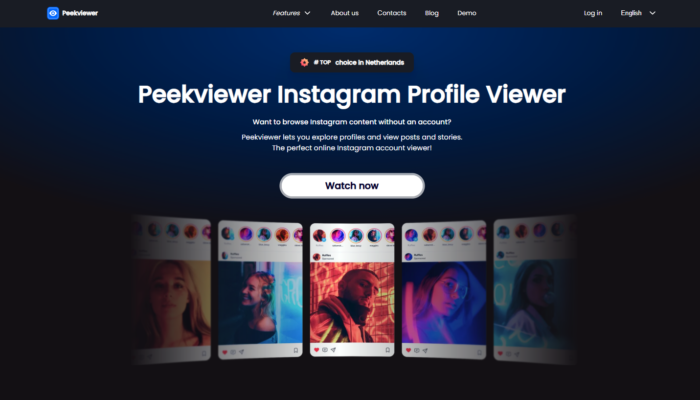
    1. PeekViewer (Anonymous Instagram Viewer Experience)

    PeekViewer is the tool we trust most when the goal is to view Instagram anonymously without friction or confusion. In practice, PeekViewer works as a browser-based Instagram viewer without account access. 

    You enter a public username, and the system loads posts, reels, profile photos, bios, and available stories inside its own interface. Because the content loads through PeekViewer’s servers, Instagram never registers a profile visit, which keeps anonymous Instagram viewing intact. What stands out is stability. 

    During testing, profiles loaded consistently, even during peak posting hours. Story previews appeared in correct order, and captions displayed without formatting issues. The limitation is intentional. 

    PeekViewer does not claim private account access, which we see as a positive sign of transparency. We think PeekViewer fits users who want reliable, fast, and discreet Instagram profile viewing anonymously without technical setup.

    2. uMobix (Private Instagram Viewing and Monitoring Depth)

    uMobix takes a more structured approach to anonymous Instagram viewer functionality. Instead of focusing only on quick viewing, uMobix is designed for users who want ongoing insight into Instagram activity. 

    Once set up, it allows visibility into public posts, story activity, profile changes, and engagement patterns over time. In real use, the experience feels closer to monitoring than browsing. 

    After configuration, the dashboard updates automatically, which means you are not repeatedly searching usernames. We think this works well for parents or users who want consistency rather than one-time checks. 

    The strength is depth and persistence. The limitation is speed. uMobix is not ideal if you only want to view Instagram profiles anonymously once or twice. It fits users who prefer structured access and long-term visibility through an anonymous Instagram viewing setup.

    3. xMobi (Fast, Simple Anonymous Instagram Viewing)

    xMobi is built for users who value speed above everything else. This anonymous Instagram viewer focuses on letting you view Instagram anonymously with minimal steps and no distractions. 

    You enter a username, and the tool loads public posts, reels, bios, and profile photos almost immediately. We found xMobi especially useful for quick checks, such as confirming recent posts or viewing a profile without triggering visit signals. 

    Because it operates as a no-login Instagram viewer, there is no account connection and no learning curve. The trade-off is depth. xMobi does not store history, track changes, or provide extended story archives. 

    Still, we think that limitation matches its purpose. xMobi fits users who want fast, anonymous access and a clean Instagram viewer anonymous experience without extra features getting in the way.

    4. AccountViewer (Quick Anonymous Instagram Viewing)

    AccountViewer positions itself as a straightforward anonymous Instagram viewer online, and in practice, that description fits. The tool focuses on public profile visibility and does not attempt to layer complex features on top. 

    When testing AccountViewer, we found it reliable for loading posts, captions, profile photos, and basic story previews. The interface is simple, which helps users avoid mistakes or accidental interactions. 

    Content loads through an intermediary viewer page, which supports anonymous Instagram viewing by preventing direct contact with Instagram. One thing we noticed is that AccountViewer performs best with standard public profiles rather than high-volume creator accounts. 

    Even so, we see AccountViewer as a solid option for users who want a lightweight Instagram profile viewer that keeps their activity invisible.

    5. XNSPY (Instagram Viewing Plus Monitoring Features)

    XNSPY combines anonymous Instagram viewer access with broader monitoring functionality, similar to uMobix but with a stronger emphasis on cross-platform visibility. 

    In real use, XNSPY allows access to public Instagram posts, stories, profile updates, and interaction patterns through a centralized dashboard. Once configured, data updates automatically, which removes the need for repeated searches. 

    We found this helpful for tracking posting behavior over time rather than checking individual uploads. The strength lies in coverage and structure. The limitation is complexity. 

    XNSPY requires setup and is not designed for casual users who just want to view Instagram stories anonymously once. We think XNSPY fits users who need organized, long-term insight and are comfortable with a more technical anonymous Instagram viewing environment.

    6. PhonySpy (Anonymous Viewing Approach and Coverage)

    PhonySpy offers a balanced middle ground between quick viewing and structured access. As an Instagram viewer anonymous tool, it focuses on public profile content such as posts, reels, bios, and story activity. 

    In practice, PhonySpy uses a relay-based viewing system, which means your request passes through its servers before content loads. This helps maintain anonymous Instagram viewing without exposing your device or IP. 

    We noticed that PhonySpy performs well with standard public profiles but may struggle during heavy posting periods. Its strength is accessibility. Users can start viewing without technical setup. 

    The limitation is refresh frequency, as updates are not always immediate. PhonySpy fits users who want a usable anonymous Instagram viewer that balances privacy with ease of use.

    7. InstaSpy (Basic Anonymous Instagram Viewer Use Case)

    InstaSpy is the most basic option on this list, and we think it works best when expectations are realistic. It allows users to view Instagram profiles anonymously by loading public posts, profile photos, and limited story previews through a simple interface. 

    The setup is minimal, which helps beginners avoid confusion. However, during testing, we noticed inconsistent load times and occasional missing content for high-traffic profiles. The strength of InstaSpy is simplicity. 

    The limitation is reliability. We see InstaSpy as suitable for quick checks or occasional use, not for users who rely heavily on consistent anonymous Instagram viewer performance.

    How Anonymous Instagram Viewing Works

    An anonymous Instagram viewer relies on technical workarounds that separate your identity, your device, and your browsing activity from Instagram itself. Here is the exact process these tools use, step by step.

    Public Instagram Data vs Private Instagram Data

    • Public Instagram profiles expose posts, reels, captions, profile photos, usernames, follower counts, tagged posts, and sometimes highlights. Anonymous Instagram viewer sites can legally access this data because Instagram allows public viewing without login.
    • Private Instagram profiles restrict all media behind follower approval. Anonymous Instagram viewing tools cannot access private posts, private stories, close friends stories, or private highlights.
    • Any site claiming “private account access” without approval is not a real anonymous Instagram viewer and often uses fake loading screens or redirect traps.

    Anonymous Instagram Viewer Access Methods

    • Web-Based Instagram Viewing
      The viewer loads public Instagram content through a browser-level request that is not linked to a logged-in Instagram session. No account, cookies, or engagement signals are sent back to Instagram.
    • Proxy and Server Relay Requests
      Many anonymous Instagram viewers route requests through their own servers. Instagram sees the server IP, not your device, which prevents profile visit tracking and viewer identification.
    • Cached Instagram Content Retrieval
      Some tools temporarily store public Instagram stories, reels, and posts. This allows users to view content anonymously even after it expires, depending on cache refresh timing.
    • Viewer Portal Interfaces
      These portals act as an insulated layer between the user and Instagram. You search for a username, and the portal fetches available public content without exposing your IP or browser fingerprint.

    Why Anonymous Instagram Viewer Results Vary

    • Public vs Creator Accounts
      Creator and business profiles expose more metadata, making them easier for anonymous Instagram viewer tools to load accurately.
    • Content Volume and Frequency
      Profiles that upload many stories in short time frames can exceed cache limits, causing partial or delayed story visibility.
    • Tool Refresh Cycles
      Some anonymous Instagram viewers refresh data every few minutes, others every several hours. This directly affects how current the visible content is.
    • Instagram Platform Updates
      Instagram regularly changes how public data is served. Strong tools adapt quickly, while weaker viewers temporarily stop working or show errors.

    What to Look For in an Anonymous Instagram Viewer

    When we judge an anonymous Instagram viewer, we break the evaluation down into clear areas that directly affect privacy, reliability, and real-world usability.

    • True anonymous access
      We always verify that the tool lets users view Instagram anonymously without asking for login details, app installs, or account connections. A proper Instagram viewer without account access works fully in the browser and never touches your personal Instagram profile.
    • Content coverage quality
      A reliable Instagram profile viewer should load public posts, reels, captions, and profile photos consistently. Strong platforms also function as an anonymous Instagram story viewer, allowing users to view Instagram stories anonymously without broken previews or missing timelines.
    • Privacy protection and invisibility
      In our experience, the safest tools act as a no login Instagram viewer and route requests through external servers. This setup keeps your IP address hidden and ensures anonymous Instagram viewing without leaving profile visit traces.
    • Speed, stability, and refresh rate
      The best anonymous Instagram viewer online platforms load profiles quickly and refresh public data regularly. When a tool can repeatedly view Instagram profiles anonymously without random downtime, it signals active maintenance and stronger infrastructure.
    • Honest limitations
      We immediately dismiss any Instagram viewer anonymous tool that claims access to private accounts. Real tools focus on public Instagram profile viewing anonymously and clearly explain what they can and cannot show.

    Breaking it down this way makes it easier to spot tools that genuinely respect privacy versus ones that only look convincing on the surface.

    Conclusion

    Using an anonymous Instagram viewer gives users a practical way to check public Instagram content without revealing their identity or creating unwanted interaction signals. 

    When used correctly, anonymous viewing helps avoid accidental likes, profile visit traces, and account visibility issues. 

    We think the key is understanding how these tools work, what data is actually accessible, and where clear limits exist. Public posts, stories, and profile details can often be viewed quietly, while private content remains protected by Instagram’s design.

    Frequently Asked Questions

    Can an anonymous Instagram viewer access private accounts?

    No. An anonymous Instagram viewer can only access public Instagram profiles. Private posts, private stories, close friends content, and follower-only highlights remain restricted. Tools that claim private access without approval usually rely on misleading interfaces or unsafe practices.

    Can someone see that I viewed their profile anonymously?

    No. When you use an anonymous Instagram viewer correctly, Instagram does not register your visit as a logged-in profile view. This prevents profile visit signals, story viewer listings, and engagement notifications.

    Can you view Instagram stories anonymously?

    Yes, but only for public accounts. Anonymous Instagram viewing allows users to watch public stories without appearing in the viewer list. Once a story is restricted to followers, anonymous access is no longer possible.

    Do anonymous Instagram viewers require an Instagram account?

    No. A proper anonymous Instagram viewer works without login. You do not need an Instagram account, and your personal profile remains completely disconnected from the viewing process.

    Is anonymous Instagram viewing safe?

    Anonymous Instagram viewing is generally safe when using reputable platforms that do not ask for login credentials or personal data. Users should avoid tools that request verification steps, app installs, or account connections.

    Why do some anonymous Instagram viewers stop working?

    Instagram regularly updates how public data is delivered. When these changes occur, some anonymous Instagram viewers temporarily lose access until they adapt. Reliable platforms usually recover faster, while weaker ones may fail permanently.

    Disclaimer

    SOFTWARE INTENDED FOR LEGAL USE ONLY

    This is a SPONSORED POST & Contains AFFILIATE links.

    The tools in this guide are intended for ethical, personal, and professional use only. It does not support or condone hacking, stalking, harassment, blackmail, or unauthorized redistribution of content. Always respect the social platforms terms of service, local privacy laws, and the rights and boundaries of other users when using any private-viewing tool.

    The post Anonymous Instagram Viewer: 7 Sites That Let You View Instagram Privately appeared first on jeffbullas.com.


    * This article was originally published here
    Start making $100+ per day this week with the best dfy system - Subscribe here!


    Friday, February 13, 2026

    The Real Risk of AI Isn’t Misuse, It’s Unskilled Use 

    A colleague asked me a question that stopped me mid-sentence: “Why are you designing all these guided prompts and frameworks into our AI startup interface? Why not just let people talk to the AI naturally?

    I paused, watching the cursor blink on the screen. The question wasn’t skeptical, it was genuine curiosity. And it deserved an honest answer.

    Because,” I said, “we’ve just handed humanity the most powerful intellectual tool ever created, and it doesn’t come with a manual. Worse, most people are using a Ferrari like it’s a bicycle—not because they’re incapable, but because no one taught them how to drive.

    That conversation led to a deeper exploration, one that reveals something profound about where we are in the Human + Machine Age: we’re at a civilizational inflection point where technological capability has vastly outpaced human literacy.

    Think about it. 

    You can open ChatGPT, Claude, or any AI assistant right now and have access to more reasoning power than any human who lived before 1950 had in their entire lifetime. Yet most of us use it to write grocery lists or summarize articles we’re too busy to read.

    The gap isn’t in the technology. It’s in our understanding of how to wield it.

    Why This Matters More Than You Think

    The Stoic philosopher Epictetus wrote: “It is impossible for a man to learn what he thinks he already knows.” We approach AI with a fatal assumption—that because we can use it, we are using it well.

    But there’s a difference between access and mastery, between using a tool and wielding it with intention and skill. This distinction matters because AI interaction isn’t like using Google or browsing social media. It’s more akin to conducting an interview, facilitating a coaching session, or engaging in Socratic dialogue.

    These are skills we develop through frameworks, practice, and guidance.

    Consider what happens when someone opens an AI chat interface for the first time. They’re facing what psychologists call “choice overload” combined with “blank page paralysis.” The possibilities are infinite, which paradoxically makes it harder to start. As the ancient Chinese philosopher Lao Tzu observed: “A journey of a thousand miles begins with a single step.” But which step? In which direction?

    Without frameworks, most people default to what’s familiar: transactional queries. “Summarize this article.” “Write an email.” “Give me a recipe.” These aren’t wrong, but they barely scratch the surface of what’s possible.

    The real tragedy isn’t that people use AI for simple tasks. It’s that they never discover what else is possible—that AI can serve as a thinking partner for pattern recognition, a mirror for self-reflection, a collaborator for creative exploration, or a guide through complex decision-making.

    This matters because we’re not just talking about productivity gains. We’re talking about cognitive capability, about expanding what we can think, create, and become. When used well, AI doesn’t replace human thinking—it amplifies it. When used poorly, it atrophies it.

    The frameworks and scaffolding we build now will determine whether AI becomes a tool for human flourishing or just another technology that uses us more than we use it.

    The Data: How Badly We’re Missing the Mark

    Let me share some sobering statistics that reveal the magnitude of this literacy gap.

    According to MIT Sloan research (2025), up to half of the performance gains from more advanced AI models are lost when users fail to adapt their prompting strategies. Data from the 2024 Microsoft Work Trend Index indicates that the vast majority of users have never received formal training on AI tools, leading to a reliance on “thin queries”: single-sentence, context-free prompts that treat LLMs like a standard search engine. This suboptimal usage prevents the model from engaging in complex reasoning or “chain-of-thought” processing, resulting in generic outputs that capture only a fraction of the AI’s actual potential.

    A comprehensive study by MIT’s Center for Collective Intelligence analyzed over 50,000 interactions with GPT-4 and found that well-structured prompts (including role definition, context, and output specifications) produced responses rated 3.2x higher in quality by independent evaluators compared to basic queries (Malone et al., 2023).

    The quality difference isn’t marginal—it’s exponential.

    But here’s what stunned me: When researchers provided users with simple frameworks for structuring their prompts, quality scores improved by an average of 67% within a single session. This wasn’t about AI getting smarter. It was about humans learning to collaborate more effectively.

    Anthropic’s own research on Claude’s extended thinking capabilities revealed that users who provided structured context (background, goals, constraints) received outputs requiring 40% fewer iterations to reach their desired result (Anthropic Research, 2024). Each iteration costs time and cognitive load. Frameworks reduce friction.

    From a neuroscience perspective, the data gets even more interesting. Cognitive load research from the University of California, Irvine shows that the human prefrontal cortex can effectively manage approximately 4 chunks of information simultaneously in working memory (Cowan, 2010, Nature Reviews Neuroscience).

    When someone faces a blank AI interface, they’re attempting to juggle:

    • Their actual question or need
    • How to articulate it effectively
    • What context might be relevant
    • How to structure the query
    • Anticipating what the AI needs to know

    That’s five concurrent cognitive processes—already exceeding working memory capacity. No wonder most people default to simple queries. They’re cognitively overwhelmed before they start.

    Dr. Elina Halonen and researchers at the University of Portsmouth found in their 2025 study that poorly structured AI interaction is highly correlated with mental exhaustion. Their findings suggest that while “free-form” prompting increases cognitive fatigue, employing structured frameworks reduces mental load and improves output quality by replacing repetitive trial-and-error with strategic interaction.

    The business case is equally compelling. A McKinsey analysis of AI adoption in enterprise settings found that companies that implemented prompt engineering training and frameworks saw productivity gains 2.3x higher than those that simply deployed AI tools without guidance (McKinsey Digital, 2024).

    But perhaps the most telling statistic comes from OpenAI’s own user research: 68% of users abandon AI tools within 30 days of first use, citing “inconsistent results” and “unclear how to get value” as primary reasons (OpenAI User Research, 2023).

    The technology isn’t failing. Our onboarding and education around it is failing.

    The Ancient Wisdom We’ve Forgotten

    The Greek philosopher Aristotle distinguished between techne (technical skill or craft) and episteme (theoretical knowledge). We’ve developed the techne of AI—the engineering that makes it work—but we’ve neglected the episteme, the structured knowledge of how to use it wisely.

    The craftsman doesn’t approach the forge without understanding fire. The archer doesn’t release the arrow without understanding wind and distance. As Confucius taught: “The man who moves a mountain begins by carrying away small stones.”

    Frameworks are those small stones. They’re the accumulated wisdom of what works, codified so others don’t have to rediscover it through trial and error.

    The Buddhist concept of upaya (skillful means) is instructive here. Upaya recognizes that the same truth might need different approaches for different people at different stages of understanding. A master teacher doesn’t give everyone the same instruction—they provide scaffolding appropriate to the student’s current capability.

    This is exactly what good frameworks do. They meet people where they are and guide them toward where they could be.

    The Tao Te Ching offers this: “To know that you do not know is the best. To think you know when you do not is a disease.” Many of us suffer from this disease with AI. We think fluent English means fluent prompting. We mistake access for expertise.

    The Case for Intentional Scaffolding

    So why build frameworks and guided prompts into AI tools and interfaces? Because learning research from the past century gives us a clear answer.

    Lev Vygotsky’s concept of the “Zone of Proximal Development” showed that people learn best when operating just beyond their current capability with appropriate support. Frameworks are that support—temporary structures that help learners bridge from novice to competent practice.

    Consider how we teach writing. We don’t hand someone a blank page and say “write brilliantly.” We provide structures: thesis statements, supporting paragraphs, transitions, conclusions. These aren’t permanent constraints—they’re training wheels. Students internalize the patterns, then eventually transcend them.

    The same principle applies to AI literacy. Most people have never engaged in Socratic dialogue, conducted a structured coaching conversation, or practiced explicit pattern recognition. These are learnable skills, and frameworks accelerate that learning.

    Dr. John Sweller’s Cognitive Load Theory demonstrates that structured learning environments reduce extraneous cognitive load, allowing learners to focus mental resources on the actual skill being developed rather than on figuring out how to approach the task (Sweller, 1988, Cognitive Science).

    When we provide frameworks for AI interaction, we’re not limiting creativity—we’re creating the conditions where creativity can emerge. As Igor Stravinsky famously said: “The more constraints one imposes, the more one frees oneself.”

    The Evolution: From Scaffolding to Fluency

    But here’s the crucial insight: effective frameworks are designed to eventually transcend themselves.

    Think about learning piano. Beginners practice scales—structured, repetitive patterns. Intermediate students work through études—frameworks for technical development. Advanced musicians have internalized these patterns so deeply they become intuition. They can improvise, compose, play with the rules because they first mastered them.

    The goal isn’t permanent dependence on frameworks. It’s progression through stages:

    Stage 1: Guided Discovery — Structured prompts teach the fundamental patterns of effective AI collaboration

    Stage 2: Adaptive Scaffolding — As users internalize patterns, frameworks fade into optional suggestions rather than required structures

    Stage 3: Conversational Fluency — Users develop their own style, returning to frameworks only when exploring new territory or when stuck

    This mirrors ancient apprenticeship models. The master doesn’t just demonstrate the craft—they provide structure, guidance, and progressively more autonomy as skill develops. The Japanese concept of shu-ha-ri captures this beautifully:

    • Shu (守): Follow the rules, learn fundamentals
    • Ha (ç ´): Break from the rules, make them your own
    • Ri (離): Transcend the rules through mastery

    Frameworks enable shu. Practice enables ha. Mastery achieves ri.

    The Counter-Argument: Why Some Resist Structure

    The strongest argument against frameworks is worth taking seriously: over-scaffolding can create learned helplessness.

    If frameworks are too prescriptive, users never develop their own prompting intuition. They become dependent on structure rather than developing internal capability. This is a legitimate concern, and it’s why framework design matters as much as framework existence.

    There’s also the cognitive diversity argument. Frameworks necessarily reflect a particular way of thinking—often linear, analytical, explicit. But what about visual thinkers? Intuitive leapers? People who discover through unstructured exploration?

    The answer isn’t to abandon frameworks—it’s to design multiple pathways and create progressive autonomy. Provide structure for those who need it, optional guidance for those who want it, and full freedom for those ready to forge their own path.

    As the ancient Greek principle of kairos teaches, timing matters. The right thing at the wrong time is the wrong thing. Frameworks should appear when needed and dissolve when they’re not.

    What This Means for You

    If you’re building AI tools, the question isn’t whether to include frameworks—it’s how to design them so they empower rather than constrain, guide rather than limit, teach rather than prescribe.

    If you’re using AI, the question is whether you’re content with surface-level utility or ready to develop genuine fluency. The most powerful technology in the world doesn’t come with a manual, but that doesn’t mean you can’t create one for yourself.

    Start with structure. Practice deliberately. Notice what works. Eventually, transcend the scaffolding entirely.

    As Michelangelo understood: “The sculpture is already complete within the marble block before I start my work. It is already there, I just have to chisel away the superfluous material.”

    The frameworks don’t create the capability. They remove the obstacles so the capability can emerge.

    The question isn’t whether we need frameworks for AI literacy. The data, the research, and centuries of learning theory tell us we do. The question is whether we’ll have the wisdom to build them well—structures that guide us toward mastery rather than chains that keep us dependent.

    That’s the work ahead. Not building smarter AI, but building wiser humans who know how to wield it.

    What frameworks have you found helpful in your own AI interaction? What scaffolding have you outgrown? I’d love to hear your experience in the comments below.

    The post The Real Risk of AI Isn’t Misuse, It’s Unskilled Use  appeared first on jeffbullas.com.


    * This article was originally published here
    Start making $100+ per day this week with the best dfy system - Subscribe here!


    Thursday, February 12, 2026

    Best Facebook Profile Viewer – 7 Trusted Tools to See Private Profiles

    The search for the best Facebook profile viewer often leads to fake tools, dead dashboards, and empty promises. 

    We tested everything ourselves and found seven platforms that actually deliver full access to private Facebook content – not just profile names, but messages, photos, activity logs, and even deleted conversations in some cases. 

    If you’ve ever tried to view someone’s locked account and ended up staring at a paywall with no results, you know how frustrating this space can be. That’s why we broke each tool down by features, accuracy, and value. 

    7 Best Facebook Profile Viewer Tools

    These are the only options we’d recommend using in 2026.

    1. uMobix 

    We chose uMobix as our top pick because it gives the most complete access to private Facebook profiles. The dashboard is clean and updates almost instantly. We could see messages, likes, friend changes, and even deleted chats.

    It works on both Android and iOS. For iPhones, you’ll need iCloud credentials, but no jailbreak. On Android, full access requires root. 

    Sync speed was around 5–15 seconds in our test. If you’re serious about full tracking, uMobix is the most reliable Facebook viewer we’ve used so far.

    Pricing:

    • 1 Month: $49.99
    • 3 Months: $29.99/month
    • 12 Months: $12.49/month

    2. XNSPY 

    We found XNSPY to be a solid pick if you’re looking for Facebook Messenger monitoring with behavioral insights. The dashboard offers full chat logs, screen activity, contact lists, and alerts based on specific keywords. It supports both rooted and unrooted Android phones. 

    For iOS, you’ll need a jailbreak to unlock full Facebook access. We appreciated the automated activity reports and how quickly the tool updated – usually under 10 seconds. 

    This is one of the few tools that lets you combine profile viewing with behavior analytics, making it ideal for employers or security-focused users.

    Pricing:

    • Basic Plan: $4.99/month
    • Premium Plan: $7.49/month

    3. xMobi 

    We tested xMobi specifically to see if it could really view Facebook profiles without app installation, and it delivered. 

    After entering the target’s username, we received a full report with messages, posts, friend lists, and status updates. The tool doesn’t require physical access, rooting, or jailbreaking. 

    It’s a web-based viewer, so everything runs from your browser. Reports are generated in 2–5 minutes. For fast, anonymous access to private Facebook accounts, we think xMobi offers one of the cleanest user experiences.

    Pricing:

    • 1 Month: $49.99
    • 3 Months: $29.99/month
    • 12 Months: $12.49/month

    4. AccountViewer 

    AccountViewer impressed us with its simple approach. You just enter the target’s Facebook username, and the platform scans for all accessible content – friends, messages, photos, comments, even likes. 

    The tool doesn’t require installation or special permissions. It’s browser-based and works well on mobile too. While it doesn’t have deep real-time tracking, it gives a full snapshot of any Facebook profile. 

    We liked how the interface walked us through every step clearly, with a report delivered in under 10 minutes. If you need fast access with minimal setup, this is the one.

    Pricing:

    • 1 Month: $99
    • 3 Months: $69/month
    • 12 Months: $25/month

    5. PeekViewer 

    PeekViewer stands out for those who want anonymous access to private Facebook accounts with minimal steps. 

    We entered a username and received a detailed report covering stories, chat history, images, and friends. What makes it different is its privacy mode – your identity is completely hidden during the process. No downloads or account access are needed. 

    The delivery time for the full profile was under 5 minutes, and everything appeared neatly organized in the web dashboard. We think it’s one of the best tools if stealth is your priority.

    Pricing:

    • 1 Month: $50.99
    • 3 Months: $30.03/month
    • 12 Months: $12.74/month

    6. Eyezy 

    We found Eyezy extremely useful for those needing in-depth Facebook activity reports. The app tracks everything: posts, DMs, screen time, and even keystrokes. It runs in stealth mode and has a clean, organized dashboard. 

    On Android, it works best with root for full visibility. iOS requires iCloud access, with jailbreak unlocking deeper features. Reports update roughly every 10–15 seconds. 

    What we like is the level of control – it gives alerts, filters, and full visibility without crowding the interface. If you’re managing a team or keeping an eye on your child, this one gives real insight.

    Pricing:

    • Basic: $7.99/month (12-month plan)
    • Ultra: $19.99/month (12-month plan)

    7. mSpy 

    We’ve used mSpy in several test cases, and it’s consistently stable. It’s built for Facebook Messenger tracking, but also covers timeline updates, contact changes, and post history. The dashboard is modern and fully encrypted. 

    Root or jailbreak unlocks full features, but even without it, the basic monitoring works on iPhones using iCloud credentials. 

    What stood out was the export feature – it let us download message history for offline review. For long-term monitoring of a single profile, mSpy offers the best subscription value.

    Pricing:

    • 1 Month: $48.99
    • 3 Months: $27.99/month
    • 12 Months: $11.66/month

    What’s the Best Facebook Profile Viewer Tool Today?

    We compared real tools, not fake generators or clickbait apps. After testing every feature, pricing model, and data sync speed, some options clearly stood out depending on your specific goal.

    Best Overall – uMobix

    We picked uMobix as the most complete Facebook viewing tool because it gave us everything: real-time Messenger logs, friend changes, deleted content, and synced updates without delays. 

    The dashboard is clean, mobile-friendly, and refreshes every 5–15 seconds. Root access on Android unlocks full social media logs, including stealth screenshot functions. No other app matched this level of control and reliability in our review.

    Best for Anonymous Viewing – xMobi

    xMobi is the only platform we tested that required no installation and no login access, yet still showed Facebook messages, photos, and friends lists. We entered a username and got results in under 5 minutes. 

    It runs entirely from a browser, making it ideal for users who want quick access without touching the target device. If you care most about privacy and convenience, this one wins.

    Best Budget Option – XNSPY

    XNSPY delivered stable Facebook Messenger tracking for less than $8 per month. We were able to monitor chats, contacts, and even Facebook call logs on rooted Android devices. 

    The premium dashboard includes alerts for flagged keywords and lets you export message history. For users on a strict budget, it’s the only low-cost option with actual Facebook access – not just browser history or general app usage.

    Best for One-Time Reports – AccountViewer

    If your goal is to view a private Facebook profile just once without ongoing tracking, AccountViewer is the easiest choice. 

    You type the username, and the system generates a report showing timeline activity, photos, profile data, and likes. No app, no dashboard, no need to touch the target’s device. It’s a premium option with a higher price, but the delivery was fast and the results accurate.

    Best for Parents or Employers – PeekViewer

    We think PeekViewer fits best for users who need detailed Facebook usage patterns – like screen time, message tracking, and keyword alerts. Its smart dashboard gave us full control over notification settings, app access, and scheduled reports. 

    It works well for parents managing screen addiction or employers tracking misuse of company phones. Root access unlocks full Messenger logs, but basic data still works through iCloud sync.

    Our Facebook Viewer Testing Criteria Explained

    We didn’t rely on claims or screenshots. Every tool we reviewed was installed, run, and evaluated on real devices to measure accuracy, stability, and feature depth. Here’s exactly how we tested each Facebook viewer and why these criteria matter.

    Real Facebook Accounts and Devices

    We created two test Facebook accounts – one on Android and one on iPhone – and set up a mix of posts, messages, photo uploads, deleted conversations, and friend list changes. Then we used each tool to see how much of that data could be captured. This allowed us to verify what content was actually accessible.

    Root and Jailbreak Access When Needed

    For tools like uMobix, mSpy, and Eyezy, we tested both root/jailbreak and no-root modes. We noted exactly what data unlocked with advanced access, and what remained hidden without it. That way, we could show the real limits of each viewer, not just their ideal use case.

    Sync Speed and Dashboard Stability

    We tracked how long it took for new Facebook activity to appear in the dashboard. Some tools synced messages in under 10 seconds, while others took several minutes. We also tested the interface responsiveness, page load times, and how well the data stayed updated during extended use.

    Pricing Value Based on Feature Depth

    We compared price tiers not just by cost, but by feature availability. If a tool charged $50/month but only gave chat access, we marked that as low value. If another charged $30 but included full timeline, friends list, and deleted content, we ranked it higher. You’ll see that reflected in our picks.

    Anonymous Access and Ethical Framing

    We also evaluated tools like PeekViewer and xMobi for stealth use. We checked whether the viewer alerted the target, required any permissions, or left digital footprints. This is critical for users concerned with privacy or discretion. But we also clearly noted the ethical and legal lines that should not be crossed.

    Final Thoughts

    After reviewing every feature, testing real data, and comparing dashboard results across devices, we’re confident in our recommendations. The best Facebook profile viewer for most users is uMobix, offering the most complete access to private profiles, messages, and updates in real time. 

    Always weigh access level, sync speed, and safety before deciding. Each tool here was tested, verified, and chosen for a specific use case.

    Frequently Asked Questions

    Can these tools see private Facebook profiles without being friends?

    Yes. Tools like xMobi, PeekViewer, and AccountViewer allow profile viewing without needing to be on the friend list. We tested this and confirmed access using only a username.

    Do Facebook profile viewers actually work?

    Yes, but only a few. Our tests confirmed that uMobix, mSpy, XNSPY, and others on this list successfully retrieved messages, posts, and profile data – not just fake loading screens.

    Is it legal to use Facebook viewing tools?

    No tool should be used without consent or a legitimate reason. Parental control, employer monitoring on company devices, or accessing your own accounts are generally permitted. Always check local laws.

    Which Facebook viewer is best for parents?

    We recommend Eyezy or uMobix for parental use. Both offer real-time Facebook tracking, keyword alerts, screen time control, and full message visibility from a clean dashboard.

    Can I use a Facebook profile viewer on iOS and Android?

    Yes. All seven tools reviewed support both Android and iOS. However, features may vary. iPhones often require iCloud access, while Androids may need root for full data.

    How much do Facebook viewing tools cost?

    Prices range from $4.99/month (XNSPY) to $99/month (AccountViewer). We listed exact pricing for each tool in the review, including best-value plans and long-term options.

    Disclaimer

    SOFTWARE INTENDED FOR LEGAL USE ONLY

    This is a SPONSORED POST & Contains AFFILIATE links.

    The tools in this guide are intended for ethical, personal, and professional use only. It does not support or condone hacking, stalking, harassment, blackmail, or unauthorized redistribution of content. Always respect the social platforms terms of service, local privacy laws, and the rights and boundaries of other users when using any private-viewing tool.

    The post Best Facebook Profile Viewer – 7 Trusted Tools to See Private Profiles appeared first on jeffbullas.com.


    * This article was originally published here

    Start making $100+ per day this week with the best dfy system - Subscribe here!


    AI Didn’t Kill Authorship. It Changed What Authorship Means.

    About ten years ago I was wandering through the Musée Rodin in Paris. I am not an artist. I went in with the naive assumption most of us ca...