💡 Start Your Online Business Today

🚀 Ready to Build Your Online Business?
👉 Start Here with This FREE Guide!

Sunday, November 13, 2022

Why it Pays to Invest in Animated Videos in the Age of the Metaverse

In October last year, Mark Zuckerberg did a keynote speech at Connect 2021, promising to spend billions of dollars on research to build the Metaverse. To prove he was serious, he then renamed his company Meta. 

Now a lot of big companies like Disney, Robolux, and Microsoft are working on plans for growing their businesses in the Metaverse too.

Is it time you started making plans too?  

Building an interactive engagement experience for users in the metaverse is challenging, but it can also be a great opportunity to capture a future-minded marketplace. But where in the heck do you get started?

In this article, we’ll demystify the Metaverse and let you know how you can use virtual reality to build a brand presence inside the Metaverse.

Virtual Reality, Augmented Reality, and Mixed Reality

The Metaverse can be defined as an online place where people can work, socialize or play as avatars (aka a digital representation of their identity). But how do they interact inside these digital spaces?

There are 3 ways to interact within the metaverse. 

  1. Virtual Reality:

Virtual Reality is a simulated experience created using headsets, speakers, and multi-projected environments to generate realistic images, sounds, and other sensations that mimic users’ physical presence in the real world. 

Virtual Reality gives businesses tons of opportunities to interact with customers and create sales using interactive virtual interfaces and videos to make the shopping experience feel life-like. 
  1. Mixed Reality: 

Mixed Reality (also known as Xtended Reality) is the merging of real and virtual worlds, to collectively create an entirely new environment, where the physical world and digital objects coexist for interaction in real-time. Mixed Reality doesn’t exist solely in the physical or virtual world but can be defined as a hybrid of both.

This allows businesses to place digital assets in the real world for your audience to come across. This also gives property owners a chance to rent out ad spaces in Mixed Reality.
  1. Augmented Reality:

Augmented Reality is an interactive experience where real-world objects are enhanced using computer-generated perceptual information.

Businesses can leverage AR to create a store without the need for physical stock or expensive infrastructure. Customers can shop from a huge catalogue of products and get them shipped from across the world in an AR store.
Screenshot_20221004-101548_Pokmon GO

Source: ‘AR Mode’ capture from the Game Pokemon Go.

Now that you know what’s possible inside the Metaverse, is investing in building a digital shopping environment a smart strategy for businesses? Keep reading to find out.

Media in the Metaverse 

There are a lot of misconceptions about the complexities of building a brand presence inside the Metaverse.

But is it really that complicated?

If you don’t know much about the world of computers or technology, it might feel too difficult to build an online presence for your business inside the Metaverse right now.

But no matter what resources you have access to right now, there are certain content formats that you can tap into to start building a 3D model of your business.

Those content formats include:

A. Portable Network Graphics (PNG) 

B. Joint Photographic Experts Group standards (JPEG) 

C. High Dynamic Range (HDR) 

D. Filmbox (FBX) 

E. Object File (OBJ) 

F. MPEG Audio Layer 3 (MP3) 

G. Waveform Audio File Format (WAV) 

H. Graphics Language Transmission Format (GLTF) 

I. Universal Scene Description (USDZ) 

You’re probably already familiar with all of these content formats. But where should you invest your time if you want to create content that can be utilised in both the real world and the Meta world?

Animated video content in the Metaverse

Animated video content is one of the most cost-efficient and result-oriented choices when it comes to content creation. Video content can be repurposed on all owned, paid, and third-party distribution channels including the Metaverse.

Animated Explainer Videos are doing wonders when it comes to video marketing in the real world, and by choosing the right animation style you can repurpose them in the metaverse as well.

Let’s check out these amazing animations which can be used in both the real world and the metaverse effectively:

Animation styles in the Metaverse

  1.  Head-up Display (HUD) Animation:
Animation style Metaverse

Source: Marvel Studios Iron Man Series

A Heads-Up Display (also known as HUD) animation style is typically used by video game creators to display information at the beginning of tutorials.

This type of animation was best portrayed on-screen by MCU as a part of the Iron Man franchise. Videos created using HUD Animation can not only revolutionize the metaverse in AR but also can be a great tool for advertising in VR and MR.    

  1. Kinetic typography: 
Motion - Gility

Source: Image Captured In-House using Microsoft MR Viewer

Kinetic typography (the technical name for moving text) is an animation style where text is mixed with motion animations to express ideas using a video. This text is presented over time in a way that conveys an impeccable message or induces an emotion.

  1. UI explainer animations: 
UI explainer animations

Source: Image Captured In-House using Microsoft MR Viewer

UI explainer animation is the process of using line graphics to create a user interface design to explain the entire customer experience of the product. This is one of the most effective forms of animation when it comes to creating explainer videos for mobile apps, web, and SaaS user interfaces. 

  1. Immersive perception animation:
Immersive perception animation

Source: Image Captured In-House using Microsoft MR Viewer

Immersive perception animation is an animation style where 3D objects are designed in 2D using various projections (typically Isometric) and objects are animated in a way that creates the sense of them moving in a 3-dimensional space. 

Since both Virtual and Xtended reality creates a 3D metaverse, having an immersive perception animation video could do wonders for your business.

Interesting fact 
Businesses with animated videos on eCommerce platforms are making 46% more sales over those who don’t.

Animated video content is actively helping businesses achieve target goals on social media, landing pages, paid distribution, and content marketing.

But as competition rises, businesses need to rely on advertising as much as they do on marketing. So is there a way we can advertise in the metaverse to rise above the competition?  

Advertising in the Metaverse

Some of the unique ways brands can advertise in the Metaverse include:

  • Sponsor a team of the best players in a gaming metaverse.
  • Place brand logos or advertising in community spaces or corporate metaverse.
  • Create virtual billboards and tv screens to advertise your brand in a public space.
  • Sponsor metaverse creators to create objects and products in an alternate reality based on your brand.
  • Offer coupons in all metaverses when a user performs a certain action.

All of the above can be created using elements in CSS, SVG, and PNG content formats, which can be repurposed to use in all MR, VR, and AR metaverses. 

Some facts about the Metaverse

1. Metaverse is an open network trying to connect virtual worlds together like the internet.
2. Metaverse is independent of hardware and can be entered into as all mixed, virtual, and augmented realities.
3. Metaverse is for everyone and no single company controls it.

Final comments

The internet is now more video-oriented than ever and platforms like Instagram and Snapchat have revolutionized the way we repurpose or watch videos.

There barely is any video content type where investment might seem like a waste of money or effort. Investing in animation videos seems like a lot of effort to a lot of marketers, however, with the coming age of the metaverse, animated videos are now more of a futuristic investment than anything else. 

The post Why it Pays to Invest in Animated Videos in the Age of the Metaverse appeared first on Jeffbullas's Blog.


* This article was originally published here

Start making $100+ per day this week with the best dfy system - Subscribe here!


Friday, November 11, 2022

51 Online Side Hustle Ideas – Start Making Money Now!

There are 9.5 million Amazon sellers globally, and on average, they make revenue of $26,000 to $810,000 annually with $300 billion in gross sales. 

Why it matters

Starting an e-commerce store on Amazon is one of the easiest online businesses to start, as you can use the platform to research the best product to sell and find that product. Amazon can also store and deliver your products globally without you having to worry about logistics or storage. In essence, you can outsource almost everything without a big capital outlay. 

The term for this type of e-commerce business is “Fulfillment by Amazon” (or, to use an acronym, FBA).  And over the last ten years, it has become big business. 

It is perhaps one of the best online side hustles to start.

In the news

Venture capitalists noticed the rise of the Amazon FBA e-commerce market segment (they always notice a money-making opportunity), and they started raising funds to buy and aggregate Amazon stores.

In 2018, Thrasio launched as an Amazon aggregator in New York and so far has raised over $3.4 billion in funding and has bought over 200 FBA stores. They are now the top Amazon aggregator.

Starting a revenue-producing business that helps pay for your holidays, contributes to the rent, and puts your kids through college is one thing… but the real payoff comes when you sell a business and realize a large capital payback. 

So the good news?

It has never been a better time to start an online store, grow it and sell it for millions of dollars. And the aggregators are on the hunt for successful Amazon stores to acquire.

These are some of the numbers for acquisitions by aggregators: 

  • 47% of deals sell between $2 and $5 million.
  • 24% of deals close for under six figures.
  • 12% of deals sell for over $5 million.

Image Source

Online side hustle opportunities

E-commerce is just one of many side hustles you could start. Here is a list of a few more to get you inspired.  

  1. Virtual Assistant
  2. Remote tech support
  3. Coaching
  4. Online consulting
  5. Affiliate marketer
  6. Blogging
  7. Youtuber
  8. Instagram influencer
  9. TikTok influencer
  10. Sell your handmade crafts on Etsy  
  11. Online tutoring for students
  12. Launch an online course 
  13. Podcasting
  14. Social media manager
  15. Translator services
  16. Online fitness trainer
  17. Freelancer
  18. Sell your services on Fiverr
  19. Publish and sell an ebook
  20. Create and sell an online course
  21.  Start a monthly newsletter
  22. Launch a software as a service business (SaaS)
  23. Fill in online surveys
  24. Freelance writer
  25. Sell on eBay
  26. Start an online store on Shopify
  27. Sell stock photos online
  28. Teach English online
  29. Become a Beta Reader
  30. Provide Facebook ads services
  31. Buy and sell domains
  32. Sell your expertise as an SEO expert 
  33. Website developer
  34. Customer support
  35. Online nutrition expert
  36. Provide online research 
  37. Write CV’s
  38. Sell your photos
  39. Online videographer
  40. Freelance designer
  41. Create a video game
  42. Design and build apps
  43. Provide online legal advice (only if you’re a lawyer!)
  44. Write speeches
  45. Ghostwrite books  
  46. Create and sell NFTs
  47. Daytrader
  48. Sell voice-over services
  49. Edit podcasts
  50. Create a membership community in your area of expertise 
  51. Design logos for businesses

The list is large and the opportunities are endless. But the difference between success and failure? 

Action. 

Over to you.

The post 51 Online Side Hustle Ideas – Start Making Money Now! appeared first on Jeffbullas's Blog.


* This article was originally published here

Start making $100+ per day this week with the best dfy system - Subscribe here!


Wednesday, November 9, 2022

The Top 6 SEO Metrics Clients Really Want To See (Must Read for SEO Marketers!)

SEO is one of the most popular branches of online marketing today. And there’s a good reason for that – SEO continues to produce great results and the ROI is incredible, especially compared to paid media.

But with the growth of SEO, many businesses became interested in using SEO to grow their companies. With that interest came a challenge for agencies… How do you present the work you’ve done for your clients and which SEO metrics do you choose to showcase your success?

Having worked with hundreds of agencies, we know the exact SEO metrics you need to show your clients to prove that you’re getting them the results they seek. And in this article, we’ll reveal what those SEO metrics are!

Organic traffic

There are plenty of vanity metrics in SEO, but organic traffic is not one of them. Simply put, if your agency is doing its job well, your client’s organic traffic should be increasing steadily each month.

Of course, you should let your clients know that they cannot expect meaningful results after just one month of content marketing and SEO.

However, beyond 2-3 months, your clients will expect a steady increase in organic traffic and this is a KPI you should always include in your reports.

With the average conversion rate hovering around 2% depending on the industry, the difference between 10,000 and 100,000 website visitors can make a huge impact on your client’s bottom line.

It doesn’t take a marketing expert to know that more people on your client’s website usually translates to higher profits. This brings us to our next point.

Conversions from organic traffic

If you set up your SEO reporting tool properly, tracking this metric is a breeze. Clients want to know the immediate impact of SEO activities on their bottom line and this is the easiest way to show them that.

With each new conversion that came in from organic search and content marketing, you can show your clients the exact value and effectiveness of SEO as a strategy. The key here is to do two things.

One, set up proper attribution so you and your clients are on the same page when it comes to what a conversion is. Two, set up a baseline so you can compare organic traffic conversions compared to PPC, social media and other channels.

Keyword rankings

Even if your client knows nothing about SEO, they likely understand the value of ranking well for their desired keywords. Even without an SEO expert, they know well enough which keywords they want to rank for and which of them brings in new revenue.

First off, make sure to report on keyword movements for existing keywords, especially the money keywords that bring in conversions. If there are any movements at all, they’ll want to know about them.

Moreover, update your clients about the total number of keywords they’re ranking for. While not the ultimate SEO metric, this is a pretty good signal that your SEO and content marketing efforts are going in the right direction.

New and lost backlinks

If your client is fairly new to SEO, understanding the importance of backlinks for their website and SEO is crucial. Make sure to educate your client base about what a backlink is, how it influences search engine results and what differentiates a good from a bad backlink.

The problem that often happens with backlinks is that they cost a lot of money to do right. White hat link building requires lots of hands-on work and many times, there are hidden costs involved, such as paying writers, editors and people in charge of outreach.

When you want to report on backlinks, be sure to include both new and lost backlinks in your report, especially in correlation with new pages that are ranking. This is a surefire way to convince any client about the importance of backlinks for SEO and overall business growth.

Bounce rate from organic traffic

A bounce happens when a visitor lands on a page and leaves it without going any further or taking any action. A bounce in itself is not a bad thing, but it usually signals that the visitor found nothing of value on the page and decided to leave.

A bounce rate is a good signal that you need to work on your content and provide a meaningful, engaging experience for your visitors. Make sure the content is structured well, with plenty of internal links to help them move on to other pages on your website.

More importantly, a high bounce rate is a ranking signal for search engines such as Google. Your clients should be aware that a high bounce rate can significantly impact not just their rankings but also their revenue. This is a metric that belongs on every SEO report.

Page load speed

It doesn’t take much to figure out why a fast website matters in 2022 and beyond. A website that loads fast provides a great user experience and makes visitors want to stay and click through.

Your website page load speed is more of a technical website issue but it should be included in your monthly or weekly SEO report. If you see a sudden slump in page load speed, this means that there’s a technical aspect of your client’s website that needs to be addressed.

More importantly, page load speed is another major ranking factor for Google and other search engines. If a website takes too long to load, the visitor will bounce immediately after opening a link, resulting in high bounce rates and short session duration. The end result? Poor user experience and a drop in rankings.

Wrapping up

With so many buzzwords and mysteries surrounding SEO, focusing on what really matters can be difficult. And when you’re dealing with clients who have little understanding of internet marketing, you really need to be proactive and choose the metrics that make an impact and are easy to understand.

Guest Author: Mile Zivkovic is the Head of Content at Whatagraph, the ultimate marketing reporting tool for agencies and in-house marketers

The post The Top 6 SEO Metrics Clients Really Want To See (Must Read for SEO Marketers!) appeared first on Jeffbullas's Blog.


* This article was originally published here

Start making $100+ per day this week with the best dfy system - Subscribe here!


Tuesday, November 8, 2022

5 Ways to Double Your Website Sales Without Spending More on Advertising

If you’re looking for ways to increase your website sales without spending any additional money on advertising, you’ve come to the right place.

In this blog post, we’ll discuss five strategies that you can use to achieve this goal. Implementing even one or two of these tactics can have a significant impact on your bottom line. So, let’s get started! 

1. Optimize your website for conversions 

By optimizing your user experience for conversions, you can increase your website sales without spending any additional money on advertising. 

Big brands update their websites all the time, and they do a lot of testing to see what works the best. You can use tools like Archive.org to see how much optimizing successful websites have done in years. 

This is Amazon.com in 1999: 

This is Amazon.com in 1999

Image Source

This is Amazon in 2022: 

Amazon

Image Source

See? They have optimized their website layout and text over the years to maximize their sales. The best way to optimize your website is to make social trust your priority.

It is an absolute must that your potential customers trust your brand. You can increase your social trust in many ways, here are some of them: 

Add customer testimonials. Customer testimonials are one of the best ways to increase trust and credibility with your potential customers. By adding customer testimonials to your website, you will be sure to increase your website sales. 

A/B test your website copy. Your website’s copy is one of the most important elements of your website. It’s what tells your potential customers what you’re all about and what you have to offer. Make sure that your website copy is clear, concise, and persuasive. You can use tools like Google Analytics to A/B test your website copy and see what works best. 

Add an about us and contact us page. An about us page is a great way to build trust with your potential customers. By adding an about us page, you can tell your website visitors who you are, what your company is all about, and why they should trust you. By adding a contact us page, you can give your website visitors a way to get in touch with you if they have any questions or concerns. 

Make your shipping times clear.  If you are selling physical products on your website, it is important to make your shipping times clear. Customers want to know when they can expect to receive their products. 

Also make sure that your website speed is fast, which has a direct correlation to your conversion rate.  

2. Use high-quality images for your website 

A picture is worth a thousand words, and this definitely applies when it comes to website images. By adding high-quality images, you will make your website attractive and thus, more trustworthy. 

In addition, good visuals can help explain your products or services in a way that text alone cannot. As a result, potential customers are more likely to make a purchase from your site. 

There are a few things to keep in mind when selecting photos for your website: 

  • First, make sure that the images are high resolution and clear. Blurry or pixelated photos will make your site look unprofessional and can deter potential customers. 
  • Second, avoid using generic stock photos whenever possible. Instead, try to use images that are specific to your brand and product. This will help your website stand out from the competition. 

Here are a few examples of bad and good product images: 

Hydro-Master-Gel

Image Source 

Skin-By-Syd

Image Source 

By using clear and compelling images, you can increase the likelihood that people will stay on your site and make a purchase. High-quality images help to create a more professional and trustworthy feeling for your business. 

3. Create SEO content that ranks on Google 

One of the best ways to increase your website sales without spending on advertising is to create SEO content that ranks on Google. To rank on Google, you need to understand how SEO works and what factors affect your rankings. 

You can use keyword research to find keywords that are relevant to your product and then create content around those keywords. 

Use tools like Google Keyword Planner to research the best keywords for your website. If you want to rank on page one and you are just starting out, you have to start with long-tail keywords. 

It is hard to rank for a keyword like “best couches” but you have a higher chance to rank for a keyword like “best low-cost modern couches”. 

Once you have found the right keywords, you need to create high-quality content that is optimized for those keywords. Your content should be well-researched and provide value to your readers. 

If you can create SEO content that ranks on Google, you will get more website visitors which will lead to more sales. Having SEO-written content will also help your website to make sales with affiliate marketing if that’s one of your income streams.  

4. Take customer service seriously 

Your website’s customer service is the face of your company for many website visitors. That’s why it’s important to offer top-tier customer service on your website. 

Provide a level of service that users will remember and appreciate. Go the extra mile to ensure that their needs are met. 

Here are a few key things that you can do to provide better customer service on your website: 

  • Respond to customer inquiries quickly and thoroughly 
  • Offer live chat support 
  • Have a robust FAQ section 
  • Offer a money-back guarantee 
  • Provide free shipping 

By offering excellent customer service on your website, you will be sure to please your website visitors and increase your website sales. 

5. Add complementary products and upsells 

A great way to increase your website sales is to add complementary products and upsells. By offering products that complement your main product, you can increase the average order value of each order. 

For example: If you sell garden tools, a complementary product could be garden gloves. 

Where should I place complementary products and upsells?  

  • You can add a “Frequently bought together” block to your product page, where customers can add the complementary product to the cart. Creating a bundle of products on a product page is also a great idea. 
  • You can create a popup on the add-to-cart page of the complementary product. Customers are more likely to buy the complementary product if you give them a discount on it.  
  • The page after a completed purchase (Thank you Page) is a great place to sell more products. You can offer the same product for a discounted price, for example with the text: “Get one more for 30% Off”. Or you can sell complementing products, for example, if you sell flashlights, you can upsell batteries for them. 

Try different combinations of complementary products, upsells, and positions and see what works for your brand. Experiment and find what works for you! 

Conclusion 

All of these five steps are proven ways to increase your website sales with no additional advertising cost. If you follow all these steps, you can double your sales without spending a penny on advertising. 

Guest author: Elmeri Palokangas is the founder of elmerpal.com, where he teaches on topics like advertising, eCommerce, and making money online. With a rich experience in the eCommerce space, Elmeri wants to share his knowledge bombs with other entrepreneurs, to help them maximize their sales. 

The post 5 Ways to Double Your Website Sales Without Spending More on Advertising appeared first on Jeffbullas's Blog.


* This article was originally published here

Start making $100+ per day this week with the best dfy system - Subscribe here!


Friday, November 4, 2022

6 Compelling Reasons to Start an Online Side Hustle

6 Compelling Reasons to Start an Online Side Hustle

Did you know that over 40% of American households have someone engaged in a side hustle to stay on top of bills? People are in survival mode and living paycheck to paycheck. Most people start a side hustle for one very important reason: Money!

Why it matters

Our high inflation, expensive, expanding and consumerist society has created a culture that leaves people always “wanting more”. And that “more” needs to be paid for. 

Sure, a side hustle can help ease the pain of excess bills, but it’s also an opportunity to change your life. A side hustle can allow you to design a life where you work without the commuting grind and the corporate slavery.

Good news, right? 

And on top of that, it’s never been easier to start an online side hustle. The digital and technology ecosystem has provided the tools to start, manage and market to the world. This wasn’t available just over a decade ago.

There are so many options to make money online; all you need is an idea, a laptop, and a good internet connection. 

Start Your Digital

Let’s dive deeper

Is a side hustle really just about the money? 

In my opinion, starting an online side hustle is about more than just the money. Let’s take a look at some other reasons you might want to start one.

  1. To achieve independence
  2. To have time and space to pursue your dreams.
  3. To escape the time suck that is commuting, so you can spend more hours with your partner and children. 
  4. To create a life of freedom that allows you to work from anywhere (by the way, the “digital nomad” is a very real and rewarding experience as I have done it and it beats working from a high-rise office block!).
  5. To do something that you’re passionate about rather than just work for the money.

Here’s another great reason why you should consider starting a side hustle. Fulfilment. To become a fulfilled creator. 

All humans were designed to create. And there is something about transforming imagination into a personal creation that is shared with a global digital tribe. 

It’s “you” revealed to the world. That is a powerful affirmation. This is not often on people’s radar. But it sits deep inside all of us.

To tease you, let’s look at the four elements that make up a perfect online side hustle: 

  1. Fulfilled creator (Happy)  
  2. Living and working in a beautiful exotic location (Beauty) 
  3. Make enough money that pays for your life (Abundance)
  4. Able to work from anywhere in the world (Freedom)

The intersection of these elements provides what I would call an optimal side hustle.

This is what a digital (or online) business can provide. And this wasn’t possible just a few years ago. But the reality is that you can design your life for happiness. You just need to start. 

Some interesting data on online side hustles

Here is what the data shows about the “growing interest in an online side hustle” as revealed by Google Trends.

Google Trends

Some of the breakout sub-trends include the following:

  • Side hustle jobs from home
  • Online jobs from home
  • Freelance

The “old” versus the “new” side hustles

Side Hustles can be put into two categories. Old and new. What do I mean by that? 

The Old Way

Let’s take a closer look at the old way. 

A side hustle taken on in the old way might look like an after-hours cleaning job, waiting on tables, or walking dogs. It requires you to show up at a physical location. It is location trapped and therefore means you trade time for money. And I don’t know about you but that sounds like hard work!

These side hustles are analog and mean we need to show up after a hard day’s work. It doesn’t scale, you need to arrive and commute. 

Same treadmill, same old habits. So….last century!

The New Way 

These side hustles are based upon an online digital world and it’s global. So what does an online side hustle look like?

The fast-changing digital world is reinventing how we work and live.

It’s transforming how we do business in plain sight. It’s overwhelming, yet we often take it for granted. In just a generation we have seen the rise of the internet, the emergence of social media and the smartphone. It’s a perfect storm. 

The digital world breaks the norms and comfort zones of how we have worked, created and shared information for centuries. It is a new way. It’s a digital business. And it is global and scalable.

What are some online side hustle opportunities?

Coming up with ideas is easy. Turning them into reality is another thing. And some are easier to start than others. 

Here is a quick cheat sheet of online side hustle businesses you could start: 

  1. A blog – This could be where you travel the world and share your stories and become something like a travel influencer.  
  2. Affiliate website – Sell other people’s products and take a commission for every sale. 
  3. Virtual assistant – You might like helping support other businesses, CEOs and founders. You look after the daily details to help them be more productive and profitable.  
  4. Online consulting – 40%+ of the world’s employees are knowledge workers and have specialist skills. This can be turned into an online consulting services business. Showing up to consult in a physical location to have a chat is now done by Zoom.    
  5. Youtube influencer – The video version of a blogger. 
  6. Sell E-books – Creating an online book and selling it on Amazon is a popular way to make money online.  
  7. Create an online course – Education is no longer restricted to a physical classroom. 

And the list goes on!

Here are some more online side hustles that you may want to explore:

The best online side hustle opportunities

There are some intriguing and tempting online business ideas out there, but that doesn’t mean they’re all worth exploring. 

The best online side hustle for you sits at the intersection of the following:

  • What you are good at.  
  • What you have some experience in. 
  • What you enjoy doing. 
  • What the world will pay you for.

Some side hustles are easier to start than others but you also need to be prepared for the long game and that will require resilience and persistence. Overnight success is very rare.

Opportunity 1: Freelancing as an online side hustle 

Freelancing is where you share and sell your expertise online on sites like Upwork, Freelancer.com or Fiverr.com. And it is one of the easiest ways to start a side hustle. 

The top 4 revenue results by sales for freelancers were the following:

  1. Illustration – $406,000+ (Design)
  2. Proofreading and editing –  $341,000+ (Writing)
  3. Animation – $309,000+ (Design)
  4. Video editor – $280,000+ (Design)

Here are the Top 10 Paying Freelancing “Side Hustles” as listed by Canva and they are all digital. 

Top 10 Ranking Of Jobs

Opportunity 2: ECommerce side hustle 

Online stores have been with us for 2-3 decades now but the platforms to build your own have never been easier or cheaper. 

You don’t have to create an online store from scratch today as platforms like Shopify and BigCommerce have a monthly subscription service that makes it as easy as possible for you to start in just a few hours.    

To add to that you can launch your own Amazon store and let them do the heavy lifting from helping you find the products, providing storage and giving you access to global shipping and fulfilment. The acronym for that is (FBA) which is code for “Fulfillment By Amazon”. 

According to Marketplace Pulse modelling:

  • The Amazon seller eCommerce distribution by sales volume estimated that there was $390 billion in collective sales 
  • Approximately 350,000 sellers exceeded $100,000
  • 60,000 sellers sold over $1 million 
  • Over 3,000 had more than $10 million in sales in 2021
Number of Amazon

Image Source

Opportunity 3: YouTuber side hustle 

Now before you start getting too excited (and salivating) this type of online business requires a certain type of personality. So you need to make sure that the side hustle you settle on is something that suits your skills, experience and personality.   

YouTube has been with us since 2005. That was only 17 years ago. And you thought it was all about cat videos and cute videos of babies. But it is now a serious business. And it is a side hustle option worth investigating.

You have a lot more chance of making money on YouTube than joining the Global Tennis circuit. 

Below is the revenue of the top 10 YouTubers:

Youtuber

Image Source

So how do they make money?

There are some key factors that determine success:

  • The number of views your video receives
  • The number of clicks an ad receives
  • Ad quality
  • Ad blockers
  • Video length

But…what do they actually do?

Taking a video of your baby or cat isn’t the answer. 

#1 MrBeast 

Jimmy Donaldson is only 22 years old and started his YouTube career in 2014. 

For 2-3 years he struggled to get any traction as he tried to crack the secrets of the algorithms for getting attention and traffic. But persistence paid off. His first video to go viral was a video showing himself counting to 100,000. That took 44 hours!   

Today his go-to strategy and tactics are about big-scale philanthropic giveaways. Designed to go viral.

#2  Markiplier

This side hustler experimented with different content creation ideas and now records and streams himself playing different types of games.

#3 Nastya (7 Years old)

She sang, danced and shared her day-to-day activities with followers, and for her parents, it was exactly what the channel was made for. 

In just one year, she amassed 107 million subscribers across seven of her channels. In 2020, Anastasia earned an estimated $25.8 million, and in 2021 – her projected income reached $39 million.

#4: Rhett and Link – The Duo

YouTube fame tends to be counted in hours, days, weeks or, possibly, months if all goes right. It doesn’t often stretch much further—into something delineated by years. 

This makes the ongoing nine-year run by comedians Rhett and Link, whose daily show, Good Mythical Morning, counts 17.1 million subscribers, surprising even to them.

Wrapping it up

Money is one big reason to start a side hustle. But there are other, deeper reasons to start a side hustle too. Many side hustlers are motivated by freedom, independence and getting their time back.

What drives you?

Start Your Digital

The post 6 Compelling Reasons to Start an Online Side Hustle appeared first on Jeffbullas's Blog.


* This article was originally published here

Start making $100+ per day this week with the best dfy system - Subscribe here!


Tuesday, November 1, 2022

Isn’t it Time Your Business Reintroduced In-Person Marketing?

As we all know, the world changed in March 2020.

In the uncertainty of the lockdowns, many traditional in-person marketing methods were not viable. Other traditional in-person marketing opportunities, like trade shows for the B2B market, went virtual.

Most brands quickly switched focus to adopt a near-all-digital approach, which made sense since people were online much more frequently. This had been the case until recently.

Today, there is optimism that the worst of the pandemic is behind us. While digital marketing is always going to play a major role, the time has come for brands to reintegrate physical marketing into their campaigns.

There are many opportunities for companies to return to their physical space, though these will depend on factors like the target audience (B2B or B2C) or industry (goods or services). In this article, we’ll explore some different in-person marketing methods.

Guerilla marketing

Guerilla marketing is something most established brands don’t typically embrace.

However, it can be very effective. Guerilla marketing is about interacting with people in a surprising or unconventional way that could lead to your brand message going viral on social media.

The beauty of it is that if your efforts go viral, you can reach thousands with little effort on your part. This type of marketing is hyper-localized but must be well-timed to surprise the targeted customer when they least expect it. Some guerilla marketing examples include colorful chalk drawings on streets or sidewalks that grab attention or projecting images on the side of buildings at night.

While guerilla marketing can be affordable, it is not without its risks. Take for example what happened to a pair of marketers in the Boston area in 2007. They were looking to build attention for the Aqua Teen Hunger Force movie by placing battery-powered LED placards throughout the city and surrounding area. Unfortunately, people mistook these lights for improvised explosive devices which caused some panic in the area and resulted in a police investigation. Tread carefully!

Sticker marketing

Stickers are highly effective marketing tools. Brands can create different types and styles to help promote their products.

Stickers can be included in purchases or handed out at trade shows. Best of all, they can be placed literally anywhere. They could be placed on the back of a street sign, sidewalk, lamp post, benches, or the bumpers of vehicles. If enough of these stickers are spread across an area, the constant exposure could result in people contacting the company as possible new leads.

Stickers are an affordable marketing tool because today’s technologies allow companies to print in various formats and styles in the quantity they require. They can be die-cut on durable, weather-resistant vinyl, come in all shapes and sizes, and can be removed without leaving a sticky residue or damaging property. However, care must be taken when plastering public areas because people can be charged with vandalism if stickers are placed on private property.

In-store or point-of-sale (POS) marketing

Businesses can build awareness of special offers, events, sales, or new or upcoming products through a creative window display, signage, stickers, posters, videos, or merchandise displays.

Point-of-sale (POS) marketing attempts to get the customer to purchase additional products or services they were not originally planning to buy. For a quick-service restaurant, it could be a side dish or dessert. A clothing retailer could suggest accessories like socks or gloves, a bookstore could push items like magazines or bookmarks, and an electronics retailer can offer gift cards or extended warranties.

POS marketing is designed to appeal to impulse buying. But even if an item isn’t purchased, the customer can engage with the brand and see messaging or a call to action to visit websites or return for upcoming sales.

Billboard ads

The first billboards appeared in the 1830s, and nearly 200 years later, they are still a very effective and popular advertising format. However, when the first lockdowns started, brands that paid for a billboard on the side of a busy road may have seen little return on that investment.

This type of marketing works best when it is constantly seen by people every day during a campaign. Billboard marketing is ripe for a return.

People can find billboards on benches, on bus shelters, and even on the bus themselves. They are a phenomenal tool to build brand awareness and help make purchasing decisions. Small businesses or major corporations can use billboards to promote products and services. Companies can buy space at one location or across a wider area, depending on the size and scope of their marketing plan.

Wrapping it up

The world is slowly returning to a life that’s closer to the pre-pandemic norm. This gives brands a chance to return to traditional marketing methods and engage people physically.

There are some advantages to this because, unlike digital marketing, there are no ad blockers or pop-up ads that block out content and annoy users. A strong physical and digital marketing strategy can pay significant dividends to businesses and brands, regardless of size or location. Best of all, it does not have to be expensive or complicated to be effective.

Guest Author: Andrew Witkin is the founder and CEO of StickerYou, a global eCommerce leader in custom-printed, die-cut products that empower consumers and businesses to create high-quality materials for personal expression, marketing, and packaging.

The post Isn’t it Time Your Business Reintroduced In-Person Marketing? appeared first on Jeffbullas's Blog.


* This article was originally published here

Start making $100+ per day this week with the best dfy system - Subscribe here!


Tuesday, October 25, 2022

The 3 Biggest Challenges for Creators Monetizing Their Brand

The creator economy has taken significant steps in recent years, both in terms of size and viability, with each year seeing more and more creators jumping into the field.

This significant momentum has resulted in an estimated 50 million people currently taking part in the multibillion-dollar creator economy market, according to a report from SignalFire.

Yet, a vast majority of those creators are only doing so part-time, and of the minority of creators who do make content full-time, many of them are unable to leverage this into an income stream that could replace their current full-time job.

Of the two million creators who make content on a full-time/professional basis, only 12% earn more than $50,000 according to research from Linktree.

This has left many questioning what is holding back those 48 million amateur content creators from attempting to transition this into a full-time career, and of the 2 million who already do so professionally, what are the major hurdles holding creators back from monetizing their brand into a livable income?

Let’s take a look at the three biggest challenges creators face when looking to monetize their brand – more specifically through the sales of merchandise, in this case – and how they can shortcut some of these hurdles with the technology available in the market today.

1. Defining your brand and identity

Defining your brand and identity

Often the biggest hurdle for many creators looking to monetize their brand is to define exactly what their brand identity is, what it represents, and how it should be represented, both in terms of design as well as the choice of product.

This requires creators to take a deeper look into who they are, what they aim to create, and what their audience wants; with the goal of finding an intersection between these three main factors that will best represent their brand in the merchandise they sell.

But luckily, as the creator, nobody has a better sense of you, your content, and your audience than you do; making you the best person to define your brand and brand identity.

With a brand identity in mind, you can begin to look for the right designs for your brand. Here are a few key outcomes that you should be aiming for.

Your merchandise and the designs on it should connect you with your audience (and vice versa), foster a sense of community among you and your audience, and spark conversation about your brand and its content.

For example, if you are looking to design a t-shirt for your brand, you should ask yourself questions like:

  • “What makes my content unique and should be represented on my merchandise?”
  • “What would I, as the creator, be proud to wear or see others wear?”
  • “What would my audience be proud to wear?”
  • “What design would inspire the most conversation around my content?”

Let’s say, for example, you are a video game streamer with a good-sized audience that you want to monetize by selling t-shirts or mugs with a custom design on them. Honing in on images and phrases associated with the games you are most known for playing, or basing a design on an inside joke you have with your audience, can be great ideas to begin monetizing your brand with merchandise.

Along with choosing the right designs to connect your brand with your audience, it is vital that you also pick the right types of products to represent your brand and display your designs on.

While most commonly creators choose to sell apparel items like t-shirts or household items like coffee mugs, aligning your brand identity with your choice of merchandise items can set you aside from your competitors.

For example, if you produce content around travel, you should be looking to sell merchandise that would be useful to travelers like travel planners, travel mugs, or document pouches.

Or, for example, if you produce content about winter sports, you should be looking to sell merchandise that aligns with that, like toques or mittens.

For any creators who do not want to sell such specific merchandise types, there are more general, time-tested merchandise options for monetization, such as stickers, which can be quickly, easily, and cheaply produced through companies like StickerYou with the custom design of your choice.

2. Leveraging data and design

Leveraging data and design

While the approach to defining your brand and its identity we have described above is an integral first step, relying solely on this strategy can be limiting, especially when there are countless streams of data that can help you to pinpoint the best designs for you, your brand, and your audience.

But how can creators who are limited on time and manpower be expected to harness the power of this data, especially without the technical or industry expertise needed to truly analyze market trends and other data trends?

This is where technology can play a huge role!

With data-driven design engines available to creators, you can leverage the oceans of data available in the market – such as global trends, search trends, consumer audience insights, and much more – as an essential step in ensuring any merchandise designs you use will resonate with the biggest trends of the day, but even more importantly, with you and your audience.

While there are numerous options, it is vital to find a data-driven design engine that is powered by the analysis of your target audience through various aspects like global trends, search trends, download transactions, and subscriber requests, with a prime example being the data-driven design engine from Vexels.

3. Finding the right tools and platforms

With your brand identity defined and the right data-driven design engine at your disposal, the time has come to turn all of that into physical merchandise to sell to your audience.

Now’s the time for you to find the right tools, platforms, or partners to manufacture your products, set up and manage an eCommerce shop, and finally, distribute your products to your consumers and handle any customer service requests.

Failing to make the right decisions in these vital areas can have serious consequences for your brand reputation and your ability to monetize your audience.

Without the right manufacturer for your products, you could be left with low-quality products that either don’t sell or leave your audience unsatisfied with the product they purchased, thus damaging your brand reputation and hindering any future attempts to monetize your business.

Without a functioning eCommerce platform, your audience will be limited in their options to purchase your products, and you will likely turn off potentially interested consumers from buying your products, with many choosing the convenience of eCommerce over any other options.

And finally, without a good distribution system in place, you will struggle to ensure all of those who bought your products have their orders fulfilled properly and in a timely fashion. Failure to deliver on purchases properly will seriously damage your brand reputation and turn off any future potential buyers.

Setting up all of this yourself, or finding the right tools, platforms, or partners to do so, can be a daunting task, especially for those who are not yet full-time creators and have limited time to dedicate to their content creation.

But these are essential steps to monetizing your brand successfully!

If you’re a creator and want to shortcut these processes with the support of industry experts and connections with the best manufacturing, eCommerce, and distribution platforms and partners, you should consider The Creator Program by Vexels as the end-to-end solution to take your brand to the next level and allow you to become the full-time, monetized creator you want to be.

Guest Author: Matias Colotuzzo is the co-founder and Chief Executive Officer of Vexels, a graphic design company focused on merch, print-on-demand, and unique designs. He is a born entrepreneur, launching his first web design company at 19. His business intelligence and interest in development propelled him to join the Uruguayan Chamber of Information Technologies (CUTI), a non-profit incubator that helps businesses and mentors entrepreneurs. He served as both a director and board member at CUTI.  

Matias has overseen the considerable growth in Vexels, which started with seven teammates in 2016 to more than 100 employees today. He is constantly looking for new ways to combine technology with daily tasks while improving the web experience.  

The post The 3 Biggest Challenges for Creators Monetizing Their Brand appeared first on Jeffbullas's Blog.


* This article was originally published here

Start making $100+ per day this week with the best dfy system - Subscribe here!


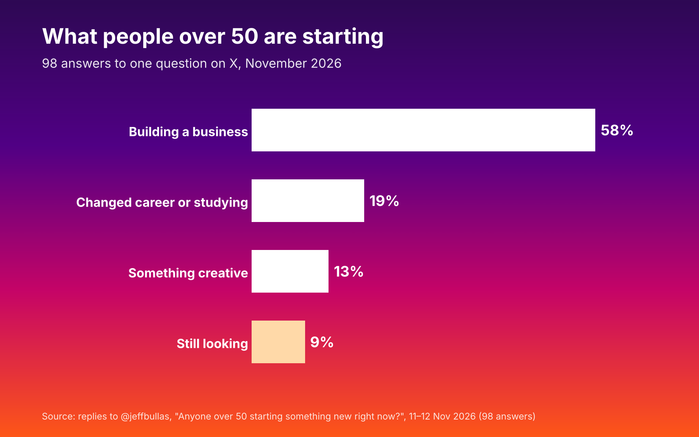
I Asked Nearly 100 People About Starting Again After 50. AI Wasn’t the Hard Part

Last Wednesday night I asked a simple question on X: “Anyone over 50 starting something new right now? A business, a course, a craft, a seco...